
























On Sunday, October 26, 2025, the Kremlin press service reported that President Vladimir Putin visited one of the Joint Forces Command Posts, where he met with the Chief of the General Staff of the Armed Forces of the Russian Federation, General Valery Gerasimov, and with the commanders of the groups involved in the Northern Military District.
 Photo: Kremlin press service
During the meeting the situation on the Ukrainian front and the recent Grom strategic nuclear deterrence exercise were discussed in detail. The exercise involved forces and assets of the Strategic Rocket Forces (RVSN), the Northern Fleet of the Navy, and the Long-Range Aviation of the Aerospace Forces (VKS), during which an RS-24 Yars intercontinental ballistic missile, an R-29RMU Sineva / RSM-54 submarine-launched ballistic missile, and two Kh-102 strategic cruise missiles were launched.
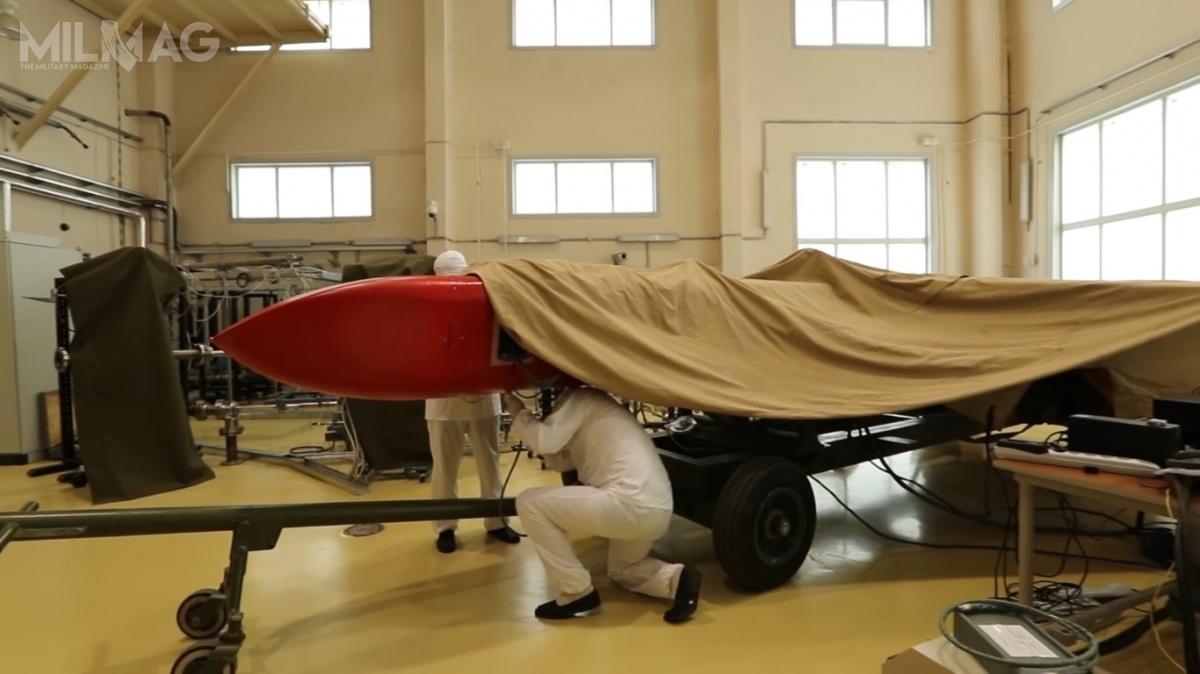
On the sidelines, Vladimir Putin asked Gen. Gerasimov about the status of the nuclear-powered cruise missile project armed with a thermonuclear warhead, the 9M730 Burevestnik, which received the DIA/NATO designation SSC-X-9 Skyfall.
The Chief of the General Staff of the Russian Armed Forces reported that the latest test took place on October 21, 2025, i.e. one day before the Grom exercise. The missile reportedly flew a distance of 14,000 km and remained airborne for about 15 hours, and, the general said, that is not the limit for this system (earlier analysts had suggested a theoretical range of about 20,000 km – editor’s note).
Putin said that it will be necessary “to determine what it is, to which class of weapons this new system belongs (…) to define possible methods of employment and begin preparing the infrastructure for its deployment (…) in the Armed Forces.”
 Photos: Ministry of Defense of the Russian Federation
9M730 Burevestnik
The Burevestnik cruise missile was unveiled on March 1, 2018, by President Vladimir Putin during his annual address to the Federal Assembly.
According to Russian sources, the subsonic ramjet engine powering the Burevestnik is believed to be derived from the liquid-fueled RD-0410 engine, developed between 1965 and 1980 (work is currently underway on an improved version under the TEM project, intended for space research). This propulsion system would allow the missile to reach the required speed, after which a reactor would activate to heat the air drawn into the combustion chamber, generating thrust.
The reactor powering the Burevestnik may therefore be a radioisotope thermoelectric generator (RTG), in effect, a miniaturized nuclear power unit, similar to those used as power sources for space probes. In such a configuration, the ramjet engine would serve as part of the overall propulsion assembly.
Experts suggest that nuclear propulsion theoretically gives the missile an unlimited range, making it a weapon extremely difficult to intercept and potentially hazardous in the event of a crash.

President Vladimir Putin announced the first successful test of the missile on October 5, 2023, and since then, there had been no new information about the program. The concept originates from U.S. Cold War–era projects such as Project Pluto and the Supersonic Low-Altitude Missile (SLAM), which were abandoned in the 1960s due to the risk of radioactive contamination and high costs.
According to available information, the testing program had so far been conducted at the Pankovo test range on Novaya Zemlya, where at least four failed missile tests reportedly took place between 2017 and 2018 (as well as another test in August 2019, which ended in a nuclear accident at the 45th Central Naval Test Range near Nyonoksa, Arkhangelsk Oblast). In 2020, there were reports suggesting the resumption of testing, but this did not occur.
Before 2023, the longest recorded flight lasted just over two minutes, during which one missile covered about 35 km. The shortest lasted only four seconds. The total number of tests is estimated at at least 13, the majority of which ended in failure.
The latest statements by Gen. Valery Gerasimov, if accurate, represent a breakthrough in the program, which Putin today described as a unique weapon system possessed by no other country in the world.
According to the newspaper Nezavisimaya Gazeta, the 9M730 Burevestnik measures 12 meters in length with its solid-fuel rocket booster and 9 meters without it, featuring an elliptical nose cone measuring 1 m x 1.5 m. It is a subsonic, ground-launched cruise missile designed to fly at very low altitudes, estimated between 50 and 100 meters.
The probable site of the first planned deployment has been identified at Vologda-20 (near Chebsara), about 475 km north of Moscow, based on 2024 satellite imagery showing the construction of nine launchers, storage facilities, and nuclear warhead depots.
Experts note that, despite its advantages, the Burevestnik remains vulnerable to detection during prolonged flights, while its nuclear propulsion poses a radiological risk, earning it the nickname flying Chernobyl.