














On Friday, October 31, 2025, the Reuters news agency quoted Ukraine’s Foreign Minister Andriy Sybiha, who stated that among the remnants of Russian weapons used during the war, a modernized 9M729 cruise missile from the Novator R-500 system (designated by the DIA/NATO as SSC-8 Screwdriver) had been found – the weapon whose secret development led the United States, six years earlier, to withdraw from one of its key disarmament treaties with Russia.
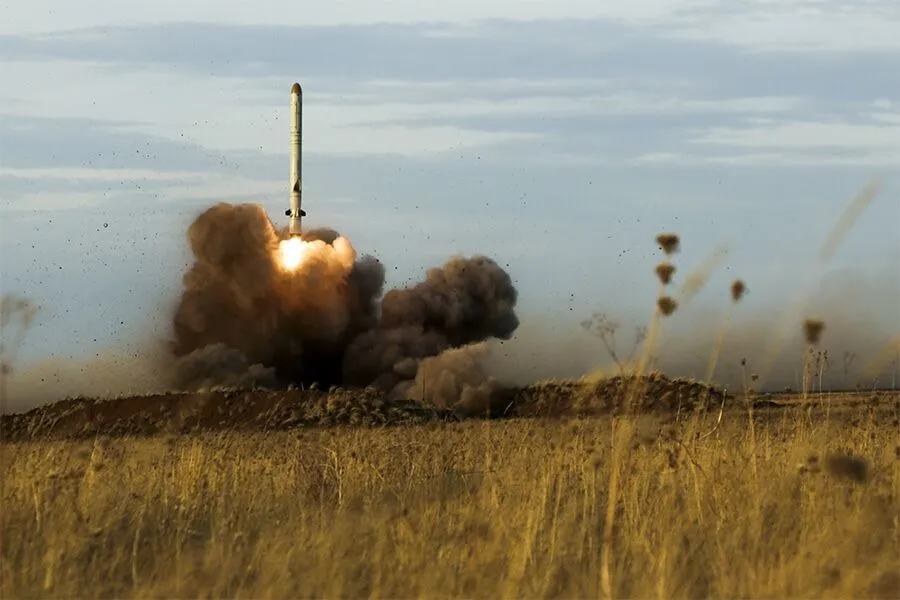 Photo: Ministry of Defence of the Russian Federation
Russia has in recent months attacked Ukraine with cruise missiles whose secret development and deployment prompted Donald Trump to abandon a nuclear arms control pact with Moscow during his first term as U.S. president, Ukraine’s foreign minister said.
To recall, on August 2, 2019, then–U.S. Secretary of State Mike Pompeo announced that the United States had formally withdrawn from the 1987 Treaty on Intermediate-Range Nuclear Forces (INF), thereby ending its validity.
Andriy Sybiha’s statement marks the first confirmation that this weapon has been used in combat conditions.
Since August of this year alone, Russia has launched these missiles toward Ukraine 23 times, another senior Ukrainian official told Reuters. According to the source, Ukraine recorded the first two launches back in 2022.
One of the missiles, fired during a massive drone-and-missile attack on October 5 this year, reportedly struck a residential building in the village of Lapayivka, in the Lviv region (8–9 km west of Lviv – editor’s note), killing four people. During that attack, Russia launched a total of 51 cruise missiles – including 42 Kh-101/Iskander-K missiles from the Samara, Kursk, and Bryansk regions, and 9 Kalibr missiles from ships in the Black Sea.
The remnants of the missile in question were examined. Two fragments, including the wiring, confirmed that it was a 9M729. Jeffrey Lewis, a global security scholar at Middlebury College, reviewed photographs of the debris with analysts. He stated that the body, engine, and panels matched what he expected of the 9M729 model, and that the markings made the identification even more likely.
According to Lewis, the 9M729 missile gives Russia the ability to attack from new directions (attack axes), compared with sea-launched Kalibr or air-launched Kh-101 missiles. Douglas Barrie, senior fellow for military aerospace at the International Institute for Strategic Studies (IISS), added that the system also allows launches from mobile launchers deployed deep within Russia.
Ukraine’s top diplomat added that Kyiv supports Trump’s peace proposals and that Russia should face maximum pressure to compel it to end the war, saying that boosting Ukraine’s long-range strike capabilities would help persuade Moscow to stop its aggression. He was referring, of course, to the supply of Tomahawk cruise missiles – a delivery plan from which Trump later withdrew.
“If it’s shown that Russia’s using INF-range missiles, which could easily be nuclear, in Ukraine, then that is an issue for European security, not just Ukraine,” said John Foreman, a former British defense attache to Moscow and Kyiv.
In the past two weeks, Russia has carried out demonstrative tests of nuclear weapon delivery systems: the RS-24 Yars intercontinental ballistic missile, the R-29RMU Sineva/RSM-54 submarine-launched ballistic missile, and two strategic Kh-102 cruise missiles during the Grom exercise, as well as experimental systems – the 9M730 Burevestnik nuclear-powered, thermonuclear-armed cruise missile and the 2M39 Poseidon autonomous nuclear-powered underwater drone/heavy torpedo carrying a thermonuclear warhead.
In response, Donald Trump instructed the Department of Defense to immediately begin nuclear weapons testing on the same terms as Russia and China.
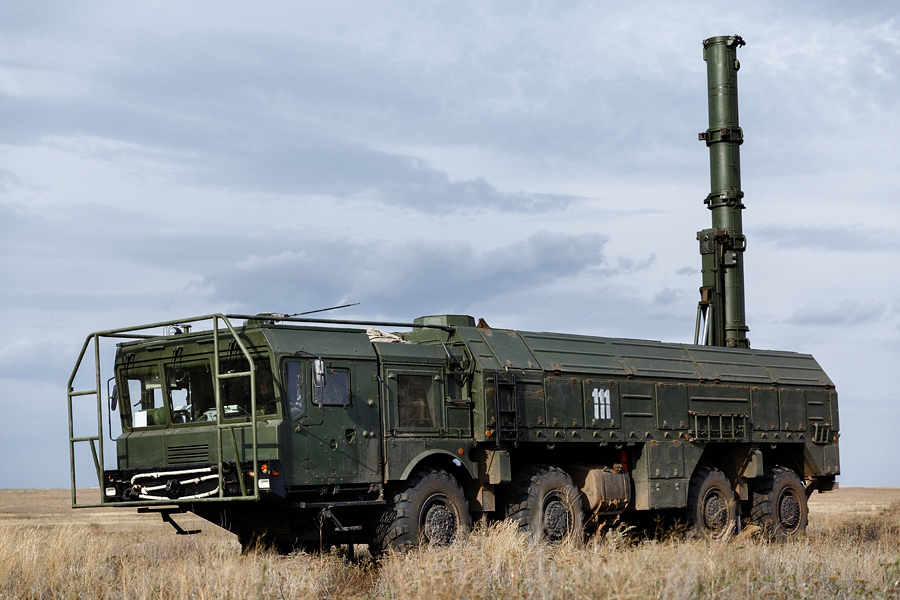 9K720 Iskander-K launcher / Photo: Vadim Grishankin
9M729
According to the position of the U.S. government, in 2016–2018 Russia deployed in frontline units of the Ground Forces several battalions of the Novator R-500 system with 9M728 cruise missiles (DIA/NATO code SSC-7 “Screwdriver”) and modernized 9M729 missiles (SSC-8), fired from MZKT-7930 Astrolog transporter-erector-launchers, the 9K720 Iskander-K system (according to the 2019 Russian designation: 9K720 Iskander-M1), thereby violating the provisions of the INF Treaty, which prohibited the deployment of land-based rocket systems with ranges of 500–5,500 km.
At the time it was assessed that by early 2019, when Russia officially acknowledged the existence of this weapon, there were at least 64 missiles in service. Moscow claimed the ranges of the two missiles were 490 km and 480 km, while Western experts put the range much higher – 2,000–2,500 km in the case of the 9M729. This is thought to stem from the belief that the 9M728 and 9M729 are essentially land-based versions of the 3M-14 missiles of the Kalibr-NK system. Experts also say that the 9M728 can carry a conventional warhead of up to 500 kg, whereas the 9M729 can carry a nuclear warhead with a yield of 10–50 kt.
Both missiles are launched by a hot-launch method, after which they climb to an altitude of about 6,000 m. In the terminal phase of flight they descend to an altitude of 50–150 m and execute maneuvers to avoid interception by the opponent’s missile-defense systems. Thanks to inertial navigation and GLONASS satellite navigation, the missiles’ accuracy is said to be about 5 m. They have the capability to engage moving targets.
The use of 9M729 missiles is the second instance of weapons originally designed to carry nuclear warheads being used against Ukraine, after the Russians in 2022 began firing obsolete strategic air-to-surface cruise missiles Raduga Kh-55 – stripped of special warheads – as decoys for air defenses (one of those missiles violated Polish airspace on 16 December 2022 and was found on 27 April 2023 in the area of Zamość, about 15 km from Bydgoszcz).
And it could even be a third case, if the intermediate-range ballistic missile “Oriesznik” used in combat – carrying hypersonic warheads – is regarded as a new/old RS-26 Rubezh missile, originally intended to carry nuclear warheads.
See also: