



























On Saturday, November 1, 2025, at the JSC PO Sevmash (Northern Machine-Building Enterprise Production Association) shipyard in Severodvinsk, a launching ceremony was held under the leadership of the Minister of Defence of the Russian Federation, Andrey Belousov, for the special-purpose nuclear submarine K-??? Khabarovsk, Project 09851.
 JSC PO Sevmash
Among those attending the ceremony were Admiral Aleksandr Moiseyev, Commander-in-Chief of the Russian Navy (VMF); Andrey Puchkov, Director General of the United Shipbuilding Corporation (USC); and Mikhail Budnichenko, Director General of JSC PO Sevmash.
“Today marks an important event for us – the heavy nuclear-powered missile cruiser Khabarovsk is being launched at the renowned Sevmash shipyard,” noted the head of the Russian Ministry of Defence, as stated in a separate press release issued by the ministry on Telegram.
Afterward, Andrey Belousov visited the SRZ-35 Zvezdochka ship repair yard, also in Severodvinsk, and boarded the first of four Project 23550 Arktika-class armed patrol icebreakers, RFS Ivan Papanin (400).

Khabarovsk
The submarine was designed at the Rubin Central Design Bureau in St. Petersburg, based on the Project 955 Borei nuclear-powered strategic submarine design (Russia: Strategic submarine K-555 Knyaz Pozharsky in service).
Work on the vessel began on 27 July 2014, and its appearance was first publicly revealed during a televised presentation in November 2015. Construction was subsequently delayed due to the COVID-19 pandemic, the war in Ukraine, and the need to introduce modifications. Now, after launching, the submarine will undergo outfitting, after which it is expected to begin approximately six months of sea trials in 2026. It is anticipated that the submarine will become part of a new Submarine Division being formed in 2024–2025 in Kamchatka within the Pacific Fleet.

The primary purpose of K-??? Khabarovsk will be to carry eight autonomous nuclear-powered unmanned underwater vehicles / large torpedoes armed with thermonuclear warheads – the 2M39 Poseidon (previously designated Status-6; NATO reporting name: Kanyon). They will be launched from special tubular launchers of the 2P39 system located in the bow section. On October 21 of this year, the first test of a Poseidon prototype reportedly took place.
Khabarovsk will join the 184-meter-long special-purpose nuclear submarine K-329 Belgorod, Project 09852, which entered service on July 8, 2022 (carrying six Poseidons). Another submarine, K-??? Orenburg (a modified Project 09853), is currently under construction, with two additional units ordered.

According to available information and analyses, the hull of the Project 09851 Khabarovsk has been shortened from 170 meters (in the Project 955 Borei class) to approximately 135 meters, and its submerged displacement reduced from 24,000 to 10,000 tonnes (the beam remains the same at 13 meters). The propulsion system is reportedly powered by a single OK-650V pressurized water reactor with an output of 190 MW, providing an underwater speed of about 30–32 knots.
The most significant change is the removal of the missile compartment for 16 R-30 Bulava / RSM-56 ballistic missile launch tubes, which has affected both the submarine’s length and displacement. The appearance of the vessel, based on materials from the Russian Ministry of Defence, was reconstructed by naval analyst H I Sutton of Covert Shores and is available [HERE].
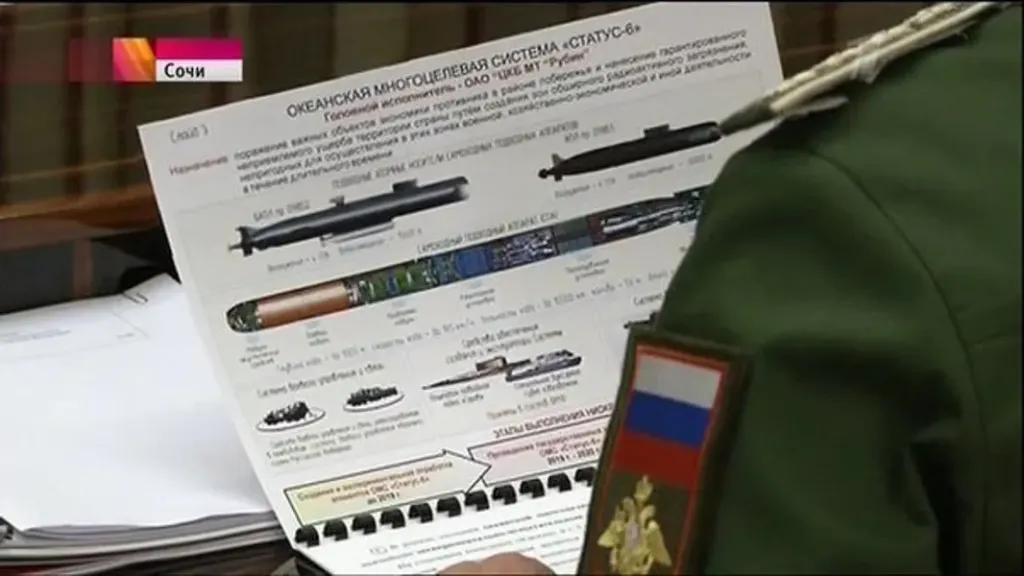 The appearance of the submarine was revealed during the presentation of the Poseidon concept in November 2015 (top right). On the left is K-329 Belgorod, and below them, in an enlarged cross-sectional view, is the Poseidon / Photo: @EvShu via X
It is intended for operations in the Arctic, with an operational diving depth of around 500 meters. Its internal hull layout is designed to allow integration of large robotic systems and unmanned underwater vehicles (including Poseidons). The submarine’s autonomy is estimated at 90–120 days, with a crew of about 100 officers and sailors.
In addition to the aforementioned Poseidon system, Khabarovsk is also expected to carry a miniaturized nuclear-powered submarine, which will be mounted beneath the keel (similarly to Belgorod). The Russian Navy currently operates a limited number of such vessels: two Project 1851.1 Paltus submarines (AS-21 and AS-35) and Klavesin-2R-RM unmanned underwater vehicles. Khabarovsk will also be capable of carrying a DSRV-class rescue submarine on its back, as well as standard self-defense armament, such as 533 mm or 650 mm conventional torpedoes.
See Also
- Russia Resumes Tests of the Nuclear-Powered 9M730 Burevestnik Missile
- Russia Carries Out Grom Strategic Nuclear Deterrence Drills
- Russia: Launch of the missile armament transport ship Akademik Makeyev
- Modernized Nuclear-Powered Missile Cruiser Admiral Nakhimov Begins Trials
Двенадцать «Посейдонов» на двоих
Итак, тяжелую АПЛ проекта 098051 «Хабаровск» спустили на воду. Лодка строго засекреченная, как и схожий по назначению «Белгород». Обе считаются подводными лодками специального назначения.
Полный текст в Telegram:https://t.co/kVvNZN1Brv pic.twitter.com/0s0jTP6OF5
— Александр Коц (@sashakots) November 2, 2025
Вроде в РФ спустили на воду очередную Вундервафлю под названием "Хабаровск" (проект 09851).
Якобы именно эта АПЛ будет носителем другой Вундервафли — 2М39 "Посейдон".
Подробно разберём, почему это всё — огромный фейк и лютое наебательство.
Большой тред, но весёлый!
1/14 pic.twitter.com/7ljZ5HH9TO— ОТЕЦ МАКСИМУС (@MAXALEXHARDY) November 2, 2025