
























Photos: Polish Armaments Group, Ministry of National Defense
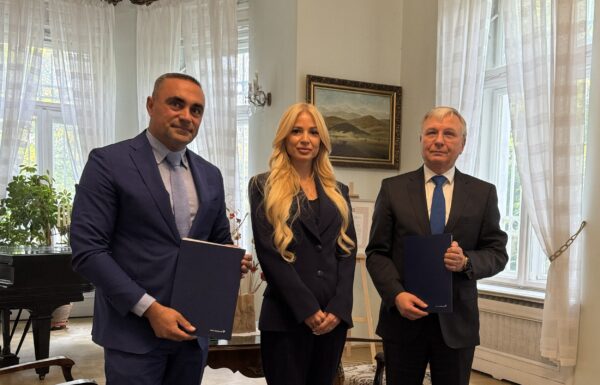
PSO Maskpol will deliver more than 300,000 HBT-02 helmets from the Tytan program, worth approximately 740 million PLN net, and several dozen thousand sets of KKZ-01 integrated body armor, worth approximately 720 million PLN net. Under three annexes refinancing existing contracts, Celtech will deliver 320 CD-10s fuel tanker-distributors worth approximately 870 million PLN net, while Jelcz will deliver a batch of Jelcz 442.32 and Jelcz S662D.43 trucks.
The head of the Armament Agency, Maj. Gen. Artur Kuptel, said:
“Procuring equipment for the Polish Armed Forces is a complex process involving many entities. In a moment, we will sign contracts for HBT-02 helmets from the Tytan program and integrated body armor for soldiers of the Polish Armed Forces. Three contracts with Celtech and Jelcz will also be amended.”
Deputy Prime Minister Władysław Kosiniak-Kamysz said:
“There is no more important matter than the security of our borders, the protection of critical infrastructure, and the protection of every citizen of the Republic of Poland. Hence these contracts, with more to follow in the coming hours. (…) No one today matches Poland in terms of investment in armaments, the accuracy of decisions, and the speed with which they are made. When we were in Canada just yesterday, Canada’s defense minister said: ‘I learned from you that in this matter, when we want to modernize and build the strength of our state, what counts is the speed of decision-making by those responsible for these decisions.’”
Magdalena Sobkowiak-Czarnecka, Government Plenipotentiary for the Instrument for Increasing Security, said:
“The Armament Agency is the quiet hero of the SAFE program: all the work put into preparing the application, the negotiating teams, and today the negotiation of contracts with contractors. All objectives have been met. This is a massive investment primarily in the Polish defense industry, because that was the first goal: for as many contracts as possible to go to Polish companies.”
The contract with PSO Maskpol will be implemented in 2026–2030.
“The signing of this contract confirms confidence in the quality and reliability of the solutions developed and manufactured by PSO Maskpol. It is also an important step in building national security and strengthening domestic industrial potential,” company representatives emphasized. “PSO Maskpol has for years remained one of the key manufacturers of protective equipment for uniformed services and the military in Poland, specializing, among other things, in the production of helmets, bulletproof vests, gas masks, and protective equipment for users from various formations.”
The HBT-02 is head protection developed for the needs of the Polish Armed Forces under the Tytan Advanced Individual Combat System. A characteristic feature of this aramid helmet is its attachable mandible guard. The HBT-02 provides protection against K2-class bullets and fragments in accordance with class O3 under the PN-V-87001:2011 standard.
It is intended to provide a high level of ballistic protection against the effects of bullets and fragments, while the use of the mandible and face guard will additionally increase the level of protection for soldiers serving, for example, as door gunners.
The helmet was developed in accordance with the requirements of the Polish Armed Forces and standards applicable within the North Atlantic Alliance, and will improve soldiers’ survivability on the battlefield and their combat effectiveness. Its design allows the simultaneous use of individual soldier equipment such as a gas mask, protective clothing, active hearing protectors, and eye and face protection devices. Helmet testing was completed in May 2024.

 Photos: PSO Maskpol
The KKZ-01/K4 integrated body armor was specially designed as an item of individual soldier equipment. The vest is intended to protect soldiers against direct impacts from fragments and small-arms projectiles, as well as dangerous objects.
KKZ-01/K4 vests offer increased ballistic resistance by raising the bullet-resistance class to K4 level, and provide fragmentation resistance in class O3. Expanded user protection is provided, among other things, through the use of additional soft ballistic inserts protecting the larynx, neck, shoulders, upper arms, and lower abdomen.
The KKZ-01 integrated body armor, as an item of individual soldier equipment, was designed to protect the user in combat conditions against being hit by projectiles from certain types of small arms, direct fragment impacts, and the effects of impacts from dangerous objects. The vest allows a wide range of individual load-bearing equipment to be carried.

Made from a laminate of Cordura structural fabric, with a MOLLE/PALS load-bearing attachment system across its entire surface, it can be fitted with any combination of pouches and pockets according to the user’s needs. The quick-release system is based on four ROC (Rapid Open Connector) buckles on the shoulders and sides of the vest. Depending on the type of ballistic insert package, the vest weighs from 3 to 7 kg.
The previous contract for KKZ-01 vests was signed on June 6, 2025.
See also:
