





















On Monday, April 27, 2026, the Royal Norwegian Navy (Sjøforsvaret) joined the user group for Type 26 Global Combat Ship (GCS) guided-missile frigates, alongside the Royal Navy of the United Kingdom, the Royal Australian Navy, and the Royal Canadian Navy.
 Photos: Royal Navy
Capt. Alexander Erichsen, representing Sjøforsvaret, signed the Global Combat Ship User Group Charter, enabling Norway to join the international team overseeing the development, construction, and operation of a common type of 34 surface combatants. The group oversees all aspects of the Global Combat Ship (GCS) program, covering Type 26 frigates for Norway (5 ships) and the United Kingdom (8 ships), Hunter-class frigates for Australia (6 ships), and River-class destroyers for Canada (15 ships).
It should be recalled that on August 31, 2025, the Norwegian Ministry of Defence announced that it had selected the United Kingdom as its strategic partner in the program to acquire new guided-missile frigates, under which BAE Systems will begin deliveries of five Type 26 GCS guided-missile frigates in 2030, at an estimated cost of GBP 10 billion.
The Global Combat Ship User Group meets regularly to discuss progress in the multibillion-pound international undertaking, covering everything from construction and crew training to maritime operations.
Senior program representatives gathered in Halifax, Nova Scotia, to discuss progress on HMCS Fraser, the first ship for Canada, whose keel was laid 12 months ago, and invited Norway to sign the agreement. The Norwegian ships will work closely with their British counterparts, focusing on protecting the Atlantic and Europe’s northern flank against hostile submarines.
“It is a pleasure to formally welcome Norway into the Global Combat Ship User Group community through signing of the joint charter,” said Commodore Stephen Roberts, the Senior Responsible Owner for the UK Type 26 frigate program. “Our strategic maritime security partnership with allies is further strengthened by Norway’s inclusion in the wider GCS enterprise alongside our Canadian and Australian partners.”
A total of 34 ships are planned to be built, each based on the core design but with different sensors, combat systems, and weapons fitted in the Australian and Canadian variants, earning it the description of “three programs, four countries.”
“It is an honour for Norway and the Royal Norwegian Navy to join the Global Combat Ship User Group and formally enter the wider Type 26 community,” said Captain Alexander Erichsen, Chief Fleet Program for the Royal Norwegian Navy. “This marks an important step in our strategic partnership with the United Kingdom and reinforces our close cooperation with Canada and Australia.”
“By aligning our future frigate capability on a common design, we strengthen interoperability, shared understanding and collective maritime security across allied navies. Norway looks forward to contributing actively to the Global Combat Ship collaboration and to benefiting from the strong industrial and operational partnerships that underpin it.”
In addition to playing a decisive role in the individual and collective security of the participating navies, which have long been allies in war and peace, the Global Combat Ship undertaking will:
- lead to closer cooperation, understanding, and, where necessary, interchangeability between allied states and their navies;
- support the shipbuilding industry in ensuring a high level of technical, material, and operational readiness in the face of evolving threats;
- spread the burden of testing and developing systems and machinery by sharing experience and reducing costs, time, and duplication;
- contribute to the long-term future of the defense industries and supply chains of the participating states by avoiding fratricidal commercial competition; and explore opportunities for upgrades, modernization, and long-term capability sustainment.
When the ships enter service at the end of this decade, together with the prototype HMS Glasgow in the Royal Navy, they will be at the forefront of anti-submarine warfare operations, while also serving as highly advanced, multirole warships capable of adapting to increasingly rapid changes in naval warfare.
Key to this adaptability is the mission bay, which can accommodate several shipping-container-sized payloads, known in the Royal Navy as NavyPODS, or Persistent Operational Deployment Systems, for specific missions: disaster relief, unmanned aerial, surface, or underwater systems, mine countermeasures or hydrographic survey equipment, and boats and equipment for marine units.
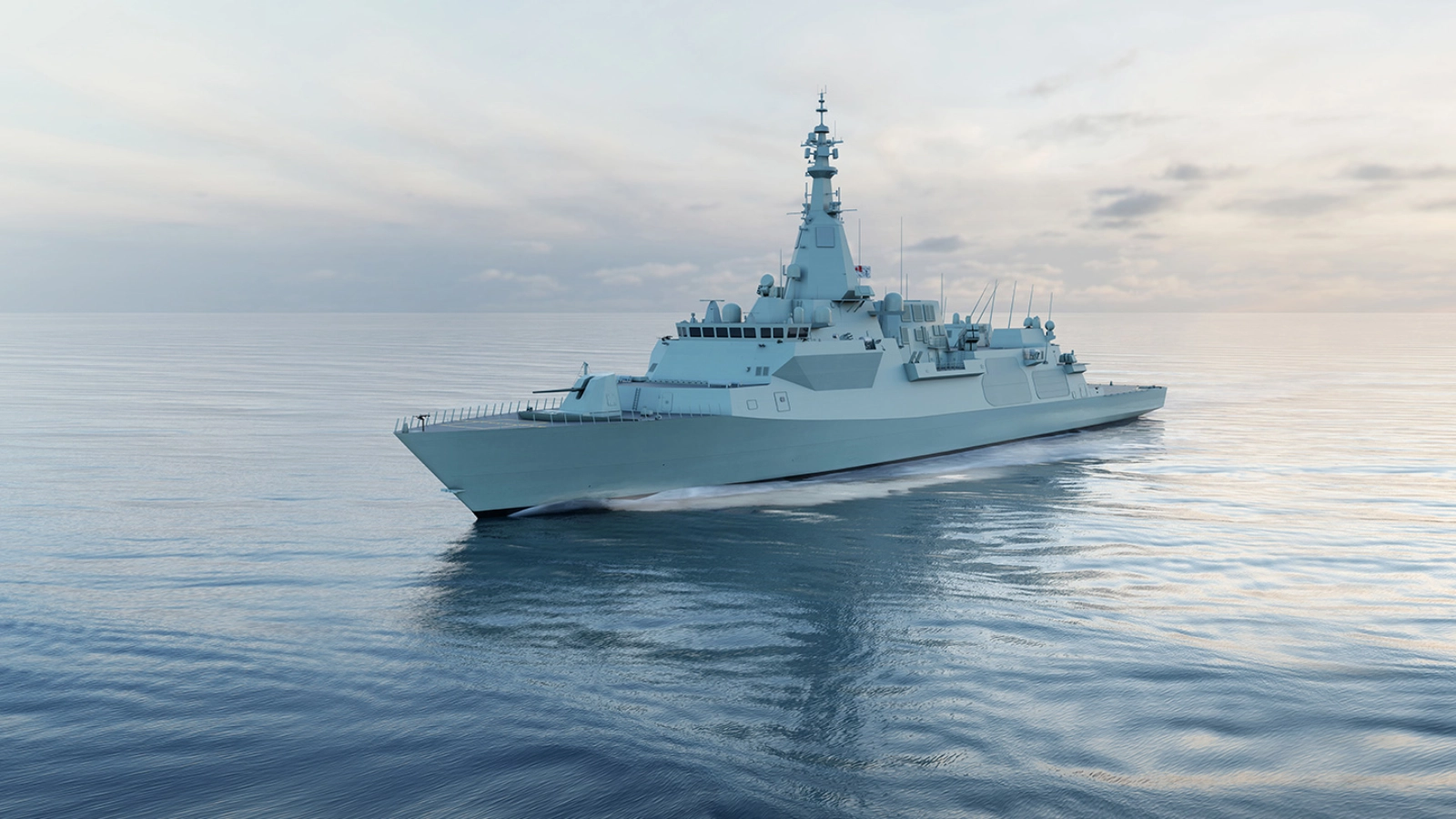 Image: BAE Systems
Fregaty GCS dla Norwegii
It should be recalled that on March 7, 2023, reports emerged that the Sjøforsvaret command had submitted recommendations to the Ministry of Defence on the need to withdraw the four Fridtjof Nansen-class frigates delivered in 2006–2011: HNoMS Fridtjof Nansen (F310), Roald Amundsen (F311), Otto Sverdrup (F312), and Thor Heyerdahl (F314). In addition to economic issues and the reorganization of the armed forces, this is probably a consequence of the loss of the frigate Helge Ingstad (F313) on November 8, 2018, when the command questioned their design after the collision with the Maltese tanker Sola TS. The need to acquire six new frigates and an unspecified number of smaller surface vessels was indicated.
Then, on April 15, 2024, the British daily The Daily Telegraph was the first to report that Norway was interested in the British Type 26 GCS frigates, but with a preliminarily agreed delivery date for the first ship as early as 2029, which would require BAE Systems to resell the hull of a unit being built for the Royal Navy.
Pending the announcement of yesterday’s decision, in May and July 2025 BAE Systems signed strategic agreements with Norwegian group Kongsberg, including on lifecycle support for future Norwegian frigates, as well as their armament and radar systems.
The frigates in the British configuration are 149.9 m long and 20.8 m wide, with a standard displacement of 6,900 tons and a full displacement of more than 8,000 tons. The CODLAG propulsion system combines one Rolls-Royce MT30 gas turbine, four MTU diesel engines, and two electric motors, providing a maximum speed of 26 knots and a range of up to 7,000 nautical miles. The crew will consist of 118 officers and sailors, with the ability to embark an additional 90 personnel.
The frigates are being equipped with the Type 997 Artisan 3D medium-range three-dimensional radar for simultaneous tracking of 800–900 air and surface targets at distances of up to 200 km. In addition, the equipment includes a Kelvin Hughes SharpEye navigation radar, Type 2087 towed sonar, Type 2050 hull-mounted sonar, and the SCOT-5 satellite communications system.
The anti-aircraft armament consists of 48 universal vertical launch cells for Sea Ceptor/CAMM surface-to-air missiles and 24 Mk 41 vertical launch cells for missiles such as the RGM-109E Tomahawk Land Attack Missile Block IV land-attack missile and the RUM-139 VL-ASROC anti-submarine missile. The remaining armament includes a 127 mm Mk 45 naval gun, two 30 mm DS30M Mark 2 close-in defense systems, two Phalanx CIWS, two powered 7.62 mm M134 Minigun machine guns, and four general-purpose machine guns. In the future, the ships are expected to be armed with next-generation FC/ASW (Future Cruise/Anti-Ship Weapon) missiles.
Norway has joined the Royal Navies of the UK, Canada and Australia to forge a formidable future Global Combat Ship partnership.
Read more: https://t.co/d3d313OmWD pic.twitter.com/AJrvtuB1Cd
— Royal Navy (@RoyalNavy) April 27, 2026