

































On Tuesday, April 7, 2026, U.S. company Northrop Grumman announced that it had signed an agreement with Hungary’s 4iG Space and Defence Technologies Ltd., part of 4iG Nyrt., to build the country’s first domestic geostationary satellite based on the GEOStar-3 platform.
 From left to right: Steve O’Bryan, Corporate Vice President and Chief Global Business Development Officer at Northrop Grumman; Dorothy Mayhew, Deputy Chief of Mission in the United States; Troy Brashear, Vice President for Space International Business Development at Northrop Grumman; Márton Nagy, Hungary’s Minister for National Economy; István Sárhegyi, Chief Executive Officer of 4iG Space and Defence Technologies Ltd.; and Gellért Jászai, Ambassador Extraordinary and Plenipotentiary for the Development of Hungary’s International Business Relations and the Promotion of Its Economic Interests Abroad, as well as Chairman of 4iG / Photo: 4iG Space and Defence Technologies
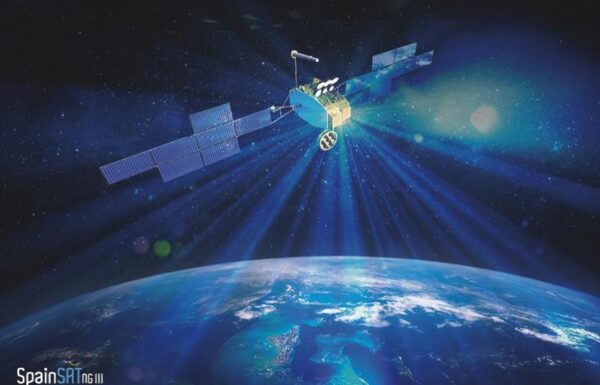
It will be Hungary’s first sovereign telecommunications satellite, providing secure Ka-band communications for government and commercial applications across the region, using the proven GEOStar-3 satellite platform, which underpins commercial and military satellite communications worldwide, with more than 50 satellites launched to date.
This historic agreement builds on the cooperation agreement signed by the two companies on December 16, 2025, covering a range of space and defense programs, including counter-UAS systems, space technologies, and advanced weapons. Northrop Grumman provides the scale, speed, and proven manufacturing capabilities needed to deliver advanced, mission-ready technologies that strengthen national security, space capabilities, and resilience.
 Image: Northrop Grumman
GEOStar-3
It is a medium-power satellite platform that can be used in both geosynchronous (GEO) and non-geosynchronous orbits. For missions lasting more than 15 years in GEO orbit, the platform can provide up to 8 kW of payload power through a regulated 36 V power bus. The GEOStar-3 structure and propulsion system are designed to make optimal use of launch vehicle performance, including tandem launch and rideshare options.
The company has delivered more than 50 satellites of this type to 23 commercial customers worldwide and to the U.S. government. The GEOStar-3 platform can accommodate payloads weighing more than 1,000 kg. The payload module can house up to 60 radiation-cooled traveling-wave tube amplifiers for generating electromagnetic signals. Various configurations of deployable booms and onboard antennas are possible. The platform can carry both analog and advanced digital payloads.
GEOStar-3 is used in national security programs, where payload systems must meet highly demanding requirements for pointing accuracy, maneuverability, and reliability.
GEOStar-3 also forms the core of Northrop Grumman Space Logistics, the company’s space servicing business, which includes satellite life-extension services using the Mission Extension Vehicle (MEV). The next generation is the Mission Robotic Vehicle (MRV), a lower-cost life-extension solution that also enables additional on-orbit servicing capabilities.
We’ve started work on Hungary’s first sovereign geosynchronous satellite, built on our proven GEOStar-3 platform. This project will deliver secure Ka-band communications and strengthen U.S.-Hungary collaboration for enhanced global security. https://t.co/2dCp5iZIG7 pic.twitter.com/ojJOoqgbD4
— Northrop Grumman (@NGCNews) April 7, 2026