




















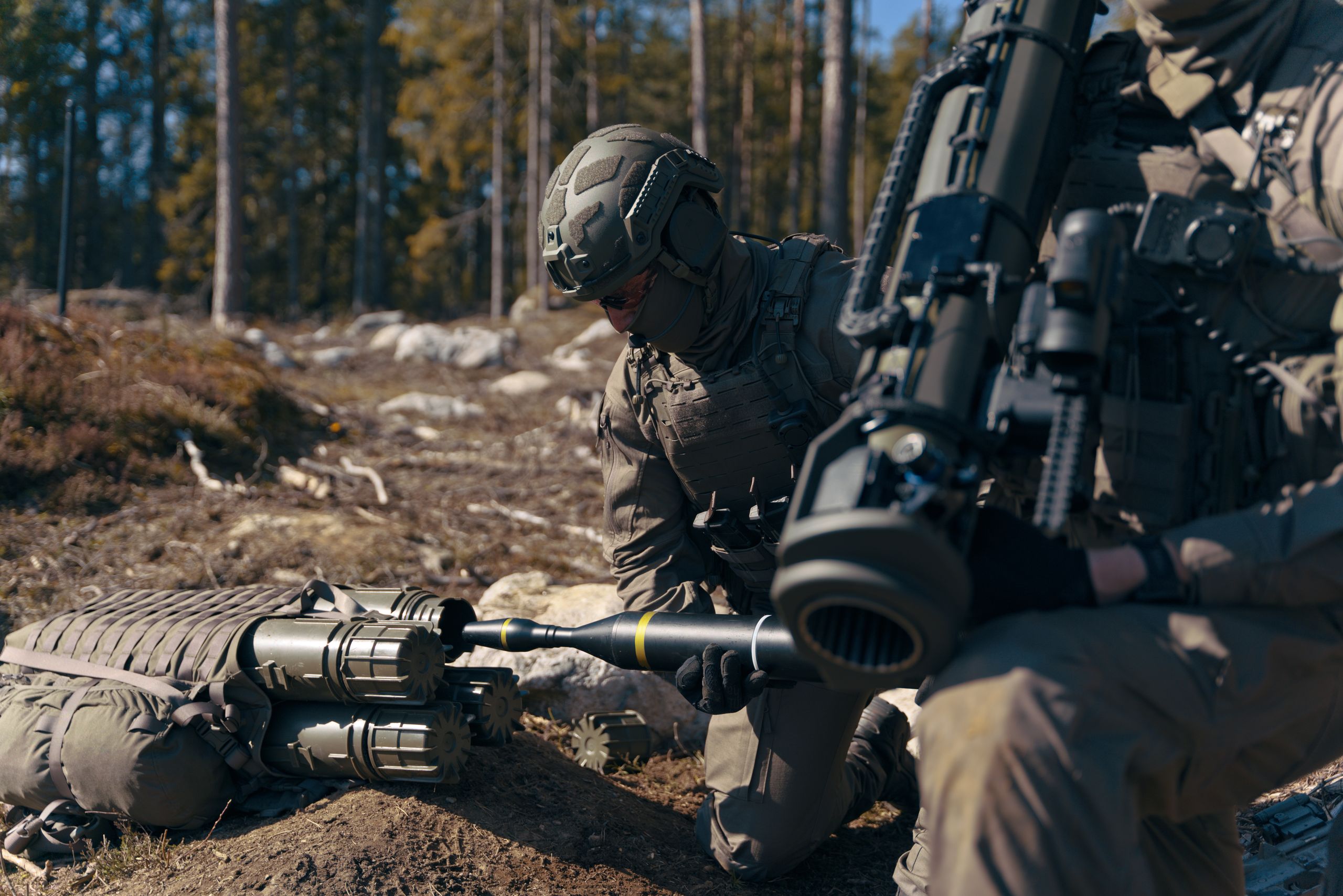
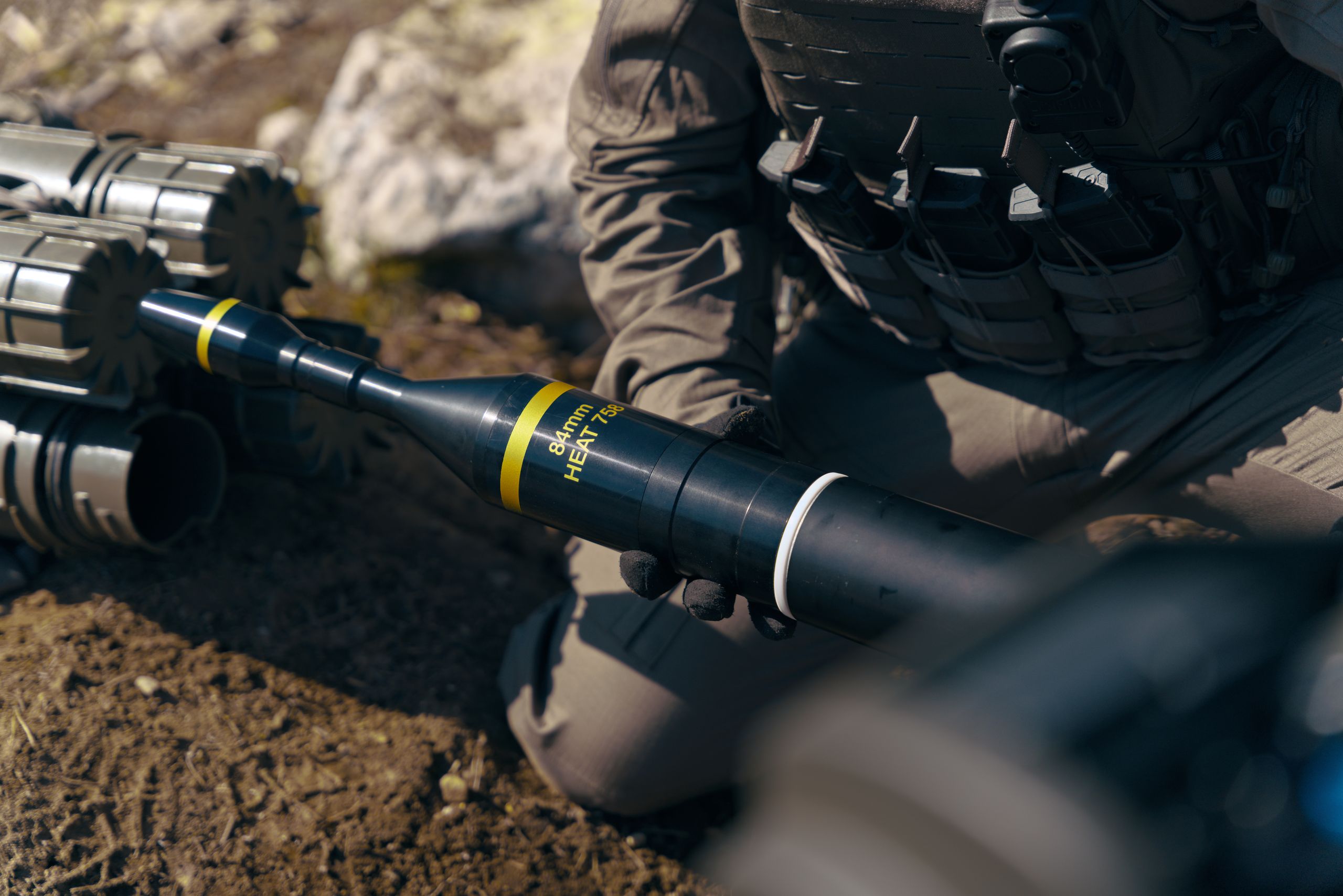
On Thursday, May 7, 2026, Swedish company Saab Defence and Security announced that earlier this month it had demonstrated in Karlskoga, during a live presentation for an undisclosed user, the new HEAT 758 anti-armor shaped-charge round designed for 84 mm Carl-Gustaf M4 (CGM4) anti-tank recoilless rifles.
 Photos: Saab Defence and Security
The new round, designated HEAT 758 (High-Explosive Anti-Tank), was designed to defeat heavy armored vehicles fitted with explosive reactive armor (ERA). Vehicles protected by ERA are becoming increasingly common on the battlefield. HEAT 758 features a tandem warhead: the precursor charge neutralizes the reactive armor mounted on the outside of the armored vehicle by forming a shaped-charge jet, allowing the main charge to effectively penetrate the primary armor. The main charge can penetrate up to 700 mm of rolled homogeneous armor (RHA), which is sufficient to defeat the heaviest armored vehicles.
An undisclosed Carl-Gustaf M4 customer has ordered HEAT 758 ammunition, and production is underway.
“This round is our response of developments of the battlefield where reactive explosive armour has become a major problem for regular munitions trying to defeat armoured vehicles. HEAT 758 is an example of how Saab continues to generate ever more capable products while decreasing the armoured vehicle threat to the operator,” says Michael Höglund, head of Saab’s business unit Ground Combat.
HEAT 758 uses Saab’s Firebolt technology, which means it can communicate with the Carl-Gustaf M4 launcher into which it is loaded and with the new FCD 558 (Fire Control Device) used for aiming the M4. This simplifies the gunner’s work while increasing the probability of a first-round hit.
The Carl-Gustaf M4 was unveiled in September 2014 at the Bofors Test Center range in Karlskoga, 23 years after the premiere of the previous generation of the system. Qualification tests were conducted in 2015. Weighing 6.7 kg, the M4 is 3.4 kg lighter than its predecessor thanks to the titanium-composite construction of the barrel and jacket, as well as the redesign of some steel components. The new recoilless rifle is also shorter, at 950 mm compared with 1,015 mm for the M3. It is equipped with a Picatinny rail, allowing additional observation and sighting devices to be mounted. The M4 version also introduced a two-stage safety system, making it possible to carry the weapon with a round loaded in the barrel.
Previously, the CGM4 had been adapted to use 11 types of 84 mm x 246R ammunition, including the FFV751 tandem shaped-charge round, the FFV551 rocket-assisted shaped-charge round, the FFV502 anti-armor shaped-charge round, the FFV441B high-explosive round, the FFV469 smoke round, the FFV545 illumination round, the FFV552 training round with the same characteristics as the FFV551, and the FFV752 training round with the same characteristics as the FFV751. The Carl-Gustaf M4 recoilless rifle has an effective range of 300 to 2,100 m, depending on the ammunition used. In the case of the HEAT 758, it is expected to be around 600 m — editor’s note. Work is also underway on introducing programmable ammunition, which will double the engagement range to 1,500-2,000 m.
Carl-Gustaf family recoilless rifles have entered service with the armed forces of more than 40 countries, and the latest M4 version with 15 countries, including Australia, Denmark, Lithuania, Norway, Slovakia, Slovenia, Hungary, and the United States. Another new user will be the Kingdom of the Netherlands. However, most users are replacing older Carl-Gustaf M2/M3 recoilless rifles, which are also in service with the Polish Armed Forces, specifically the Special Forces.
In 2024, Poland’s Armament Agency decided to purchase CGM4 systems for other Polish Armed Forces units, ordering 6,000 examples together with new FCD 558 Fire Control Devices and a stockpile of ammunition for 12.9 billion SEK net, or 4.958 billion PLN net / 6.5 billion PLN gross. Deliveries have begun to the Land Forces and the Territorial Defense Forces.