







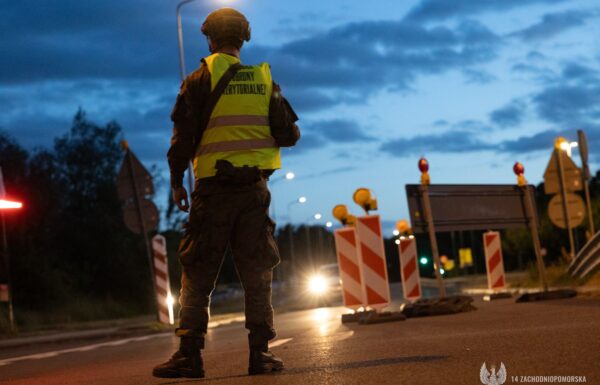





















The team’s work was led by Deputy Minister Tomasz Szymański, the Government Plenipotentiary for these systems. The main topic was a summary of the full implementation of the EU Entry/Exit System (EES), which has been revolutionizing border checks at Poland’s borders since April 10. The meeting also discussed the implementation of further IT systems designed to improve control over Poland’s and Europe’s borders.


Photos: Ministry Of Internal Affairs And Administration
Digital Revolution in Numbers
Data collected since the project began to be implemented in October 2025 show the scale and efficiency of the EES: nearly 6.8 million border crossings and almost 2.4 million people have been registered. The system also made it possible to detect 9,400 cases in which entry had to be refused.
Since April 10 this year, the EES has been fully operational at every border crossing in Poland. In less than a month, that is, since the full version of the system was launched, the Border Guard has recorded enormous activity in the new digital database:
- More than 1 million: the number of times foreigners crossed the border in the new system in less than a month.
- 250,000: the number of non-EU nationals registered in that short period.
- 1,400: the number of times the system helped effectively refuse entry to unauthorized persons.
Real Security for Poles
The EES marks the end of the era of traditional passport stamps. Border traffic is now managed in a modern, digital model. Thanks to close cooperation among multiple services and ministries, we are building “smart borders”: checks are faster and more precise. This is not just technology; it is a real pillar of security for Poland and the entire European Union.
What Comes Next? More Systems on the Way
During the meeting, the deputy minister and representatives of the uniformed services discussed progress on further solutions that will make Poland even safer:
- ETIAS: a travel pre-authorization system for visa-exempt travelers.
- EURODAC: a modern biometric database.
Ultimately, all large-scale systems are being developed within an interoperability architecture. This is a breakthrough solution that connects all databases into a single system. Thanks to this, the Police, Border Guard, and Internal Security Agency will be able to exchange information instantly and connect facts from various sources, including foreign ones.
The completion of this work, together with the continuous development of the systems already in operation, will provide Polish services with a full picture of the situation at the borders and the highest level of citizen protection in history.
See also: