














On Tuesday, December 23, 2025, the Swedish company Saab Defence and Security announced that it had signed a contract worth approximately 650 million SEK with the Swedish Defence Materiel Administration (FMV, Försvarets materielverk) of the Ministry of Defence of the Kingdom of Sweden for the delivery of Giraffe 1X three-dimensional radar systems, with immediate deliveries.
 Photo: Saab Defence and Security
The framework agreement covers the Giraffe 1X system for use across various units of the Swedish Armed Forces. The first order includes the Giraffe 1X system in the Compact Radar Module (CRM) configuration, which allows for quick and easy integration on most platforms. It will be used, among other things, in the newly developed Loke counter-drone system.
“With this order we contribute to immediately strengthening the Swedish Armed Forces’ ability to detect threats in the air and at the sea surface. The agreement also ensures that Sweden can further increase its capacity in a quick and efficient manner, when needed. This is yet another step in our cooperation with FMV and the Swedish Armed Forces to strengthen Swedish defence capabilities,” says Carl-Johan Bergholm, head of Saab’s business area Surveillance.
“This type of framework agreement enables more efficient procurement and also makes it possible to support exports through joint acquisitions with other countries,” said Jonas Lotsne, Head of the Army Materiel Business Area at FMV.
It is worth adding that the Giraffe 1X radars were previously included in a contract signed on November 25, 2025, worth approximately SEK 2.1 billion (then PLN 803.943 million), for deliveries in 2027–2028 of radar sensors along with command and control systems for a ground-based air defense system for Swedish brigades.
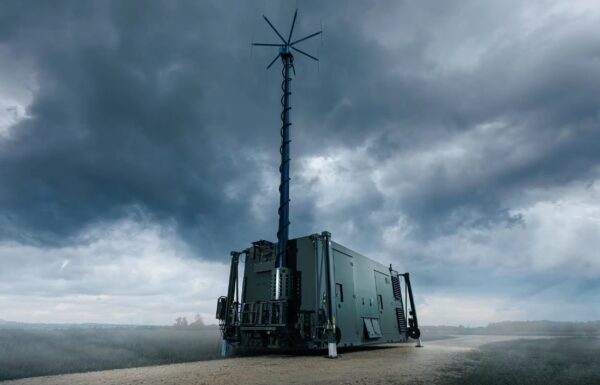
The Giraffe 1X three-dimensional radar provides high-quality target data for air defense, including the detection of unmanned aerial vehicles, as well as the capability to simultaneously detect and warn of rocket, artillery, and mortar attacks (C-RAM).
The radar’s antenna, featuring active electronically scanned array (AESA) technology based on gallium nitride (GaN) and a triangular cross-section, is 0.5 m high and 1.0 m wide, with a mass of 100 kg (60 kg for the antenna itself; it also includes an identification friend-or-foe system and a rotation unit). Together with the remaining system components (the processing computer unit, power supply unit, and the operator’s laptop), the total system weight is less than 300 kg. Most electronic components are housed internally, and the entire system is air-cooled. Thanks to enhanced ELSS (Enhanced Low, Slow and Small) capabilities, it more effectively identifies small targets at long ranges. The electronically shaped and steered antenna beam allows for very rapid scanning of space in elevation from 0 to 70°.
The radar is the land-based variant of the naval Sea Giraffe 1X, operating in the I/J band (from X to Ku; 8–12.5 GHz), with an instrumented range of up to 100 km. It is the smallest device of its type produced by Saab and one of the smallest radars on the market (also ordered by Sweden).
In its basic variant, the Giraffe 1X made its public debut on September 10, 2019, at the DSEI (Defence and Security Equipment International) defense and security industry exhibition in London. At the time, it was integrated with the British Army’s Supacat Jackal light reconnaissance vehicle. On May 2, 2023, Saab announced an order from the United Kingdom for 11 units of the basic variant.
On June 17–21, 2024, during the Eurosatory exhibition in Paris, an even more compact version of the radar, called the Compact Radar Module, was presented; this is the subject of the latest contract. Radars of this type have been ordered by the United States for Ukraine and have also become part of the MSHORAD air defense system with RBS 70 NG (Robotsystem 70 New Generation) launchers ordered by Lithuania and the Czech Republic.
Giraffe 1X radar order from Sweden 🇸🇪
“With this order we contribute to immediately strengthening @Forsvarsmakten ability to detect threats in the air and at the sea surface." says Carl-Johan Bergholm, head of Saab’s business area Surveillance.https://t.co/Lu23u6wwEi pic.twitter.com/C9Rld1jocw
— Saab (@Saab) December 23, 2025