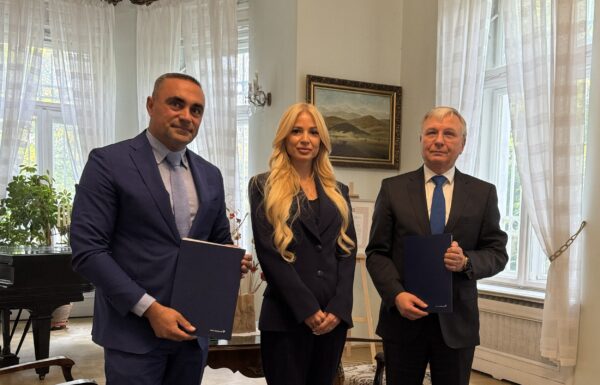





On Thursday, April 23, 2026, during the opening day of a two-day informal meeting of European Union heads of state and government in Nicosia, Cyprus, the European Commission announced the approval of 90 billion EUR in financial support for Ukraine and the adoption of the 20th sanctions package against Russia.
Photos: Volodymyr Zelenskyy via X
90 billion EUR for Ukraine
“Today is a good day – for Ukraine and for Europe. You might recall, Volodymyr, that when I visited Kyiv in February this year, I said we will deliver on the EUR 90 billion loan one way or the other. Today, we deliver on this promise. Most of the preparatory work has already been done to implement the EUR 90 billion loan. I think it is possible to disburse the first tranche of EUR 45 billion, which are assigned for 2026, still this quarter. We have agreed that one-third of the loan goes to budgetary needs and two-thirds go into defence. The first package will be a drones package – drones from Ukraine, for Ukraine. Today we also agreed on the 20th sanctions package. So in other words: the more Russia doubles down on its war of aggression, the more Europe doubles down on supporting Ukraine. That is important for us. Because we are clear about standing by your side and by the side of the Ukrainian people. Today is a good day,” – said European Commission President Ursula von der Leyen, addressing Ukrainian President Volodymyr Zelenskyy, who was present in Nicosia.
“We have secured Ukraine’s financial resilience for two years. Together, we are doing everything to ensure that our state has sufficient funds for both defense and social needs. We discussed this today with Ursula von der Leyen and António Costa. It is important that Ukraine receives the first tranche of the approved support package as soon as possible. We also discussed security cooperation. Only through joint efforts can we in Europe counter drone and missile threats. I thank António and Ursula for their support!” said Ukrainian president.
Ми гарантували фінансову стійкість України на два роки. Разом робимо все, щоб у нашої держави було достатньо коштів як на оборону, так і соціальні потреби. Обговорили це сьогодні разом з Урсулою фон дер Ляєн та Антоніу Коштою. Важливо, щоб перший транш із затвердженого пакета… pic.twitter.com/78In0ZnjCN
— Volodymyr Zelenskyy / Володимир Зеленський (@ZelenskyyUa) April 23, 2026
Сьогодні важливий день для нашого захисту і для наших відносин із Євросоюзом. Розблоковано європейський пакет підтримки для України – це 90 мільярдів євро на два роки. Цей європейський пакет додасть сили нашій армії, забезпечить Україні більше стійкості та дозволить нам…
— Volodymyr Zelenskyy / Володимир Зеленський (@ZelenskyyUa) April 23, 2026
It should be recalled that on April 1 of this year, the European Commission announced that it was taking preparatory steps regarding financial support in the form of a 90 billion EUR Ukraine Support Loan financial instrument. The loan, provisionally agreed in December 2025, is intended to secure the necessary budgetary support and accelerate urgent military procurement for the Armed Forces of Ukraine in 2026 and 2027, including increasing drone production in the country.
The approved support will be divided into two components, of which around two-thirds, amounting to 60 billion EUR, will be allocated to military assistance, while the remaining one-third, corresponding to 30 billion EUR, will be provided as general budgetary support. It will be split equally into 45 billion EUR in 2026 and the same amount in 2027, including 16.7 billion EUR for the budget and 28.3 billion EUR for the defense industry annually.
Brussels reserves the right to use Russian assets frozen in the EU to repay the loan, in accordance with EU and international law. The reparations loan, proposed on December 3, 2025, remains on the table.
Support for Ukraine will be financed through joint EU borrowing on capital markets, in line with the European Commission’s original proposal among the available financing options. The loan for Ukraine will be guaranteed by the EU budget “headroom,” as is the case with other financial assistance programs for Ukraine implemented since 2023, such as Macro-Financial Assistance+, the Ukraine Facility, and the macro-financial assistance loan under the G7-led Extraordinary Revenue Acceleration (ERA) loans initiative.
Since the start of Russia’s full-scale aggression against Ukraine on February 24, 2022, the EU and its member states have provided Ukraine and Ukrainians with a total of 195 billion EUR in support, including 3.7 billion EUR from the proceeds of frozen Russian assets – more than anyone else.

Today is a good day for Europe and Ukraine.
Last time I was with you in Kyiv, dear Volodymir @ZelenskyyUa, I said we would deliver the €90 bn euro loan – one way or the other.
Today, we deliver on this promise. https://t.co/DBBATfstJC— Ursula von der Leyen (@vonderleyen) April 23, 2026
The EU’s 20th sanctions package against Russia
In addition, the European Commission welcomes the adoption by the Community’s member states of the 20th sanctions package against Russia, intended to exert additional pressure so that Moscow engages in negotiations and does so on terms acceptable to Ukraine. The new sanctions have a strong anti-circumvention dimension.
The 20th package contains the following key elements:
Energy measures
- Russian energy sector: listing 36 entities covering both the upstream and downstream segments of Russia’s energy sector, including entities involved in oil exploration, production, refining, and transportation.
- Shadow Fleet ecosystem: revenues from Russian oil exports are further restricted by listing additional Shadow Fleet entities, including those operating in third countries, as well as a major marine insurer and 46 additional vessels. With these additions, the EU has listed a total of 632 vessels from Russia’s Shadow Fleet. They are subject to a port access ban and a ban on receiving services. In addition to these new listings, the EU is continuing outreach to flag states to ensure that their registries do not allow these vessels to sail under their flags. While 46 vessels have been added to the sanctions list, 11 vessels have also been removed from the list as part of this 20th package, showing that delisting is possible for vessels returning to legitimate activity.
- Sale of tankers: safeguards have been introduced for the sale of tankers from the EU in order to prevent their use by Russia. Dedicated due diligence by EU sellers, as well as a mandatory “no Russia” clause to be included in sales contracts, are intended to prevent them from being used in the Shadow Fleet. A new clause on scrapping Shadow Fleet vessels will facilitate the decommissioning or “recycling” of vessels and their exit from the Shadow Fleet.
- Port infrastructure ban: listing of two Russian ports, Murmansk and Tuapse, as well as, for the first time, a port in a third country, the Karimun oil terminal in Indonesia, due to their links to the Shadow Fleet and circumvention of the oil price cap.
- Future ban on transporting Russian crude oil and petroleum products by sea: the 20th sanctions package includes the basis for a future ban on the maritime transport of Russian crude oil and petroleum products, in full coordination and agreement with the G7 and the Price Cap Coalition, consisting of G7 members and other participating countries. The Council will decide when the maritime transport ban enters into force, taking into account an appropriate phase-out period. This would further reduce the total available capacity for transporting Russian oil, striking at a major source of revenue for Russia’s war machine.
- Maintenance: a new ban on maintenance services for Russian LNG tankers and icebreakers. This prevents key EU operators from supporting Russian LNG exports and further limits Russia’s ability to maintain maritime assets.
- Ban on LNG terminal services: this will allow EU operators to terminate any long-term contracts with Russian operators.
Financial measures
- Russian banks: new measures expand the ban on EU operators conducting any activity with 20 additional Russian banks, with a few exceptions, such as humanitarian transactions. This brings the number of Russian banks excluded from access to the EU internal market to 70.
- Other financial operators from third countries supporting Russia: the EU is extending the transaction ban to four banks in Kyrgyzstan, Laos, and Azerbaijan that support Russia’s war effort by significantly frustrating the application of sanctions or by connecting to Russia’s System for Transfer of Financial Messages, the Russian banking messaging network.
- Russian crypto services and exchanges: the 20th package includes a complete sectoral ban on dealing with any Russian crypto-asset service provider, as well as with any decentralized platforms enabling cryptocurrency trading, due to their use in circumventing sanctions.
- Cryptocurrencies and central bank digital currencies (CBDCs): the new measures prohibit the use of, and support for, the RUBx cryptocurrency, a ruble-based stablecoin, as well as the digital ruble, a digital currency being developed by the Central Bank of Russia and created to enable sanctions circumvention.
- Payment services: the package prohibits transactions with entities in Russia and other third countries that offer to facilitate international transactions from Russia in order to circumvent EU sanctions.
- In addition to the new financial measures, the Council decided today to delist five financial entities from third countries after receiving commitments that these entities would not engage in the type of activity for which they had been listed.
Trade measures
The package introduces new export and import restrictions and bans to further disrupt and weaken Russia’s military-industrial complex. These include:
- New bans on export to Russia on goods ranging from rubber to tractors, worth more than 365 million EUR.
- New export restrictions on goods and technologies used in Russian military activities, such as explosives, laboratory glassware, and high-performance lubricants and lubricant additives.
- New restrictions on the provision of cybersecurity services in Russia.
- New import bans on metals, chemicals, and minerals not yet covered by sanctions, worth more than 530 million EUR.
- An ammonia quota to limit existing imports.
Russian arms industry
- List of manufacturers and global suppliers: the 20th package further restricts Russia’s military-industrial complex by designating 58 companies and associated individuals involved in the development and production of military equipment, such as drones. In addition, the list includes suppliers of key advanced technology products from third countries, such as entities based in China, the United Arab Emirates, Uzbekistan, Kazakhstan, and Belarus, which have supplied Russia’s military-industrial complex with dual-use goods or weapons systems.
Anti-circumvention measures
- For the first time, the anti-circumvention tool has been activated. The EU will not ignore cases of systematic circumvention of EU sanctions by exporters from third countries that re-export sanctioned EU goods to Russia. The EU activated its anti-circumvention tool due to the systematic and persistent failure of the Kyrgyz Republic to prevent the sale, supply, transfer, or export to Russia of certain machine tools and telecommunications equipment imported from the EU and used to produce drones and missiles in Russia. These high-risk goods enable Russia to conduct its illegal military aggression against Ukraine and maintain its capacity to wage war.
- This package adds 60 entities to the list of entities providing direct or indirect support to Russia’s military-industrial complex or involved in sanctions circumvention. This includes 32 entities based in Russia and 28 in third countries: China, including Hong Kong, Türkiye, the United Arab Emirates, and Thailand.
Additional sanctions
The package contains 120 additional listings, covering 33 individuals and 83 entities, resulting in asset freezes and a ban on making funds and economic resources available to them, as well as, in the case of individuals, a travel ban. In addition to the above-mentioned listings of Russian energy and defense companies and their supply chains in third countries, the EU is also imposing sanctions on oligarchs, individuals involved in the abduction of children from Ukraine, propagandists, and those responsible for the looting of cultural heritage.
Legal protection for EU entities
- The protection of EU member states, operators, and citizens remains a key priority. The new package provides additional legal protection for EU companies against retaliatory actions by the Russian government, allowing courts in member states to impose fines on Russians who bring abusive lawsuits before Russian courts. In addition, the package allows EU companies to seek compensation in cases where abusive judgments are enforced in third countries other than Russia. Moreover, it enables the Council of the EU to impose a transaction ban on companies and individuals from third countries that cooperate in enforcing such actions.
- The 20th package also introduces a transaction ban on Russian competitors that benefit from the Russian Federation government’s de facto unlawful expropriations of EU operators.
- Furthermore, the measures introduce a transaction ban on Russians who steal and exploit the intellectual property rights of EU operators in Russia without their consent.
Other measures
- Combating propaganda: the new measures also aim to combat mirror portals that circumvent the broadcasting ban by disseminating online the same content as listed propaganda media outlets, such as Russia Today, Sputnik, and others. Content from these mirror sites and domains will also be banned from distribution in the EU. This will facilitate the faster removal or blocking of websites that act as proxies or clones of official media channels.
- Protection of EU research: new measures prohibit the acceptance of funding, including donations or grants, from the Russian government in the field of research and innovation. This applies to research institutes, higher education institutions, and other entities in the EU, as well as individuals associated with them.
Belarus
The package also mirrors certain provisions of the Russian sanctions regime concerning trade, finance, services, and legal protection for EU operators under the sanctions against Belarus.
