


















On Monday, May 18, 2026, Dutch company Destinus and Germany’s Rheinmetall AG unveiled the latest cruise missile from the Ruta family, designated Block 3, which will carry a 250-kg warhead to a range of up to 2,000 km. Flight testing is scheduled to begin in 2027.
 Image: Destinus
On April 13 this year, Rheinmetall AG and Destinus announced plans to establish a joint venture, Rheinmetall Destinus Strike Systems, in the second half of this year. The company will focus on the production of cruise and ballistic missiles for field artillery. The Dutch company had earlier independently developed the Ruta Block 1 cruise missile, with a range of 300 km and a 150-kg warhead, which has proven itself during the Ukrainian-Russian war since 2024. At the beginning of this year, it unveiled the Block 2, in which the range was increased to more than 700 km and the warhead to 250 kg. Now Block 3 takes the system to an entirely new level, with more than twice the flight range.
Ruta Block 1 is in serial production in the Kingdom of the Netherlands, while Destinus is increasing annual production capacity for the Ruta missile family across its European industrial network. Ruta Block 2, developed with support from the Ukrainian Brave1 cluster, is currently undergoing flight testing in Ukraine and is expected to enter production this year.
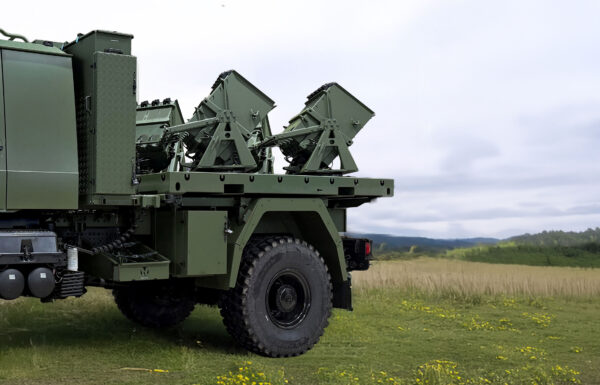
Ruta Block 3 has received a new airframe with a reduced radar cross-section. Like Block 2, the missile is to be launched by a rocket booster from a launcher housed in a 40-foot container for land-based, naval and fixed-site applications. A new-generation turbojet engine, the larger Destinus T220, will then be started. The system will combine advanced autonomous navigation for GNSS-degraded environments with emerging terminal-phase detection and guidance functions.
The program aims to move Europe from limited long-range strike stockpiles to sustainable industrial production. It is being implemented across three industrial centers. In the Kingdom of the Netherlands, Destinus serves as the engineering and design expert and as the main Ruta production facility, already producing the family at scale. In Ukraine, Destinus will participate in both the development and operational testing of Ruta Block 3, and will also serve as a production hub for essential components. In Germany, the aforementioned Rheinmetall Destinus Strike Systems joint venture is intended to provide the Bundeswehr and wider European institutional customers with rapid production, qualification and integration capabilities. Production at Rheinmetall’s Unterlüß facility is to begin with Ruta Block 1 and Block 2 in 2026–2027, complementing existing serial production in the Kingdom of the Netherlands, while Block 3 is to enter production as flight testing and qualification progress.

“Europe is entering a new defence era where the decisive factor is no longer the existence of precision weapons, but the ability to produce, replenish, and evolve them at an industrial scale during prolonged high-intensity operations,” said Mikhail Kokorich, CEO of Destinus. “RUTA Block 3 is designed around that reality: sovereign European architecture, distributed industrial production, and the ability to scale rapidly across allied nations. Our objective is not to manufacture symbolic quantities of exquisite missiles, but to help establish a credible European long-range strike capability with real industrial depth.”
“Deep precision strike capabilities, meaning the ability to strike strategically important targets with pinpoint accuracy, even deep within the enemy’s territory, contribute to a credible deterrent and are therefore of great importance in terms of security policy,” said Armin Papperger, CEO of Rheinmetall AG. “We are ready to establish the Rheinmetall Destinus Strike Systems joint venture with our partner Destinus before the end of this year and to provide these capabilities to our customers as soon as possible. We are excited to produce and deliver the first missiles from our Unterlüß site before the end of 2026.”
According to media reports, the start-up Destinus has production facilities in the Kingdom of the Netherlands and Spain, where it manufactures Ruta Block 1 missiles and their components. The company’s offices, meanwhile, are located in Switzerland, Germany, the Kingdom of the Netherlands, France and Spain. The company has also developed another unmanned system, namely the Hornet interceptor drone in Block 1 and Block 2 versions. Previously, its offering included the propeller-driven Lord unmanned aircraft.
On November 19, 2025, Destinus entered into cooperation with the US company Shield AI to integrate Hivemind, AI-based autonomy software designed to control platforms, such as the latest X-Bat, in environments without communications and satellite navigation, as well as under electromagnetic interference and electronic warfare conditions. Earlier, in August, it acquired the Swiss AI company Daedalean, with the acquisition completed on January 5 this year.