



















Allies and partners in Europe, the Indo-Pacific region, the Middle East, and the Americas are facing the same strategic reality. National territorial defense requires maintaining continuous situational awareness in the air domain now, not in 2035. Older, large platforms are approaching the limits of acceptable lifecycle costs. Their availability is also declining, as more and more sustainment challenges arise over time. As a result, allies are accelerating efforts to field more flexible capabilities that provide a higher degree of interoperability and survivability, and enable rapid achievement of operational readiness.
 Images: L3Harris Technologies
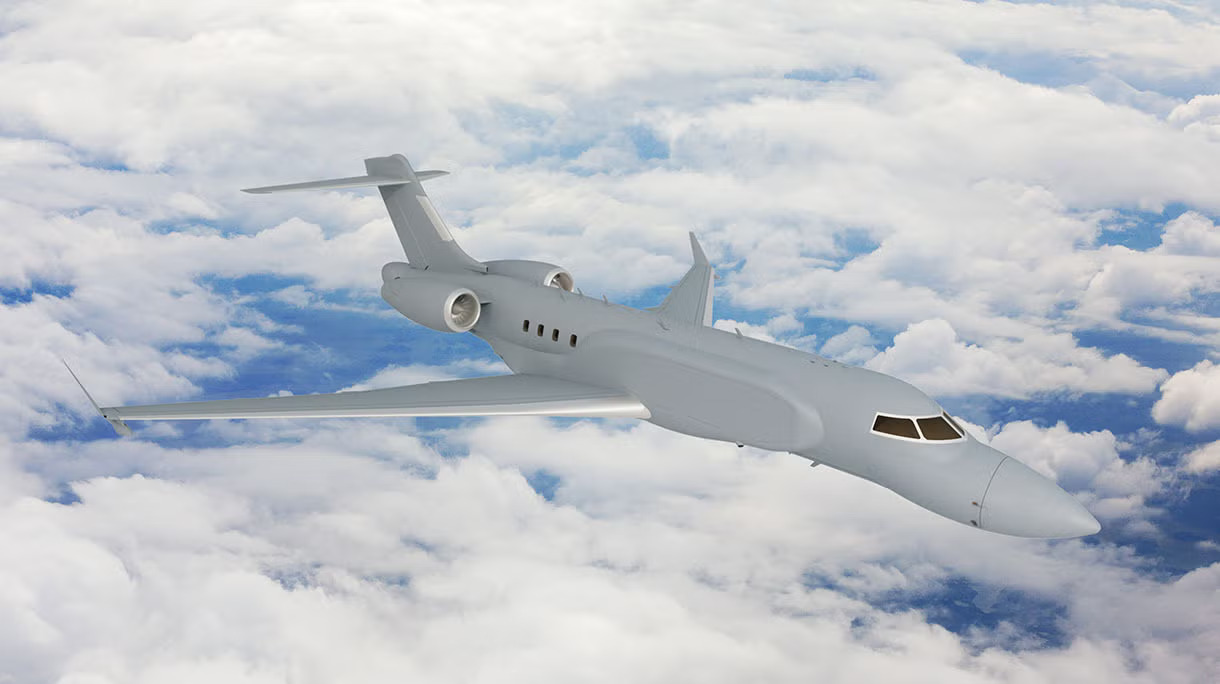
With a fundamental shift in the allied approach to airborne intelligence, surveillance, and reconnaissance (ISR) operations, and with the development of mission systems, the L3Harris AERIS X airborne early warning aircraft provides proven capabilities, ease of maintenance, and immediate operational readiness in response to evolving modern threats.
A combat-proven solution where it matters most
Conflicts in today’s world are exposing gaps in threat-countering systems, including those related to UAVs, low-observable platforms, and high-altitude cruise and ballistic missiles. AERIS X is a business aircraft-based AEW&C platform that also enables operations based on new concepts of cooperation with unmanned systems, including manned-unmanned teaming (MUM-T). The system is a critical link in the capability chain for detecting threats faster over larger areas. It also provides greater flexibility in tailoring the capabilities needed to respond to the continuous, dynamic evolution of threats, while maintaining the platform’s reduced detectability. The radar systems of the AERIS X aircraft have been proven in combat in operations involving defense against hundreds of UAVs, cruise missiles, and ballistic missiles, even in the most demanding theaters of operation. AESA, or active electronically scanned array, technology provides 360-degree coverage around the airframe, a 30% greater threat-detection range, and higher resistance to jamming.
“The operational lessons from current conflicts are unambiguous,” said Craig O’Donnell, International Business Development Director, ISR, L3Harris. “Seeing everything and seeing it earlier aren’t nice-to-have features anymore – they’re requirements when defending your homeland.”
Global operational readiness, market credibility
The delivery of 106 missionized business aircraft, achieving more than 90% operational availability in multiple allied countries, confirms how AEW&C capabilities can be provided in a sustainable and easily maintainable way. Recent allied procurement decisions, including the selection by the Republic of Korea, which chose the L3Harris solution as Phoenix to replace its existing platforms, and the selection by one leading NATO country, mark the beginning of a broader trend in the approach to assessing cost, readiness, and technological risk.

The advantage of using platforms with a civilian pedigree
Modern business jets, distinguished by excellent fuel-efficiency parameters, significantly change the cost calculations for introducing AEW&C systems. Lower acquisition costs, shorter modification times measured in months rather than years, access to global supply chains, and predictable lifecycle costs represent a clear shift compared with large, expensive, and increasingly less efficient purely military platforms.
Aging AEW&C aircraft fleets, struggling with availability issues as well as delays and high costs in replacement programs, are creating a capability gap, particularly in the area of continuous airspace monitoring. Allies can no longer afford multi-year development programs whose progress lags far behind the pace at which threats in the air domain are evolving.
Prepared for integration with fifth- and sixth-generation systems
Advanced tactical data links enable the coordination of operations across multiple domains and target designation for fifth- and sixth-generation combat aircraft. For countries investing billions in the introduction of the F-35 and future CCA systems, AERIS X offers a solution that maximizes the effectiveness of those investments without compromising the use of their reduced detectability. The conformal design of the AERIS X radar is particularly important here. The system’s open architecture enables cost-effective upgrades as technology continues to evolve. Unlike traditional systems with rotating radars, or rotodomes, or fixed antennas, the conformal radar format allows the sensor to be upgraded without altering the external geometry of the airframe, reducing the complexity, cost, and time required to introduce further improvements.
“Allies are prioritizing platforms that can integrate new sensors and capabilities without extensive aircraft modifications,” said George “Riebs” Riebling, International Business Development, ISR, L3Harris. “That’s the definition of future-proofing.”
Sovereignty and strategic partnership
Allied countries are increasingly requiring weapons-system suppliers to establish domestic capability-sustainment systems, transfer technology, and ensure control over long-term development. L3Harris takes these needs into account in its activities, offering cooperation models that strengthen user sovereignty and redefine the traditional methods of collaboration used in the defense sector to date. L3Harris tailors the scope of operational support, training, and industrial participation to the requirements of each country, rather than offering one-size-fits-all solutions for every partner. As a result, domestic defense industry capabilities are strengthened while operational independence is maintained.
For countries such as Canada, Poland, and other European allies introducing the F-35, interoperability is not an optional requirement – it is an absolute necessity. AERIS X provides the required sensor performance and integration within NATO standards, while offering the flexibility for further development as threats and technologies continue to evolve.
The right choice for every theater of operations
Allied countries face diverse and urgent operational needs – from NATO integration and cooperation with the F-35 in the EUCOM area of responsibility, through the detection of air and maritime threats across the vast Indo-Pacific region, to territorial defense against unmanned systems and missiles in the CENTCOM region, and the protection of the Arctic and the continental airspace of the Americas under NORTHCOM.
The question is not whether allies need AEW&C capabilities, but whether they can afford to wait for solutions that will not reach the market until the mid-2030s, or whether they need proven operational capabilities available today.
The future of airborne mission systems will be defined by the ability to operate in conditions of degraded ground infrastructure, provide real-time situational awareness, adapt to new threats, and maintain decision-making advantage even in the most demanding and saturated operational environment.
AERIS X addresses all of these needs through a single flexible platform. Combat-proven equipment. Availability of more than 90%. Lower lifecycle costs. Development flexibility as threats and technologies continue to evolve.
The pace of threat development requires decisions to be made within this decade. AERIS X is a platform ready for operation today.
See also:
