



















 Mr. Yoav Tourgeman, Rafael Advanced Defense Systems President & CEO / Photo: Jakub Link-Lenczowski, MILMAG
Jakub Link-Lenczowski, MILMAG: Could you provide us with a few words about Rafael in general?
Yoav Tourgeman, Rafael President & CEO: Rafael is the largest supplier of many sophisticated articles to the IDF. We were founded together with the country when our first Prime Minister, Ben-Gurion, has realized that the only way to survive in this hostile area is to have a superiority in science, technology, and moral. So, he built up an engineering corporation, smart soldiers that has scientific capabilities. Later on, he realized that uniform and innovation doesn’t necessarily go together, so he established an authority for development of weapon systems. And this is the acronym in Hebrew of Rafael.
The last 25 years, we are a company that is raising in the market, profitable, paying dividends to the shareholders, and we are growing in the last three years 30%, even more than 30% annually. Best known for Iron Dome, we have Iron Beam, we have Stunner, we have many, many other systems, Trophy and SPYDER. All those systems are very well known.
 Iron Beam, Iron Beam M, Lite Beam / Photos: Rafael Advanced Defense Systems
Jakub Link-Lenczowski: During the recent year, the way how we see the battlefield has a bit changed. So, what is Rafael’s answer to these changing battlefield requirements? If we’re speaking about the dronization, about a lot of low-cost tier, simple but AI-augmented systems. What is your answer for this?
Yoav Tourgeman: First, in general, I think lesson learned from the conflict we have been into the last three years, there is a learning race between us and the others, our enemies, and you have to build your systems in a way that it gathers information, enable you to analyze and to improve while undergoing improvement. So, from day to day, we have introduced new software versions, for example, to Iron Dome, to Spyder, etc., in order to optimize it to new threats or new tactics or a specific environment.
So, this is, in general, our system being built in open architecture, being able to gather and to process information and also to get updates from the outside.
Now, regarding the new R&D. First, the sophistication of the system is totally critical. Good enough systems that people tend to think it’s a good idea have a bottom line fail.
For example, the Shahed ones have failed. They have launched against us thousands of Shaheds, only one hit because of mistake. So, they spent huge amount of effort actually doing nothing. You have to be costly wise, meaning that you have to be as low cost as possible, but still maintain superiority. So, in general, if your fighters is in battle, it’s better that each of its capabilities will be implemented as close to 100%. Otherwise, he will be jeopardized or will be in risk or will not be able to fulfill its mission. So, we are keeping our capabilities in an area that are close to 100%, but not as costly as usually 100%. And you can see it in our systems that are cost effective, are highly valuable, and we think that nothing to match.
I’ll give you an example, the Iron Dome. Iron Dome is a low cost interceptor, but capable of doing anything, from motors to ballistic stuff. But you’ve got also the product which is called Trophy, developed to protect ground vehicles.
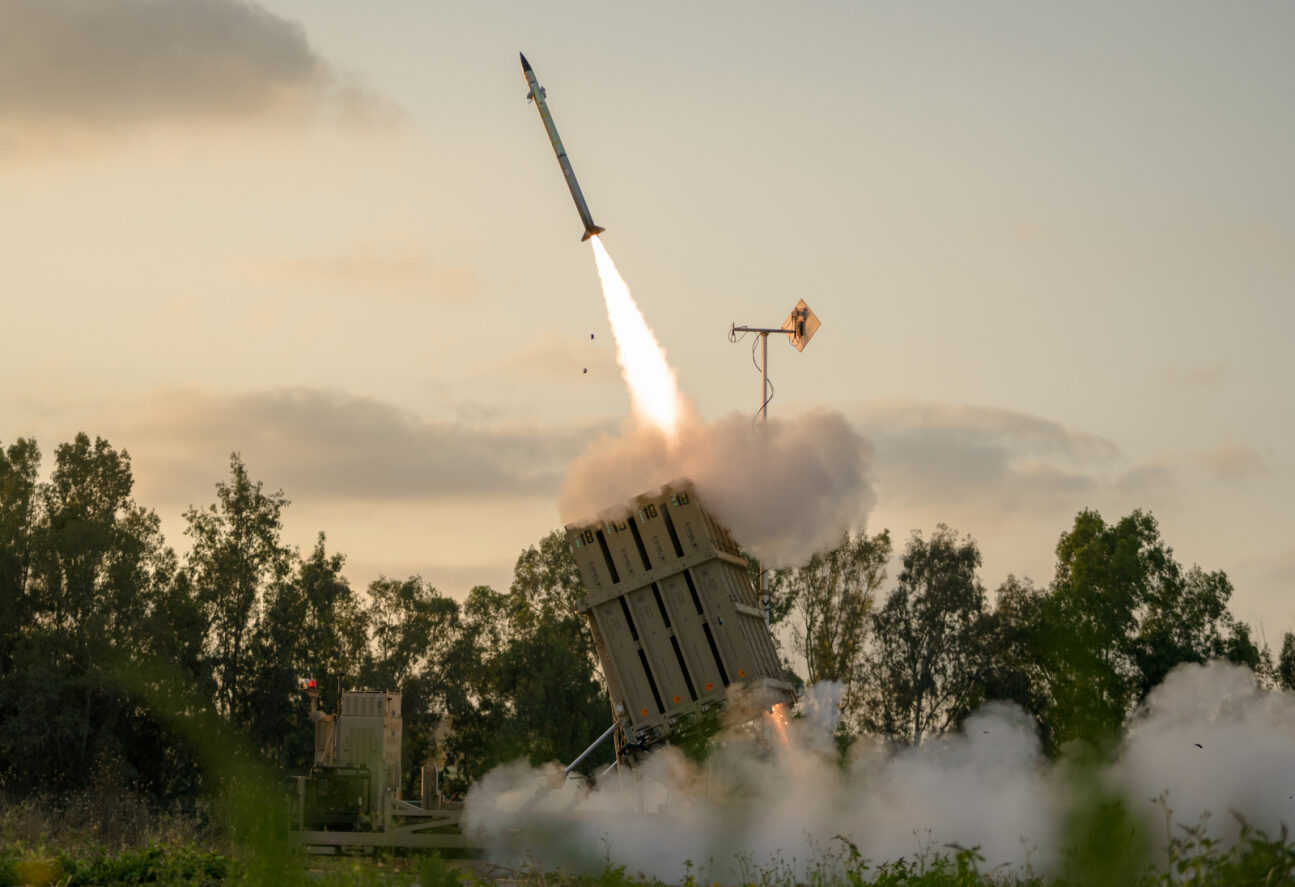 Iron Dome
Jakub Link-Lenczowski: Now we’ve got armed drones, which are used for attacking as swarms ground vehicles. Is it possible to involve Trophy to counter such threats?
Yoav Tourgeman: So, Trophy is not a stationary system. It is rapidly evolving and has new capabilities. I will not extend because of secrecy, but it is much beyond only protecting anti-tank missiles and rockets, but also other capabilities as well. I cannot elaborate on that, but this is part of its capabilities. It is constantly progressing. You know, there is an emerging threat and the system is coping with that.
You can see as an evidence the very minimal casualties we have in our battle. And believe me, nobody goes with AK-47, all of them with missiles and RPGs, etc. So, even very short ranges were countered by the system. It’s a very, very high percentage. If you are talking in general about how to counter UAVs, so that issue is being handled as a whole holistic approach of detection, classification, interception. So, we are able to detect it using radars, electro-optics, and SIGINT, actually. And we are able to intercept it using EW, hard kill, very precise guns, or drone kill drone, or missiles, very low-cost missiles that can intercept it.
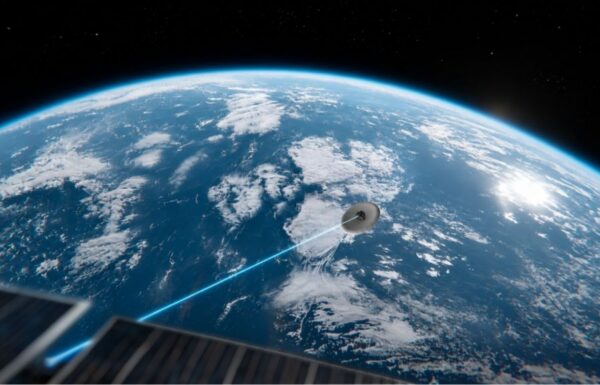
And, of course, the queen of the battle is the high-power laser. We have a tactical laser mounted on a fighting vehicle that is able to intercept, in kilometers away, those drones and kill them one by one. In that case, the cost per kill is just energy, maybe a few euros. So, this is our perspective. It enables you to have a very tuned solution, because it is not a national… We also have a national level protection system, but it can also be force protection, while they are making progress to the enemy front line or beyond it. So, each unit will have its own capability to protect itself.
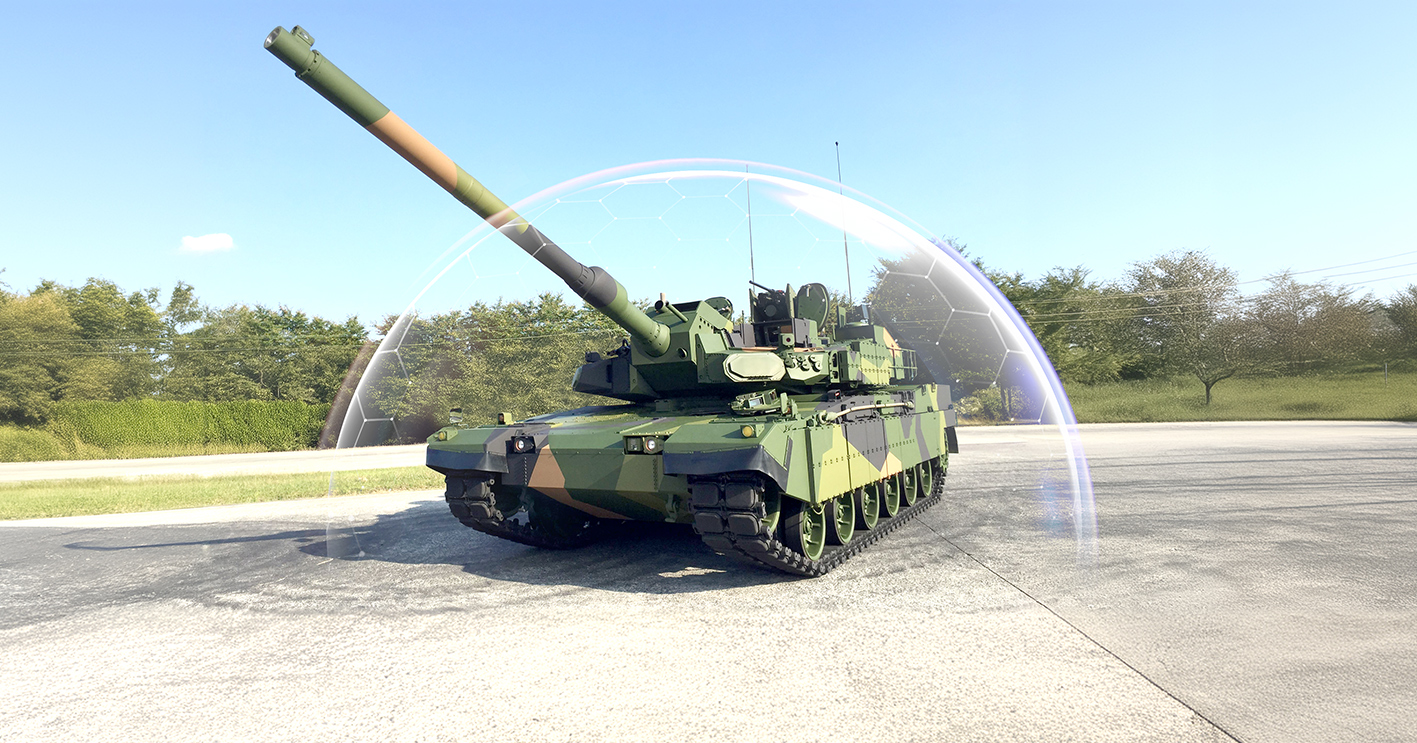 Trophy APS
Jakub Link-Lenczowski: I have a last question. In your opinion, in the coming years, what will be the crucial area of development for Rafael? Which systems might be crucial on the future battlefield for which you are working?
Yoav Tourgeman: I’ll tell you the truth. This is a very good question, which we address daily. My philosophy is that we do not deal with systems that are not crucial. And we do not do things that others can do as well. We are not into philosophy. We do either only the only ones who can do that, or by far better than the others. If not, we will move on to another solution. Our communication is unique. Our air defense is unique. Our tank protection system for tank trophy is unique. It’s the only operational in the world. And for the last 15 years. And we maintain that also for other areas, that our solution is unique or the only solution we have.
Now, in a non-critical area, we mainly don’t do anything. You will not find, even though we had in the past an unmanned boat, we found it as non-necessary, we abandoned it. Because we thought that this is not critical. And we were the first to introduce an operational autonomous boat. So this is the idea in general. I don’t want to spend my very important manpower and engineers, scientists, on stuff that is not critical.
ILA Berlin 2026: Rafael and Reflex Aerospace form strategic partnership on smart space solutions
Another record-breaking year for Rafael Advanced Defense Systems
Rafael to Showcase a Broad Range of Capabilities at Singapore Airshow 2026