











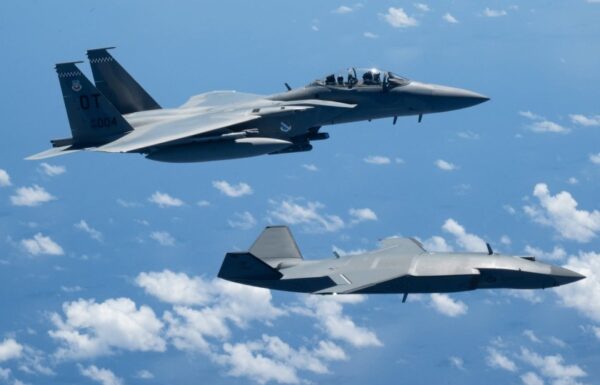






















On Tuesday, February 17, 2026, the U.S. Defense Advanced Research Projects Agency (DARPA) announced that the LongShot air-launched weapons platform, developed under its oversight by General Atomics Aeronautical Systems Inc. (GA-ASI) and recently assigned the alphanumeric designation X-68A, will soon be tested on the Boeing F-15 Eagle multirole fighter aircraft.
 Image: DARPA
The LongShot program was launched in 2020, although the concept of a powered flying missile rail (FMR), an air-launched platform capable of carrying air-to-air missiles, originated in 2017. On February 8, 2021, Defense Advanced Research Projects Agency (DARPA) awarded contracts of undisclosed value to General Atomics Aeronautical Systems Inc., Lockheed Martin, and Northrop Grumman for preliminary design work under Phase 1 of the program. In March 2022, GA-ASI was selected as the sole contractor for continued development under Phase 2, and in September 2023 the program transitioned into Phase 3.
Originally, flight tests of the selected solution had been scheduled for late 2023 or early 2024. However, this did not occur. The first flight is now expected at the end of 2026, following the completion of the ongoing integration and ground testing activities.
 Grafika: GA-ASI
According to the report, the program’s most recent milestones include full-scale wind tunnel testing as well as successful trials of the parachute recovery system and the release of the carried weaponry.
“LongShot burns down significant technical risk and presents a viable path for the military services to increase air combat reach and effectiveness from uninhabited, air-launched platforms,” said Col. John Casey, DARPA LongShot program manager. “With the help of our partners, we’ve completed critical milestones necessary for the integrated flight test campaign, which will validate vehicle performance and lay the foundation for efficient follow-on development.”
 Image: GA-ASI
The program draws on the expertise and experience of numerous U.S. government stakeholders, including:
- Arnold Engineering Development Complex (AEDC) at Arnold Air Force Base, Tennessee;
- the Air Force Life Cycle Management Center (AFLCMC) of the U.S. Air Force Materiel Command;
- the F-15 Program Office;
- the 96th Test Wing of the U.S. Air Force;
- the Air Force Research Laboratory (AFRL);
- the Naval Air Warfare Center Aircraft Division (NAWCAD) at Naval Air Station Patuxent River, Maryland;
- NASA (National Aeronautics and Space Administration);
- the Engineer Research and Development Center (ERDC);
- the Combat Capabilities Development Command Aviation and Missile Center (AvMC);
- the Redstone Test Center (RTC) in Huntsville, Alabama, and the Army Test and Evaluation Command (ATEC);
- the Yuma Proving Ground in Arizona.
 Image: DARPA
LongShot is intended to be a jet-powered uncrewed air superiority system with a reduced radar cross-section, similar in concept to a cruise missile, capable of carrying two air-to-air missiles in an internal weapons bay. The LongShot would be carried by a multirole fighter or bomber and then released in the area of operations. From there, it could approach the target, reducing the time-to-target for the air-to-air missile, or conduct an independent patrol-and-response mission. This would effectively extend the engagement range of the crewed aircraft while reducing its exposure to enemy aircraft and air defense systems.
The concept of a powered flying missile rail assumes that the missile can be launched much closer to the area where the adversary is operating, retaining higher energy and leaving less time for the opponent to react (either through counterattack or evasive maneuvers). LongShot is also assessed as enabling multi-vector attacks, further reducing the adversary’s chances of successful defense.
We’re making serious progress on our LongShot program. 💯
Thanks to support from our government and industry partners, we successfully completed several technical milestones, moving the program – recently designated the X-68A – closer to flight testing. pic.twitter.com/cZox6cxHsg
— DARPA (@DARPA) February 17, 2026
LongShot uncrewed air superiority system, a collaborative effort by DARPA and GA-ASI, designated X-68A by the U.S. Air Force.
Read the news: https://t.co/q4Es4lN4lp#LongShotUAS #sUAS pic.twitter.com/IXbN05sHDz
— General Atomics Aeronautical Systems, Inc (GA-ASI) (@GenAtomics_ASI) February 19, 2026