


























On Friday, June 5, 2026, the U.S. Department of State approved the potential sale to the United Kingdom of Great Britain and Northern Ireland of a package of AN/AAQ-24(V)N LAIRCM (Large Aircraft Infrared Countermeasures) systems with Guardian laser-tracking subsystems, for up to 160 million USD.
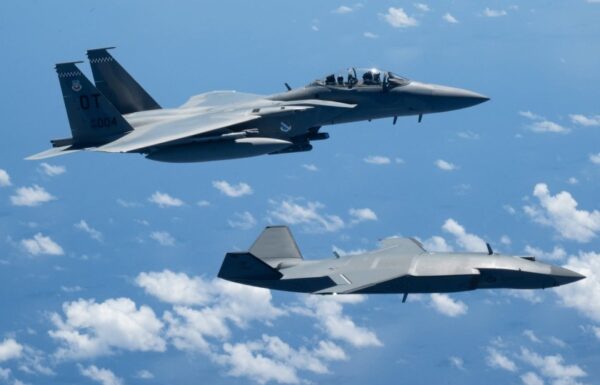
 Photo: Northrop Grumman, USAF, Royal Air Force
According to the published notice, the government in London requested the possible procurement of 36 Guardian Laser Tracking Assembly (GLTA) subsystems and 18 missile warning sensors for the AN/AAQ-24(V)N LAIRCM infrared countermeasure system.
The request also included the following non-MDE (Major Defense Equipment) items: LAIRCM user data module cards; missile warning sensors and associated equipment; test and inspection equipment; major and minor modifications and maintenance support; components, aircraft parts, and accessories; spare parts, consumables, and accessories; repair and return support; software delivery and support; publications and technical documentation; U.S. government engineering, technical, and logistics support services; and other related elements of logistics and program support.
Although Northrop Grumman is the supplier of the system, Boeing was named as the principal contractor. This may indicate the aircraft platform covered by the package, although it was not named in the notice. This is especially likely given that the document refers to providing advanced protection for large air mobility platforms.
The aircraft in question is likely the United Kingdom’s eight C-17A Globemaster III ER heavy transport aircraft, designated Globemaster C-17 by the Royal Air Force. On August 26, 2025, approval was issued for the sale of a technical support package for these aircraft, valued at up to 861 million USD. The previous support package for the UK’s Globemasters was dated September 24, 2020, and was valued at up to 401.3 million USD.
The LAIRCM system automatically detects incoming infrared-guided missiles and dazzles their seeker with a concentrated laser beam. A typical configuration consists of missile warning sensors, an AN/AAQ-24(V)N processor, and Guardian LTA laser turrets, which rotate, track the target, and emit laser pulses.

Globemaster III in RAF service
Initially, the Royal Air Force (RAF), which had lacked a strategic airlift capability since 1976, received government approval to lease four C-17A aircraft from Boeing from 2000 to 2007. The aircraft were assigned to No. 99 Squadron at RAF Brize Norton in Oxfordshire.
As the lease termination period approached ‒ with the agreement including an option to extend it by two years ‒ a decision was made in 2006 to purchase five aircraft of this type, including the buyout of the four leased examples. A seventh aircraft was ordered in 2009, followed by an eighth in 2012. The latter was delivered within a few weeks, in May, after the Ministry of Defence announced that it had cost 200 million GBP.
The aircraft now also serve with No. XIV Squadron, since 2013, also based at RAF Brize Norton, which is responsible for training pilots for the Air Mobility Fleet. On February 17, 2018, the Ministry of Defence announced the signing of an agreement with the United States worth 260 million GBP to support the Globemaster C-17 fleet for another decade, as the initial 20-year technical support agreement was due to expire in 2022.
The United Kingdom learned how important it is to have its own heavy transport aviation as a logistics enabler during Operation Herrick in Afghanistan from 2002 to 2014 and while supporting France in Mali during Operation Barkhane from 2018.
See also: