


















On Tuesday, January 20, 2026, the Defense Acquisition Program Administration (DAPA), operating under the Ministry of National Defense, announced that it had inaugurated a program for new electronic warfare (EW) aircraft with a meeting between Director Lee Yong-cheol and representatives of one of the contractors, the domestic company LIG Nex1, held at the Pangyo-ro campus in Seongnam.
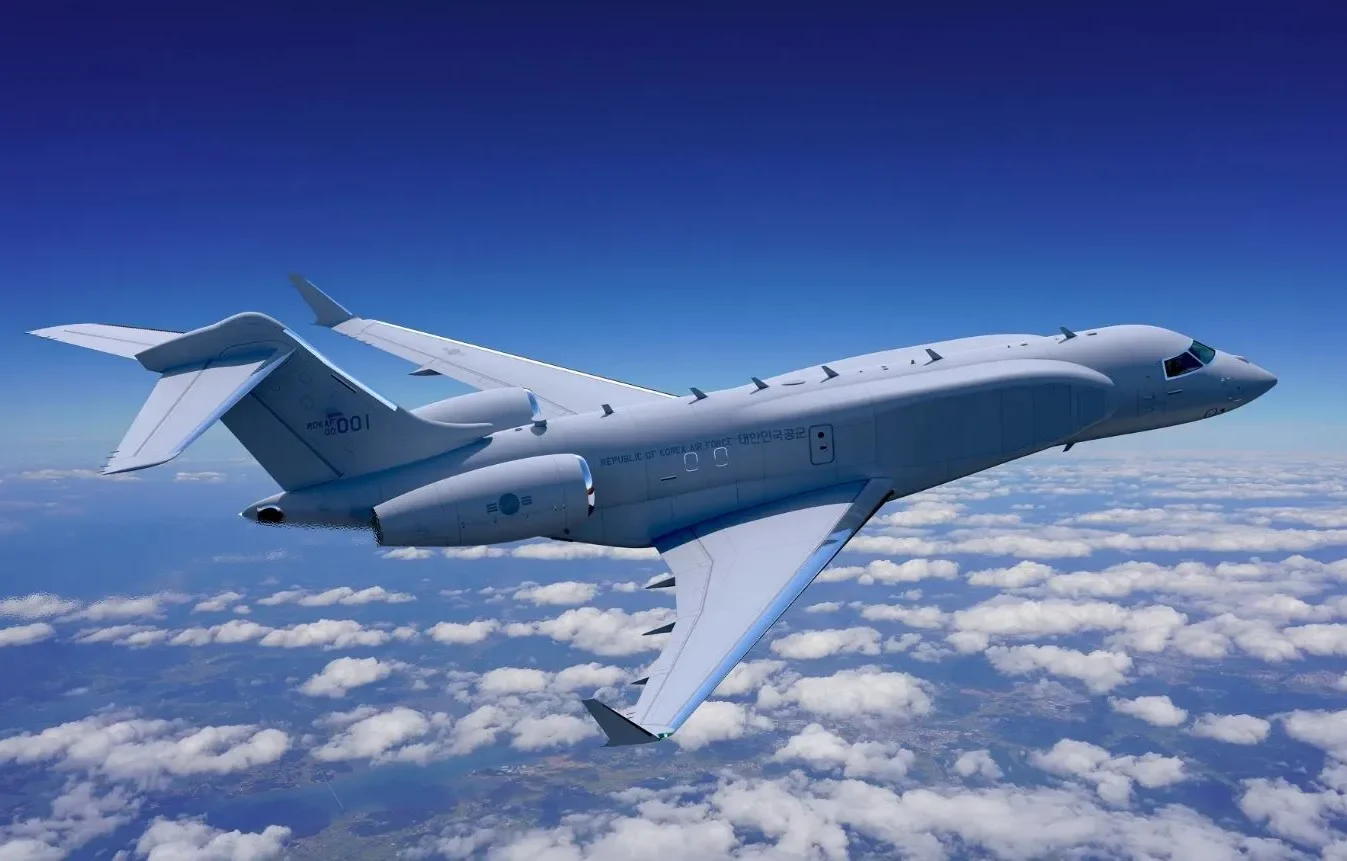 A visualization of the proposal submitted by Korea Aerospace Industries and Hanwha Systems in the program, which ultimately lost / Graphic: KAI
The meeting focused on the development of the first aircraft variant (Block I), for which the Bombardier Global 6500 platform was selected, covering two aircraft (with two upgraded Block II aircraft also planned). The entire program has a budget of 1.9198 trillion KRW, and the entry into service of the first aircraft is planned for 2034. The program aims to research and develop electronic warfare (EW) systems capable of neutralizing hostile integrated air defense systems and radio-based command-and-control systems.
The meeting was also attended by representatives of the Joint Chiefs of Staff, the Republic of Korea Air Force as the future operator, the Agency for Defense Development (ADD), the Defense Agency for Technology and Quality (DTaQ), as well as other interested organizations. Participants shared system development plans for each sector, marking the first step toward the development of the Block I EW system.
The electronic warfare system developed under this project will go beyond the limited self-protection provided by existing EW equipment for individual weapon systems. It is expected to be a game changer on the future battlefield, capable of disrupting large enemy areas from long range, effectively blinding and deafening the adversary while providing battlefield control. This is expected to significantly enhance survivability and joint operations of the Air Force and other branches of the armed forces.
Moreover, the entire Block I system development process will be led by industry, increasing the participation of related companies and research institutes while securing cutting-edge EW technologies. This will help strengthen the technological competitiveness of the domestic defense industry and create jobs. Increased use of domestically produced components is also expected to have a positive impact on the industrial ecosystem and boost the export competitiveness of South Korea’s defense industry. Additionally, drawing on experience gained during Block I development and ongoing technological advances, DAPA plans to separately develop the Block II system, which will incorporate evolutionary capabilities.
“Electronic warfare is a new weapon system concept that will change the rules of the game on the future battlefield, and the launch of this development will be a key milestone that transforms the paradigm of future warfare,” said Jeong Gyu-heon, Head of the Future Assets Business Division at the Defense Acquisition Program Administration (DAPA). “We will work closely with relevant organizations and make every effort to ensure the success of this project and manage it comprehensively.”
It should be recalled that in December 2025, LIG Nex1 was awarded a contract worth 1.56 trillion KRW for system integration and the development of the core specialized electronic warfare (EW) equipment. The main subcontractor is the research institute Korean Air Aerospace Division (KAL-ASD), which will be responsible for airframe conversion. The losing bidder was a consortium of Korea Aerospace Industries (KAI) and Hanwha Systems, which had also proposed a solution based on the Bombardier Global 6500 platform.
See also: