
























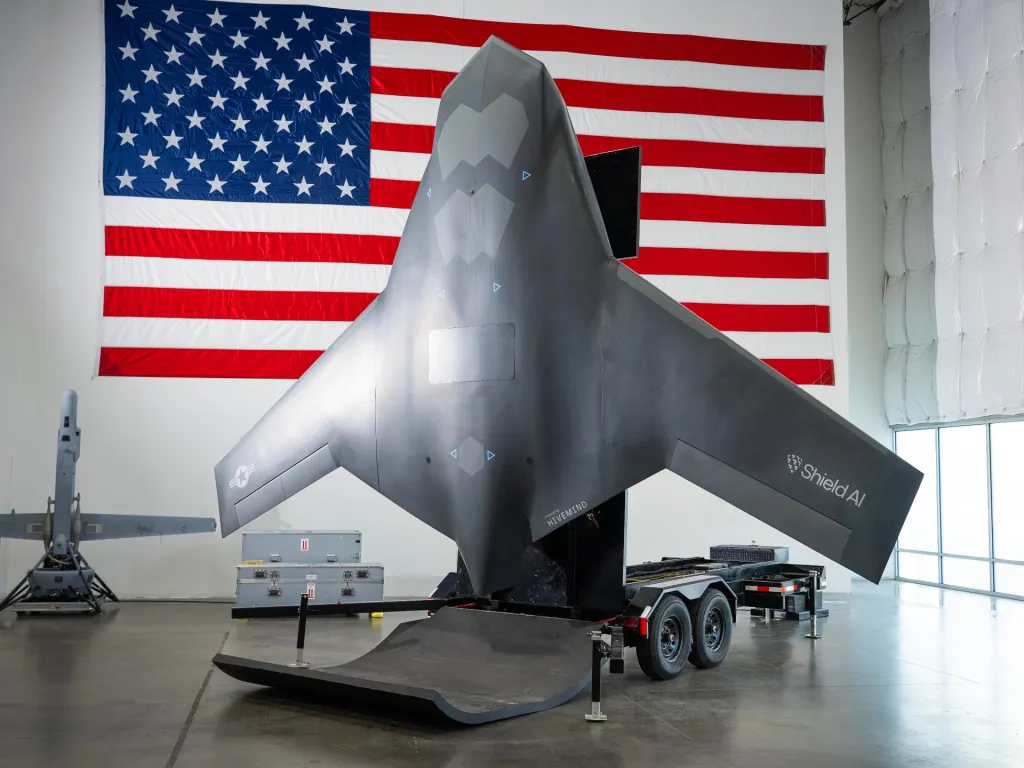
On Wednesday, October 22, 2025, the American company Shield AI announced that the previous day, in Washington, it had presented a full-scale mock-up of the X-Bat, the world’s first jet-powered, fighter-class, vertical take-off and landing (VTOL) unmanned aircraft controlled by machine learning (artificial intelligence) algorithms. The event was attended by military commanders, government officials, and industry partners. The aircraft is designed for expeditionary operations, including maritime missions, and to operate effectively in environments with intense electromagnetic interference.
 Photos: Shield AI
“At Shield AI, we believe the greatest victory requires no war. To make that belief real, we’re executing a simple but ambitious master plan: prove the value of autonomy, scale it across domains, and reimagine airpower,” said Brandon Tseng, Shield AI co-founder, president, and former Navy SEAL. “X-BAT represents the next part of that plan, expanding U.S. and allied warfighting capacity through a transformative, runway-independent aircraft. Airpower without runways is the holy grail of deterrence. It gives our forces persistence, reach, and survivability, and it buys diplomacy another day.”
At the heart of the X-Bat is Shield AI’s Hivemind, an artificial intelligence–based autonomous software designed to control platforms in environments without communications or satellite navigation, as well as under conditions of electromagnetic interference and electronic warfare (EW). Hivemind enables the X-Bat to autonomously penetrate airspace, dynamically cooperate with manned aircraft, and execute collaborative tactics without the need for continuous connectivity. This autonomy allows the X-Bat to operate either as a Loyal Wingman or as an independent combat platform.

The aircraft is expected to measure 7.92 meters (26 feet) in length, with a wingspan of 11.89 meters (39 feet) and a height of 1.43 meters (4.7 feet). It will have a service ceiling of 15,240 meters (50,000 feet) and a range of over 3,700 kilometers (2,000 nautical miles). The design is intended to be highly modular, allowing for future upgrades and modifications.
“X-BAT is a revolution in airpower because it combines four things – VTOL, range, multirole capability, and autonomy,” said Armor Harris, senior vice president of aircraft at Shield AI. “VTOL plus range solves survivability on the ground and dependency on tankers. Multirole provides critical flexibility as the threat evolves, because no plan survives first contact with the enemy. X-BAT’s ability to autonomously operate standalone or collaboratively allows it to project power when other assets aren’t around and simplifies kill chains.”
Taken together, these features add up to a combat aircraft purpose-built for distributed, high-end conflict. The X-BAT’s design combines survivability, flexibility and affordability in a way that delivers an unparalleled cost-to-effect ratio for joint forces. Key capabilities include:
- VTOL + long range: The only platform in its class that combines VTOL capability with a range of over 3,700 km while carrying a full combat load, enabling theatre-scale operations from ships, islands and austere locations.
- Multirole: Capable of strike missions, air-to-air engagements, electronic warfare, intelligence, surveillance and reconnaissance (ISR), and more — thanks to two weapons bays and the ability to carry stores on external hardpoints, including AIM-120 AMRAAM or AIM-174B missiles.
- Compact footprint: Up to three X-Bats occupy the same runway/deck footprint as a single legacy fighter or helicopter, increasing sortie generation rates.
- Proven engine: Built around a mature jet-engine propulsion architecture to ensure reliability, ease of maintenance and logistical maturity.
- Affordable and easy to operate: Designed to deliver fighter-class performance at orders-of-magnitude lower acquisition and lifecycle costs compared with fifth-generation jet fighters.
- Survivability by design: Autonomy, adaptive tactics and signature management enable mission success in contested environments.
- Hive-mind-based autonomy: Operates in communications-denied or degraded conditions and limited connectivity, cooperating as a digital wingman.
- Open architecture: Platform-agnostic design that integrates with current and future concepts of the U.S. Air Force (USAF) and U.S. Navy

The X-Bat extends Shield AI’s mission to protect soldiers and civilians with intelligent systems, delivering a new generation of autonomous combat aircraft. The system can be deployed at military bases, on warships, on civilian vessels, or carried on wheeled or other transport platforms. Previously, the company developed the V-Bat unmanned aircraft.
See also:
