




























On Sunday, May 3, 2026, at 9:00 a.m. Polish time, or May 3 at 12:00 a.m. Pacific Time, a SpaceX Falcon 9 Block 5 launch vehicle lifted off from Space Launch Complex 4 East (SLC-4E) at Vandenberg Space Force Base in California as part of the CAS500-2 mission, integrated via Exolaunch. It placed into low Earth orbit (LEO) the fourth POLSARIS radar satellite built by Polish-Finnish company ICEYE for the Polish Armed Forces, as well as the first satellite of Polish company Eycore. In total, 46 payloads were launched for KAI, Argotec S.r.l, Exolaunch, Impulso.Space, Loft-EarthDaily, Lynk Global, True Anomaly, and Planet Labs.
 Zdjęcie: SpaceX
POLSARIS-4
The fourth POLSARIS satellite, part of the MikroSAR Satellite Earth Observation System for the Polish Armed Forces, has joined the three already launched into space. The first was launched on November 28, 2025, as part of the Transporter-15 mission, and on December 8 ICEYE presented the first images of Poland taken by its instruments. Two more were launched on March 30 this year as part of the Transporter-16 mission. The Geospatial Intelligence and Satellite Services Agency (ARGUS) expects the final two satellites to be placed into orbit in 2027.
Liftoff! pic.twitter.com/HmS624ScKO
— SpaceX (@SpaceX) May 3, 2026
ICEYE, in a consortium with Polska Grupa Zbrojeniowa and Wojskowe Zakłady Łączności Nr 1, is the supplier of the satellite platforms, while the state-owned entities are providing the Mobile Satellite ISR Reconnaissance Platform (MPRS ISR). The contract for this was signed on May 14, 2025, and was worth around 860 million PLN gross.
Deputy Prime Minister and Minister of National Defence Władysław Kosiniak-Kamysz:
“A launch vehicle carrying our fourth military satellite under the MikroSAR program has lifted off from Vandenberg Space Force Base in California as part of the CAS500-2 mission! We are strengthening our reconnaissance capabilities regardless of the time of day and weather conditions. I would like to thank ICEYE for its highly effective work. All the tests carried out were successful, so the company will soon hand over the system to us for full operational use. See you on May 15…”
❗Z Bazy Sił Kosmicznych Vandenberg w Kalifornii w ramach misji CAS500-2 wystartowała rakieta nośna z naszym 4-ym satelitą wojskowym programu MikroSAR! Wzmacniamy nasze możliwości rozpoznania niezależnie od pory dnia i warunków pogodowych. Dziękuję firmie @iceye_global za wielką…
— Władysław Kosiniak-Kamysz (@KosiniakKamysz) May 3, 2026
Each POLSARIS satellite is equipped with a synthetic aperture radar (SAR), which sends short microwave pulses toward the Earth and then combines and processes their reflections to create detailed images with a resolution of up to 25 cm per pixel. SAR technology allows the satellite to “see” both day and night, while microwave signals can penetrate clouds, smoke, and fog. This makes it possible to precisely detect objects and changes on the ground regardless of weather conditions. Because radar satellites do not use visible light, the imagery is monochrome. Its resistance to weather conditions and 24/7 imaging capability make SAR an ideal tool for military applications and crisis management.
As a result, the Polish Armed Forces have gained advanced reconnaissance capabilities based on ICEYE radar satellites. The detailed specification of the system is classified.
“Reconnaissance and information exchange are what determine the strength of a modern military today. Operations must be based on knowledge – on the fullest possible picture of the situation, allowing the commander to designate a target and the soldier to accomplish it. The security of our borders begins hundreds of kilometers above them. Thanks to radar satellites, we conduct observation regardless of weather conditions, which means that every direction and every part of our territory remains under constant control, and no movement by a potential adversary goes unnoticed. The Polish military already ranks among the most modern in the world, and satellite capabilities strengthen our information advantage and national security,” said Cezary Tomczyk, Secretary of State at the Ministry of National Defence.
Kolejny satelita Wojska Polskiego leci na orbitę! W 2023 roku mieliśmy 0 satelitów. Pod koniec tego roku będzie ich 9! To fundamentalna zmiana dla zdolności Sił Zbrojnych i Polski w ogóle! Wiwat 3 Maja!!! pic.twitter.com/DYTJdmXrv2
— Cezary Tomczyk (@CTomczyk) May 3, 2026
ICEYE said in a press release that an ICEYE satellite for the Portuguese Air Force was also launched into orbit during the same CAS500-2 mission. Both satellites established communications, and routine procedures are now under way as part of the early orbital phase. Including today’s launch, the company has successfully placed 72 radar satellites into orbit for its own constellation and customer systems.
“We are maintaining a high pace in delivering the contract and are fully prepared to execute further options provided for under the agreement with the Ministry of National Defence. We greatly value our partnership with the Polish Armed Forces, commitment and enthusiasm are evident on both sides. A month ago, the entire basic scope of the MikroSAR program was placed in orbit, and today we are adding the fourth satellite. This is a major step forward, POLSARIS has the potential to become a much larger constellation in the coming years and the foundation of Poland’s satellite reconnaissance capabilities. We are pleased to be part of it,” said Witold Witkowicz, President of the Management Board of ICEYE Polska.
Dziś, w Święto Konstytucji, na orbitę trafił czwarty satelita ICEYE dla Sił Zbrojnych RP! 🇵🇱
Tempo realizacji programu bardzo nas cieszy – razem z polskim wojskiem gramy w globalnej pierwszej lidze. Dziękujemy MON_GOV_PL @ARGUS_GOV_PL i @AgencjaUzbr za dobrą współpracę!
Do… pic.twitter.com/TfY1aM3QGw— Rafal Modrzewski (@rmodrzewski) May 3, 2026


Eycore-1
The second Polish satellite launched by Elon Musk’s rocket is Eycore-1, built by Polish new-space company Eycore, and intended to mark the beginning of the construction of a satellite constellation. It is the result of several years of research and design work by engineers associated with the company. The satellite was built using a satellite platform from Lithuania’s NanoAvionics, which belongs to Norway’s Kongsberg group.
🇵🇱 Dziś, w Święto 3 maja, #Kaszubia sięga jeszcze dalej, aż po kosmos🚀
🇵🇱 Dzięki spółce @Eycore_PL, inwestującej w ramach Zielonego Okręgu Przemysłowego Kaszubia na terenie @MiastoGdynia, na orbitę wyniesiony został pierwszy satelita EYCORE-1, wyposażony w radar SAR własnego… pic.twitter.com/WgJDrqLM1V
— Maciej Samsonowicz (@NaszKaszub) May 3, 2026
As a reminder, on June 19, 2024, Eycore unveiled the first Polish SAR satellite and signed a letter of intent with another Polish company, Creotech Instruments, on cooperation in the design and construction of satellite platforms equipped with SAR radar instruments.
In turn, on April 15, 2025, during the 3rd ESA Security Conference, Creotech Instruments signed a contract worth 51,925,511 EUR (222.559 million PLN), with the European Space Agency (ESA) for the construction of a national constellation of at least three observation satellites under the CAMILA (Country Awareness Mission in Land Analysis) National Earth Observation Project.
The mission will create a constellation of at least three Polish observation satellites, consisting of one radar satellite, one high-resolution optical satellite, and one lower-resolution optical satellite, along with ground infrastructure and a system for managing the entire space mission. Creotech Instruments is serving as the system’s prime contractor, working closely with leading companies from Poland’s space sector: CloudFerro, Eycore, GMV Innovating Solutions, KP Labs, and Scanway.
The silence before launch has a distinctive sound 🛰️ The hum of the fans, the whispers of engineers and the heartbeat that quickens with every glance at the clock.
Go Eycore-1 🚀#EYCORE #NewSpace #SAR #Poland pic.twitter.com/ZEofSXGquy— Eycore (@Eycore_PL) May 3, 2026
The Polish Armed Forces Enter Space
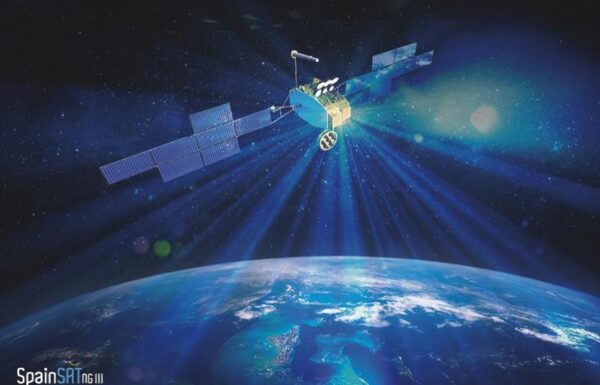
Meanwhile, on April 20 this year, during a visit to Poland by a French government delegation, European company Airbus Defence and Space, part of the Airbus SE group, the joint venture Thales Alenia Space, owned by France’s Thales with 67% and Italy’s Leonardo with 33%, and Radmor, part of the WB Group, announced the signing of an industrial cooperation agreement to develop a geostationary telecommunications satellite for the Ministry of National Defence.
As a reminder, the acquisition of a geostationary satellite with the participation of Polish industry was announced by the ministry on February 27 this year, during the presentation of a list of tasks and projects to be implemented by the government under the EU SAFE (Security Action for Europe) instrument, currently being carried out under the Polska Zbrojna program.
The above satellite capabilities should also be supplemented by the three PIAST constellation nanosatellites under the SZAFIR program, launched last year together with POLSARIS-1; four Creotech Hypersat optical satellites under the MikroGlob Satellite Earth Observation System program, with the launch of the first planned for the turn of August and September this year; and two large Airbus S950 VHR observation satellites under the POLEOS program, scheduled for the first quarter of 2027.