




























On Monday, April 20, 2026, the Malaysian defense industry portal Defence Security Asia was the first to report that Russia’s Federal Service for Military-Technical Cooperation (FSMTC) had approved the export to India of a batch of around 300 Vympel RWW-BD/R-37M long-range air-to-air missiles (DIA/NATO reporting name: AA-13 Axehead) for Sukhoi Su-30MKI heavy two-seat multi-role aircraft (NATO reporting name: Flanker-H), for the equivalent of 1.2 billion USD.
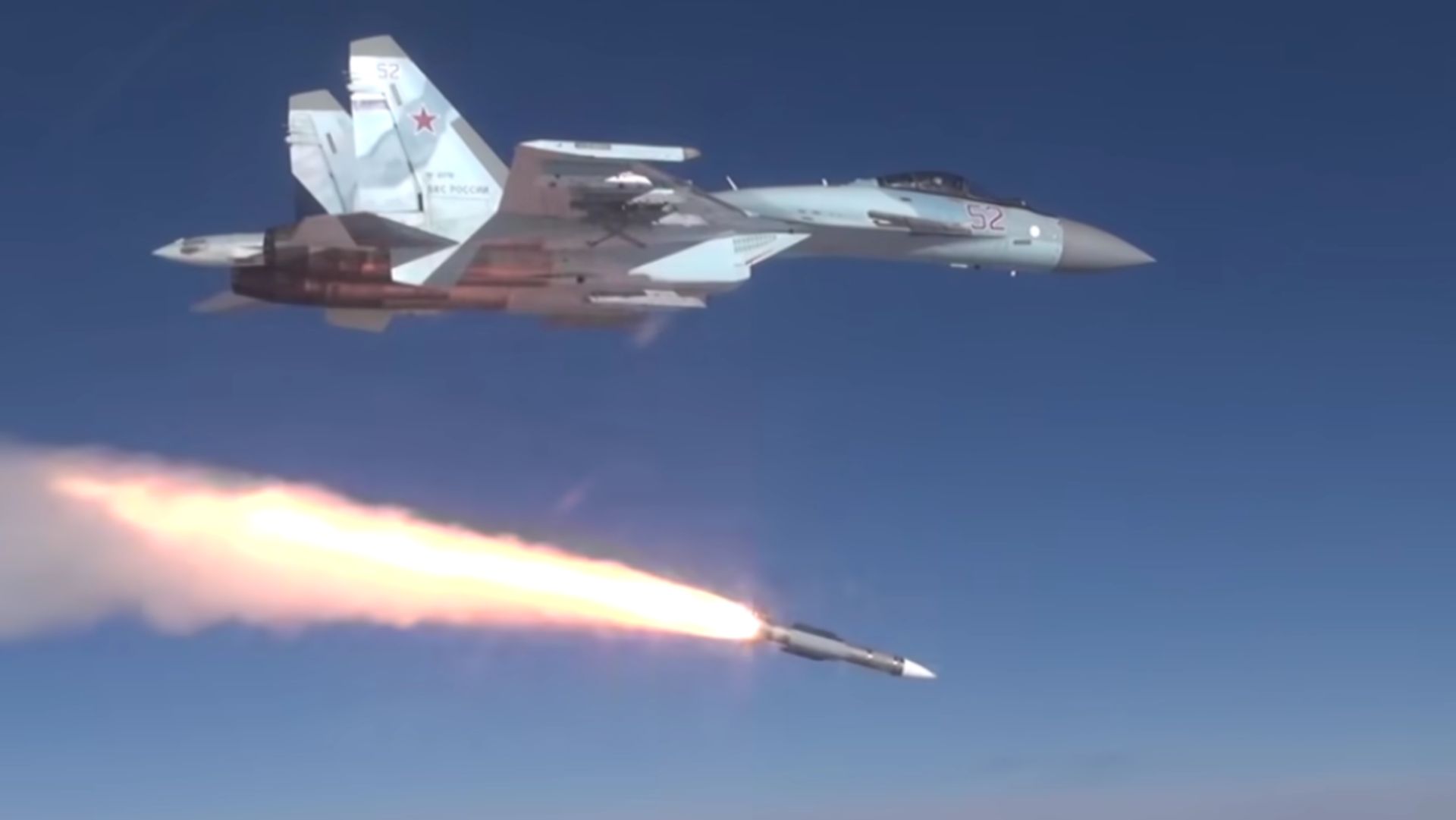 R-37M long-range missile launched from a Su-35S multi-role aircraft / Photo: still from a video by the Ministry of Defence of the Russian Federation
Although neither Moscow nor New Delhi has formally confirmed the agreement publicly, numerous converging reports indicate that the deal has already received Russian export approval.
Deliveries are expected to begin within 12–18 months. At the same time, India will continue developing improved missiles of its own design, namely the Astra Mk2, with a range of 240 km, and the Astra Mk3, with a range of 350 km, alongside the already fielded Astra Mk1, with a range of 110 km.
This appears to be a response to the introduction into service with the Pakistan Air Force (Pak Fiza’ya) of the Chinese PL-15E missile (DIA/NATO reporting name: CH-AA-10 Abaddon), with a range of around 200–300 km. This was revealed after Pakistani J-10CE multi-role aircraft armed with these missiles demonstrated their air-combat capabilities against Indian Dassault Rafale B/C F3-R fighters during the conflict between New Delhi and Islamabad in May 2025, shooting down one of them. JF-17s have also been integrated with these missiles. Indian planners are reportedly concerned that Pakistan will receive PL-17/PL-20 missiles with a range exceeding 400 km, together with 40 new-generation J-35A aircraft, previously referred to as the J-31/FC-31.
The Vympel RWW-BD/R-37M, with a range from 200 km to as much as 400 km, is a development of the R-37 missile with an additional rocket booster that increases its range. It was originally designed to engage airborne early warning and command aircraft, aerial refueling tankers, and electronic warfare aircraft.
The missile has been integrated with Su-35S, Su-30SM/SM2, and Su-57 multi-role aircraft, as well as MiG-31BM interceptors. It has been used in the ongoing Russo-Ukrainian war since October 2022. The export version, with a range of 200 km, is designated RWW-BD (Raketa Vozdukh-Vozdukh Bolshoy Dalnosti) and is also expected to arm the Checkmate LTS in the future.
The R-37M is 4.06 m long, has a body diameter of 380 mm and a tailfin span of 72 cm, and weighs 510 kg, including a 60-kg high-explosive fragmentation warhead. It travels at hypersonic speed, Mach 6, powered by a dual-pulse solid-fuel sustainer rocket motor. Guidance is provided by an inertial navigation system with mid-course updates, as well as semi-active and active dual-band radar homing.
