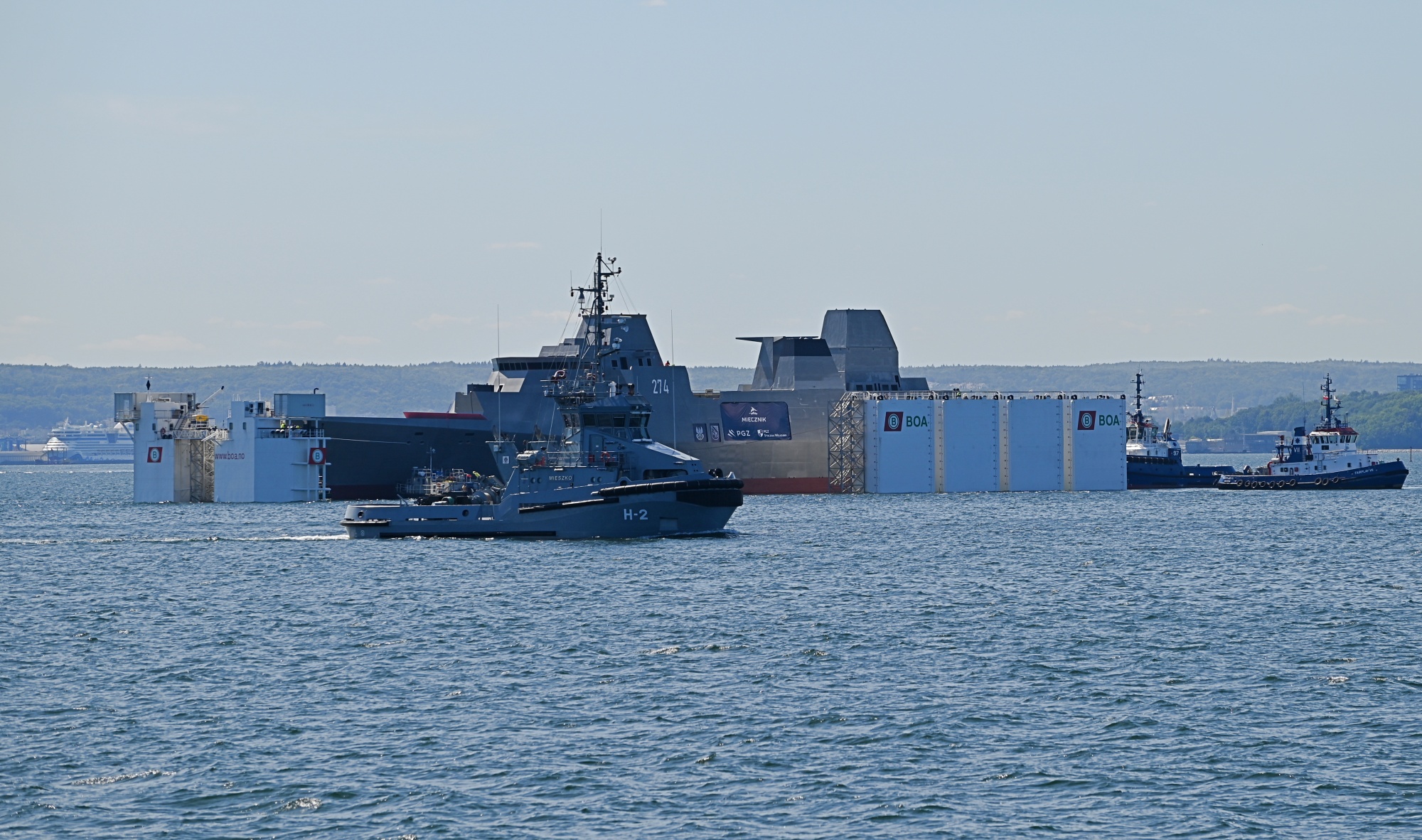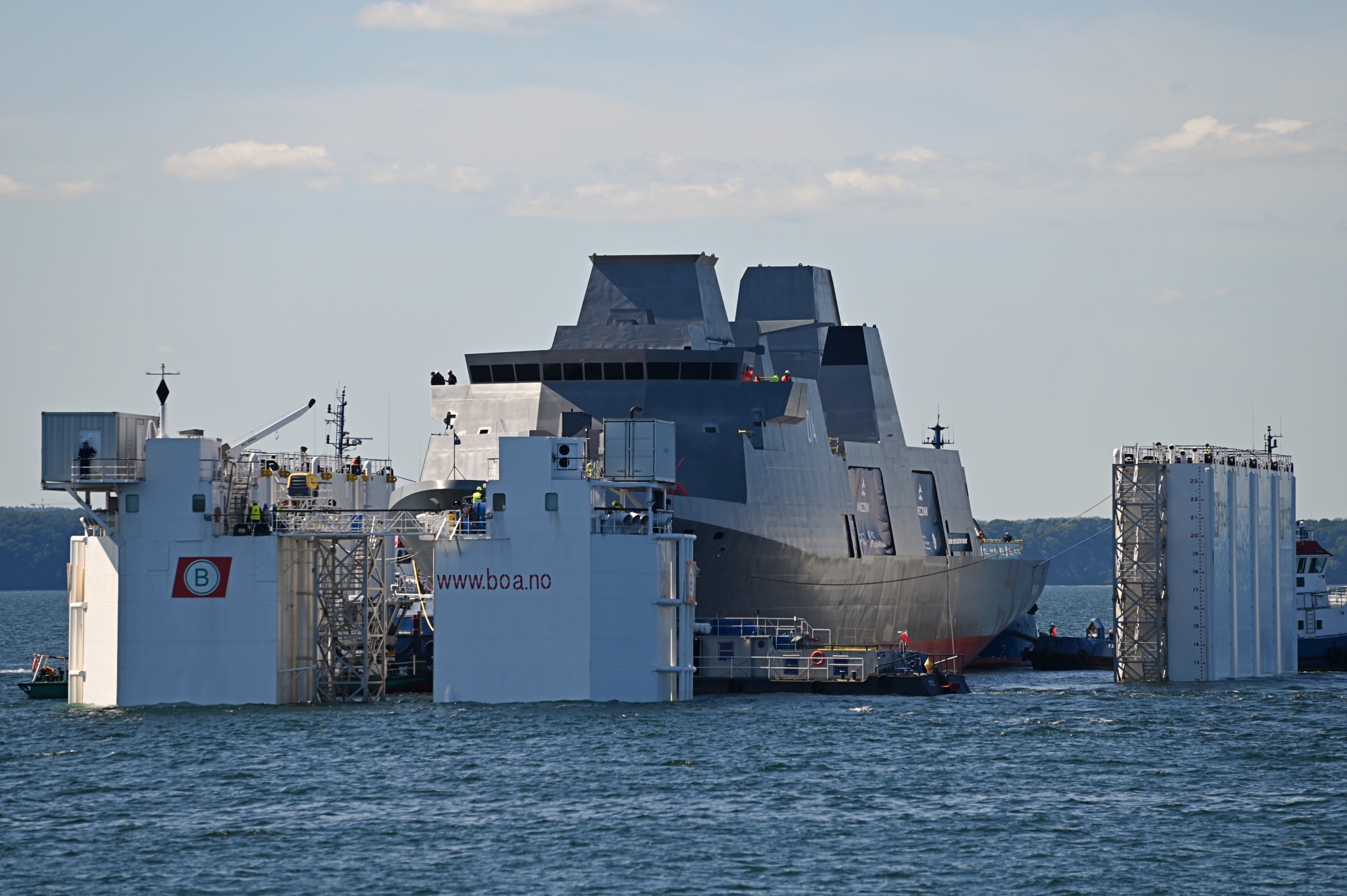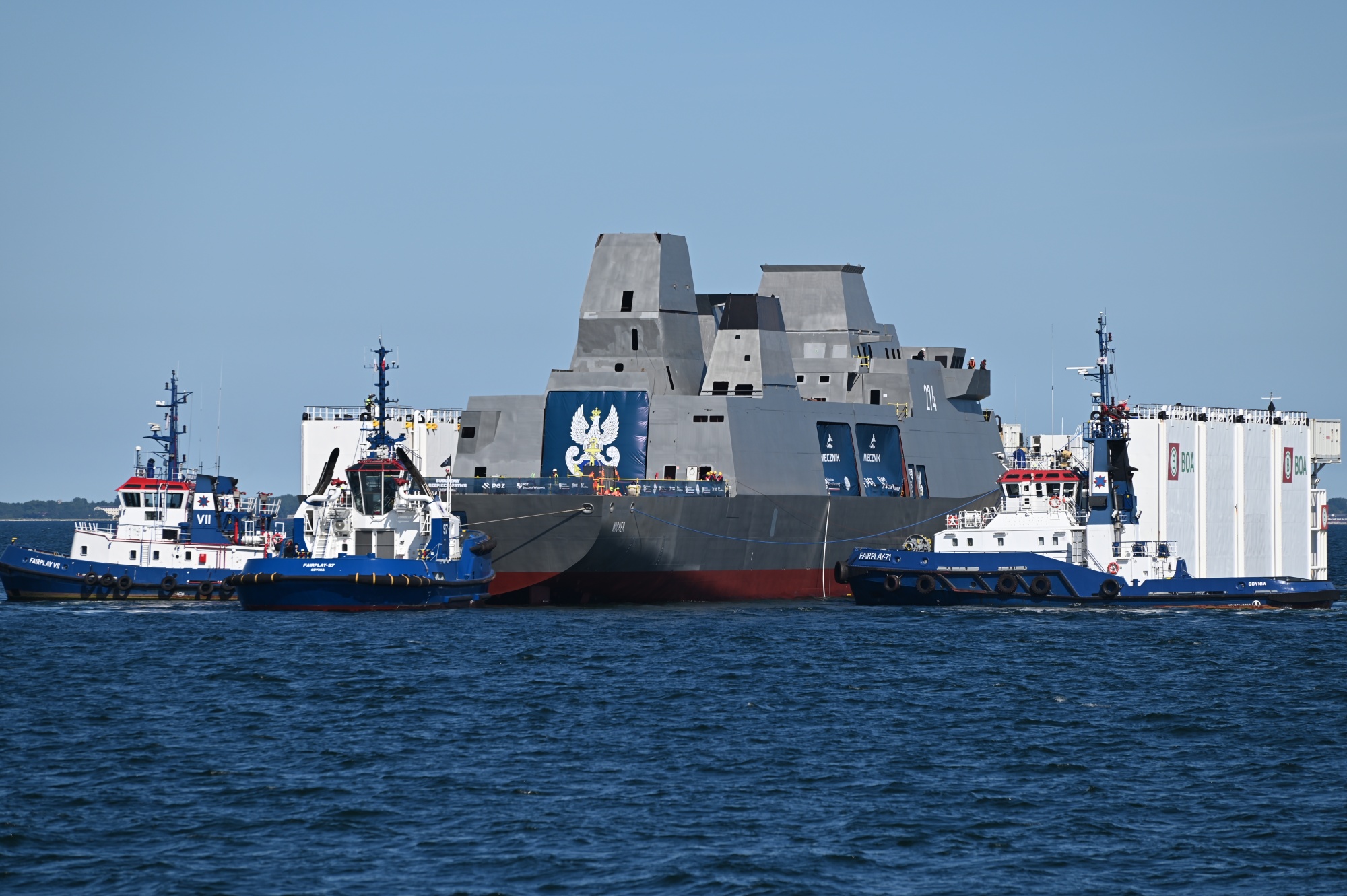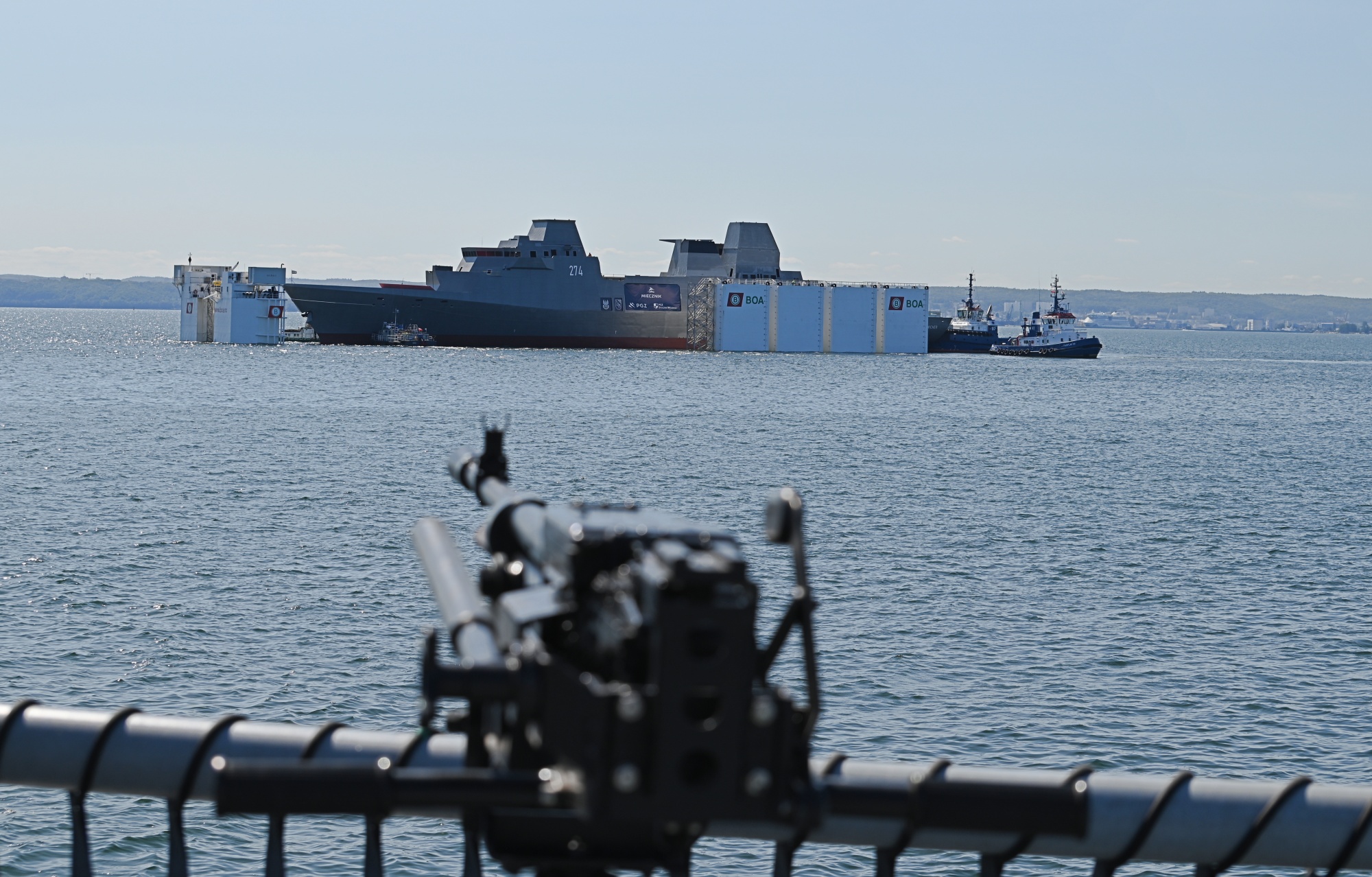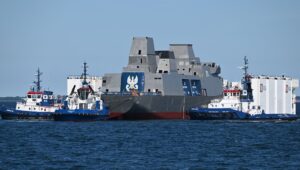





















The launch did not take the traditional form of sliding the hull down a slipway. Instead, the barge was gradually submerged until Wicher became fully buoyant and could be moved away by tugboats (Future Polish Navy frigate ORP Wicher rolled out ahead of launch).
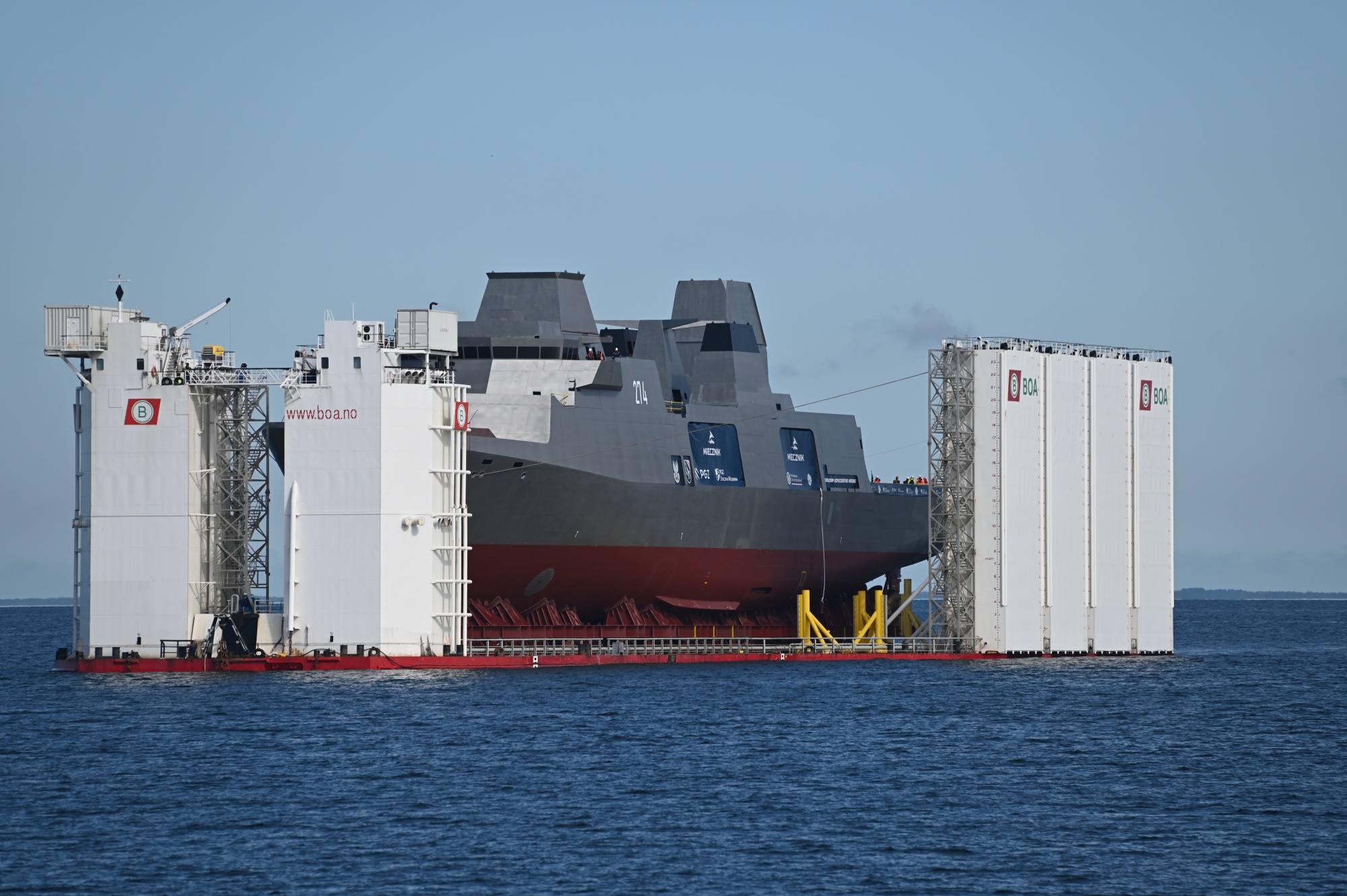
Due to the size of the frigate Wicher, PGZ Stocznia Wojenna opted for an unusual launch procedure based on gradually submerging the vessel / Photo: Jakub Link-Lenczowski, MILMAG
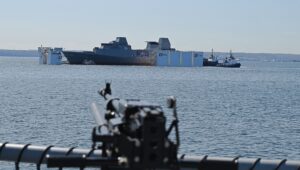
Boabarge 33 left Gdynia at around 5:00 a.m. and was towed to an area with sufficient water depth to allow the transport barge to be safely submerged. Controlled ballasting then began. As the barge’s deck was lowered, Wicher’s hull was gradually immersed until the frigate floated clear of its transport supports. The entire process, which lasted around five hours, was divided into four stages. After each stage, PGZ Stocznia Wojenna personnel aboard the barge checked the hull for watertight integrity.
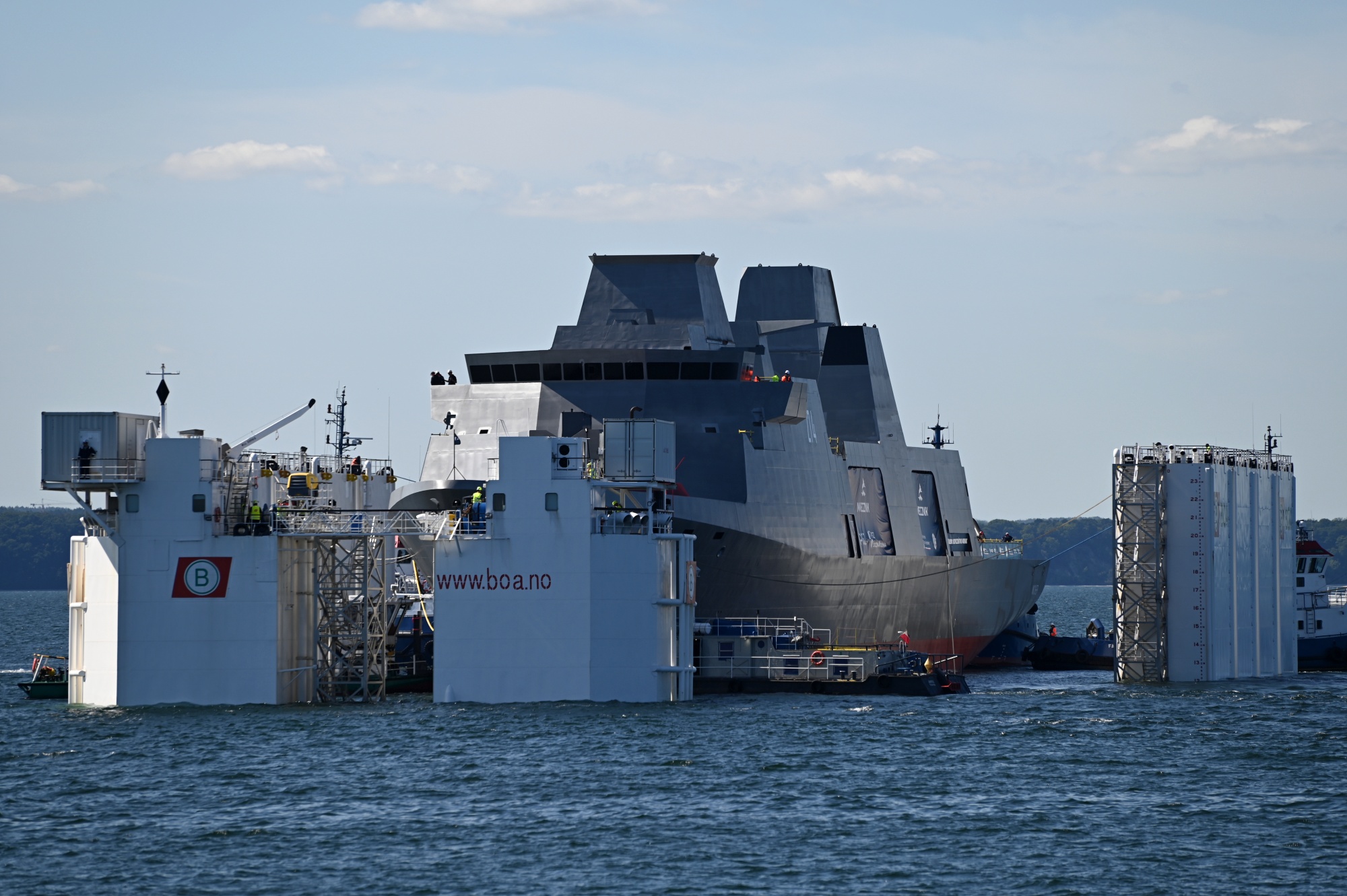
Wicher during the submerging and ballasting operation / Photo: Jakub Link-Lenczowski, MILMAG
After the operation was completed, the ship was taken under tow and returned to PGZ Stocznia Wojenna, where outfitting, systems integration, and preparations for harbour and sea trials will continue. The entire operation was observed from the deck of ORP Kościuszko by a MILMAG representative.
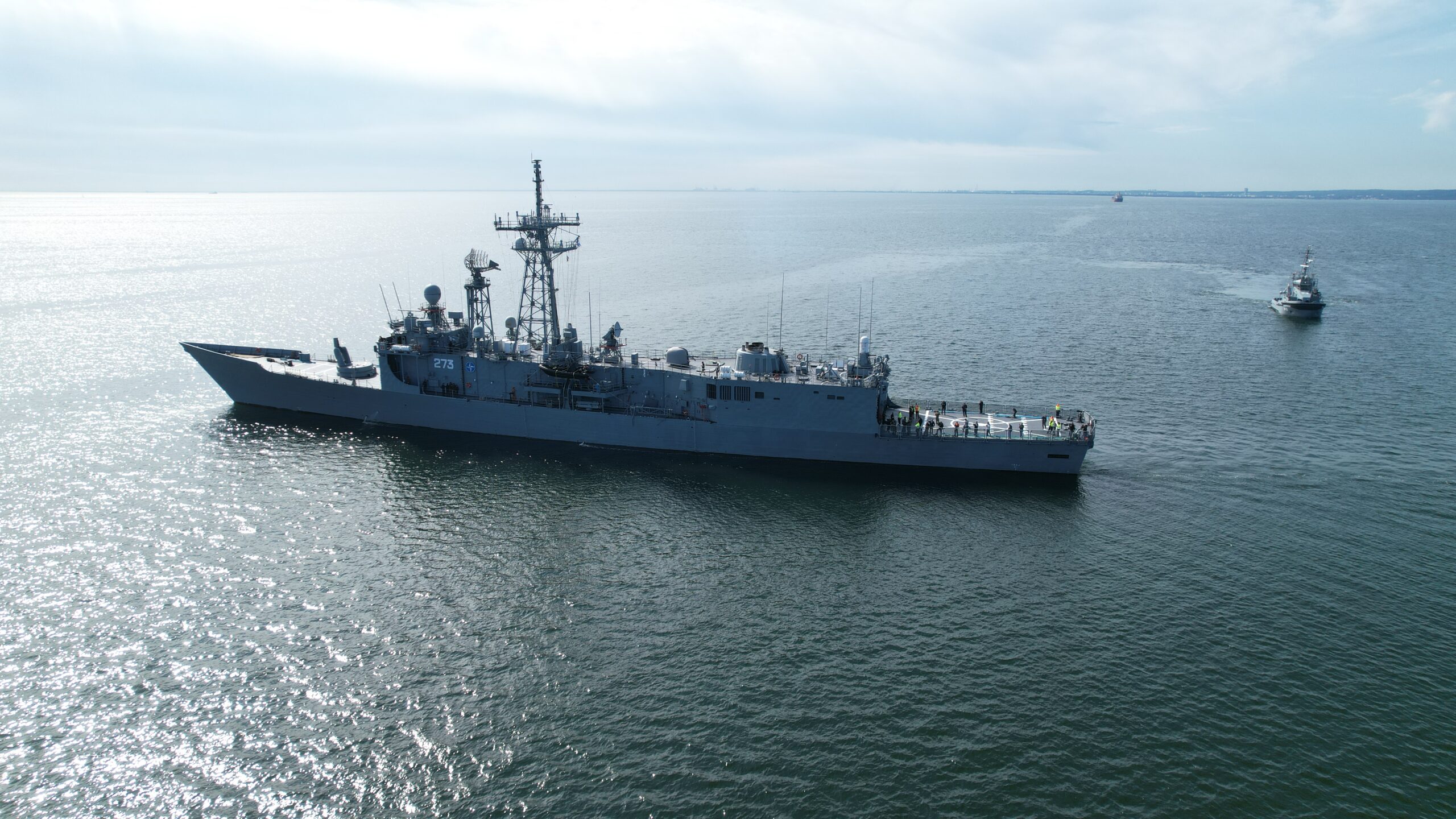
The launch operation was supported by the frigate ORP Tadeusz Kościuszko and the Polish Navy tug H2 Mieszko / Photo: Jakub Link-Lenczowski, MILMAG
The launch itself marked the completion of one of the most important stages in the construction of the first Miecznik frigate. From this point onward, further work will be carried out alongside the quay and in dry dock. This will include the installation and integration of equipment that could not be fitted earlier inside the assembly hall, as well as the commissioning of additional onboard systems. According to the current schedule, Wicher’s harbor trials are expected to begin in the fall of 2028, followed by sea trials in 2029. Delivery of the frigate to the Polish Navy is planned by the end of 2029.
The launch was preceded by two major events. On August 9, Wicher was rolled out of the hull integration hall at PGZ Stocznia Wojenna. The ship was transported onto Boabarge 33 using 278 self-propelled modular transporters (SPMTs). Three days later, on August 12, the vessel was formally christened and officially named Wicher, in reference to the prewar Polish destroyer ORP Wicher (Christening of Wicher, Poland’s first Project 106 Miecznik frigate).
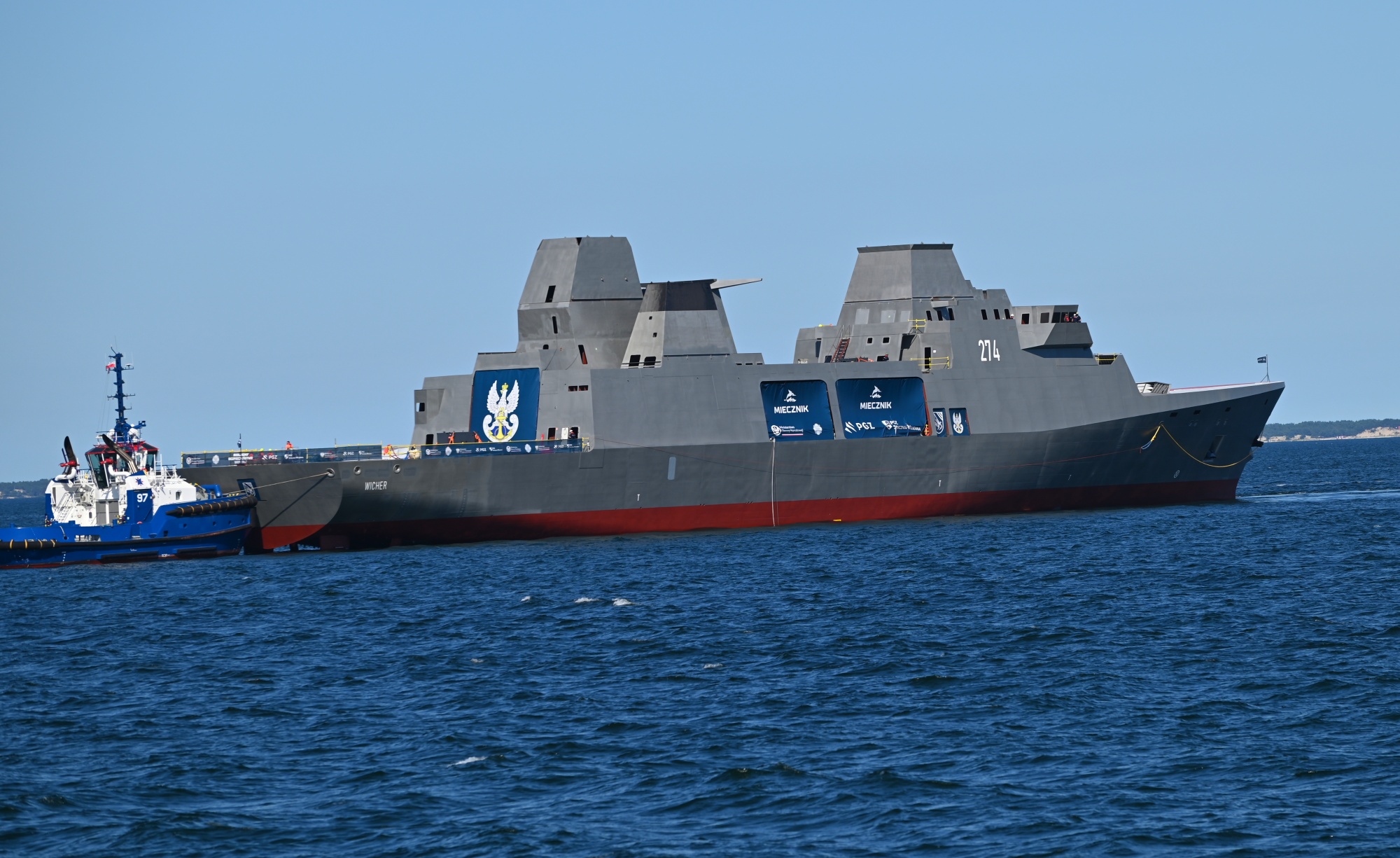
The future ORP Wicher afloat under its own buoyancy in the Gulf of Gdańsk / Photo: Jakub Link-Lenczowski, MILMAG
The frigate is based on the Arrowhead 140 design developed by the British group Babcock International, itself derived from the Danish Iver Huitfeldt-class frigates and also serving as the basis for the Royal Navy’s Type 31 ships. The Polish configuration, however, has been significantly modified and tailored to the requirements of the Polish Navy. The ship is to receive the Thales TACTICOS combat management system, Sea Master 410 and NS58 radars, the Rohde & Schwarz KORA electronic warfare system, as well as Blue Hunter and CAPTAS-2 sonars. Its armament will include, among other systems, a 32-cell Mk 41 Strike vertical launch system, CAMM-family surface-to-air missiles, NSM anti-ship missiles, a Leonardo 76/62 Super Rapid Strales gun, OSU-35K weapon systems, and lightweight torpedo launchers (Rohde & Schwarz cooperation with ELT Group in the Miecznik and F124 programs).
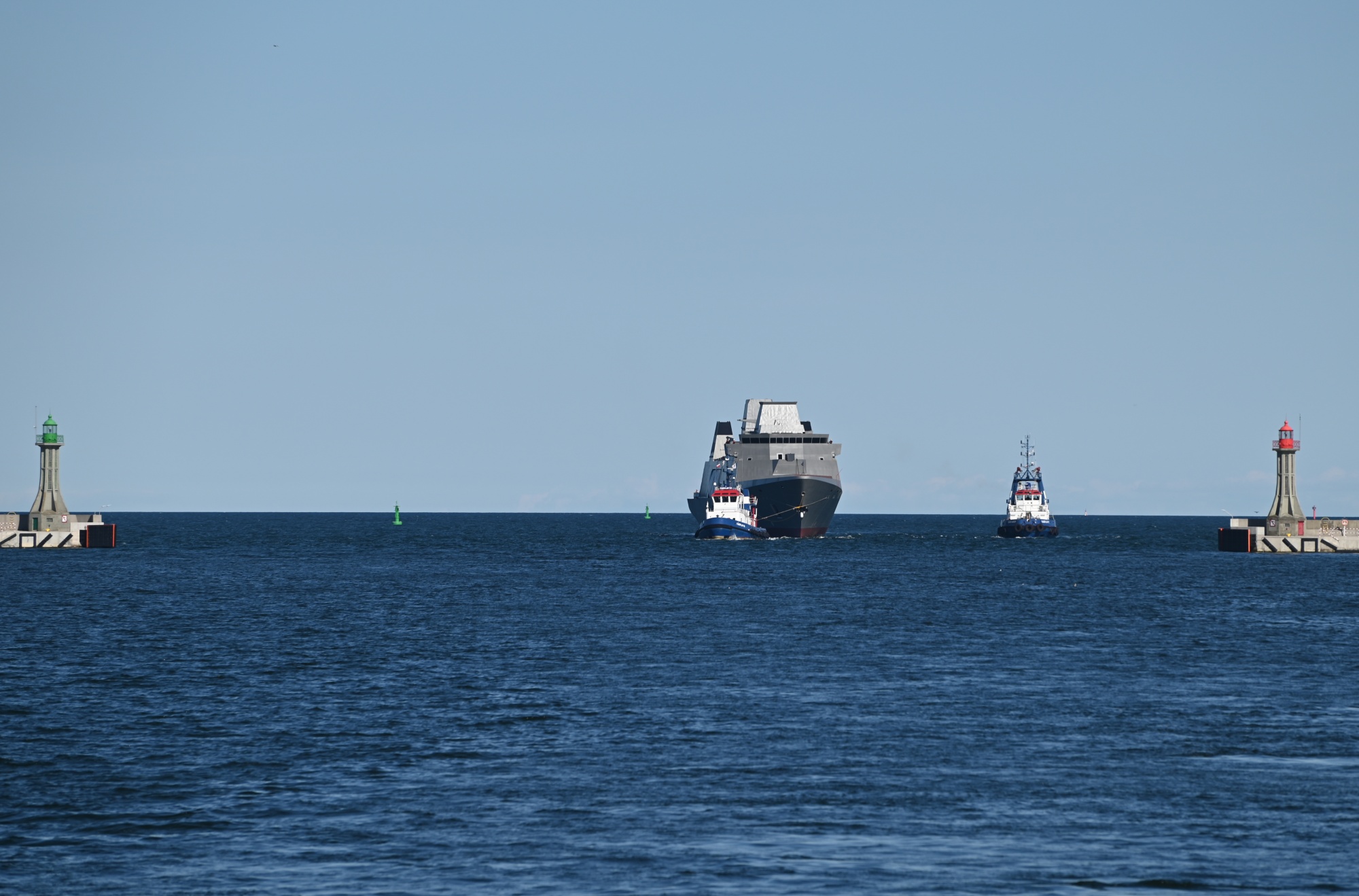
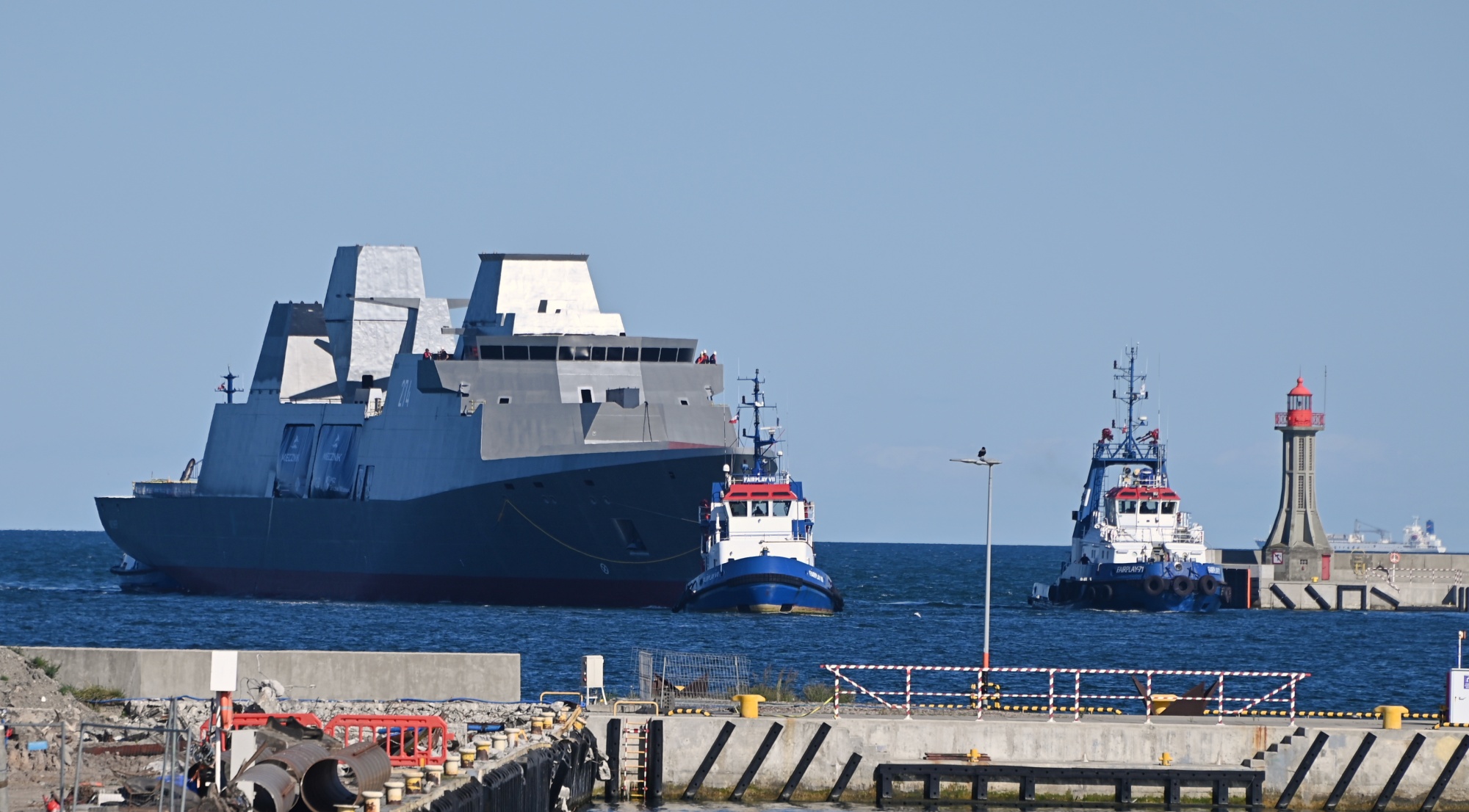
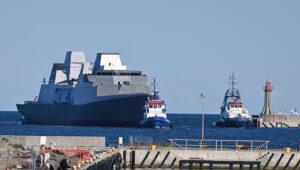
The first Miecznik frigate, the future ORP Wicher, being guided by tugboats into the Port of Gdynia, where it moored at the PGZ Naval Shipyard quay / Photo: Jakub Link-Lenczowski
The Miecznik program was formally launched in July 2021 with the signing of a contract for three frigates. During the initial stage, the Arrowhead 140PL, F-100PL, and MEKO A-300PL designs were considered. In 2022, the Arrowhead 140 was selected as the basis for the new Polish ships. Construction of Wicher began with the first steel cutting on August 16, 2023, followed by keel laying on January 31, 2024. Two additional frigates, Burza and Huragan, are being built in parallel. Burza is already at an advanced stage of construction following keel laying in December 2025, while construction of Huragan began in April 2026. In the coming years, all three ships are intended to form the core of the Polish Navy’s new surface combat force (MSPO 2024: Progress of the Miecznik Program).
The author would like to thank PGZ Stocznia Wojenna, the Polish Navy, and Gdynia-Kosakowo Airfield Control, whose support and cooperation made this material possible.