





























On Thursday, 11 December 2025, the German company Hensoldt, together with Lufthansa Technik Defense and Bombardier Defense, announced that the first PEGASUS (PErsistent German Airborne SUrveillance System) electronic reconnaissance aircraft for the German Navy’s aviation branch (Marineflieger) has already arrived in the country following its maiden flight on 24 October last year and subsequent airframe testing in the United States.
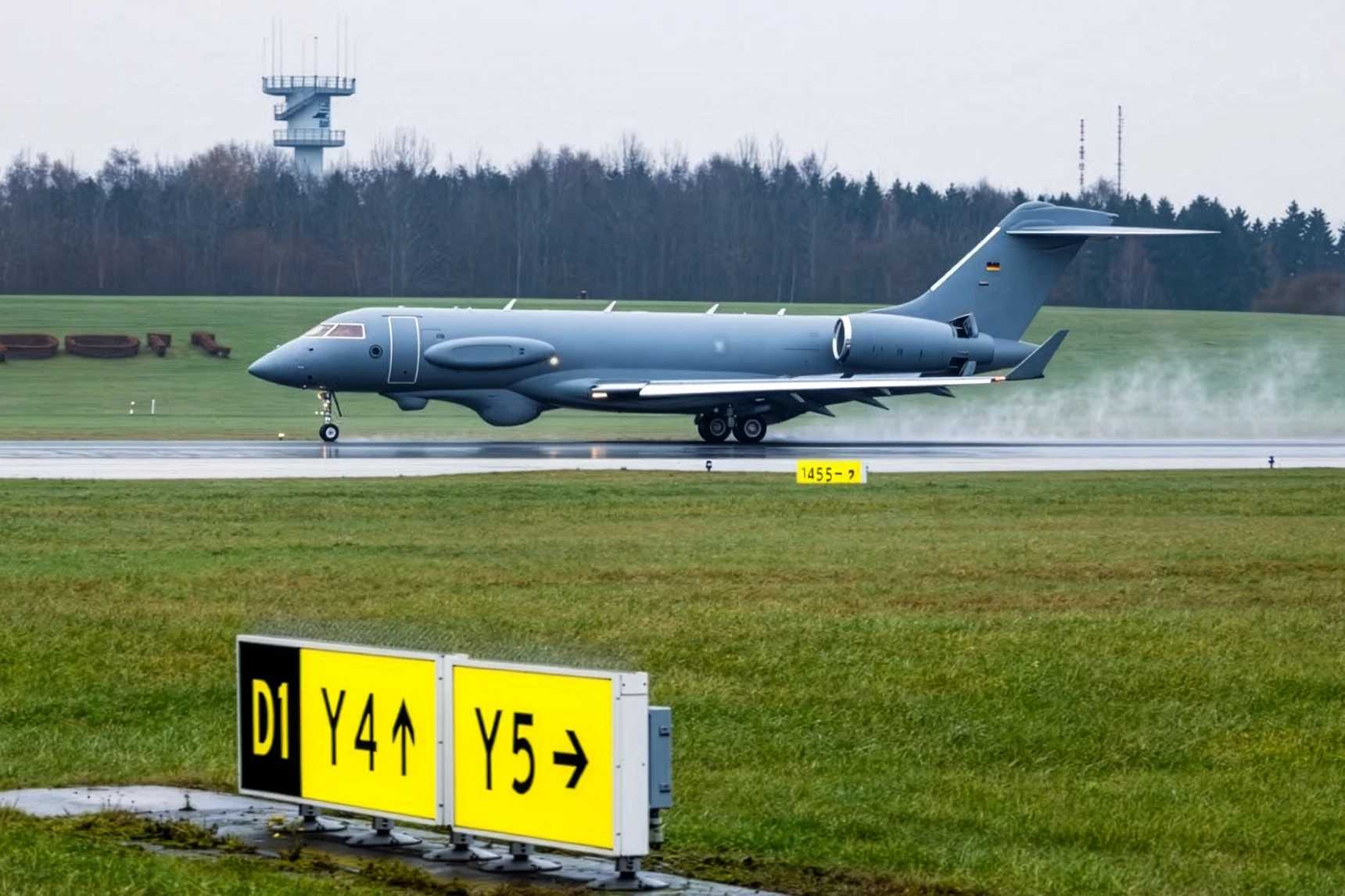 Photo: Hensoldt
The transatlantic flight took place last week from Bombardier’s facilities in Wichita, Kansas, as the platform is based on the Bombardier Global 6000 airframe. The aircraft arrived at Lufthansa Technik’s headquarters in Hamburg, where another important phase of the program will begin.
This is the first of three aircraft ordered on 20 June 2021 by the Bundeswehr’s Federal Office of Equipment, Information Technology and In-Service Support (BAAINBw – Bundesamt für Ausrüstung, Informationstechnik und Nutzung der Bundeswehr). It was presented publicly for the first time on 5 June 2024.
The PEGASUS program, valued at over EUR 1 billion, предусматривает the introduction of an airborne electromagnetic signals intelligence (ELINT) system into the inventory of the German Navy’s aviation arm. The prime contractor and systems integrator, as well as the supplier of the reconnaissance system suites, is Hensoldt. Its partners are Lufthansa Technik Defense of Hamburg, where final assembly will take place, and the U.S.-based Bombardier Defense of Wichita, Kansas (a division of Canada’s Bombardier Aviation), which supplies the airframes. In total, nearly 30 German entities are involved in the program, including companies from the SME sector.
“This delivery marks a decisive step towards operational capability,” said Jürgen Halder, Vice President Airborne SIGINT at HENSOLDT. “With the arrival of the first aircraft in Hamburg, we are entering the crucial phase of system integration and qualification. Together with our partners, we are now moving from design and test into full implementation – bringing the next generation of airborne intelligence to life.”
At Lufthansa Technik in Hamburg, the next steps will include integration of the SIGINT system based on Hensoldt’s Kalaetron Integral suite (developed from the air-tested ISIS system, jointly created with EADS, now Airbus Defence and Space, for the cancelled RQ-4E Euro Hawk unmanned aircraft), installation of the mission cabin, and integration of additional military and communications systems. The company will also be responsible for both civil and military certification of the aircraft. In parallel, preparations for entry-into-service support are already underway—including training of technical and flight personnel, as well as the development and delivery of technical documentation—to ensure a smooth transition to operational use.
“Bombardier’s high-performing Global aircraft are the go-to choice for the most demanding government missions around the world,” said Steve Patrick, Vice President, Bombardier Defense. “We are proud to collaborate with HENSOLDT and Lufthansa Technik to help bring this next-generation signals intelligence aircraft to the German Armed Forces.”
“Seeing the PEGASUS aircraft returning to Hamburg for their important next chapter is a proud moment for our teams,” said Michael von Puttkamer, Vice President Special Aircraft Services at Lufthansa Technik. “This milestone marks the start of an exciting new phase in which we will bring together technology, craftsmanship, and special mission aircraft expertise to deliver one of the most advanced airborne intelligence platforms ever built.”
Originally, the PEGASUS system was scheduled to enter service in 2025, with initial operational capability planned for 2027. The three electromagnetic signals intelligence aircraft will assume the missions previously carried out by five Breguet BR.1150M Atlantic aircraft withdrawn from service in 2010, as part of the SLWÜA mission (Signalerfassende Luftgestützte Weiträumige Überwachung und Aufklärung; airborne wide-area electronic signal collection, surveillance, and reconnaissance). Despite their formal assignment to the German Navy, the new aircraft will be based at Schleswig Air Base, home to the Luftwaffe’s 51st Tactical Air Wing.
They will be complemented by eight Boeing P-8A Poseidon maritime patrol and anti-submarine warfare aircraft, the first of which arrived in Germany on 7 November this year.
1st #PEGASUS aircraft has landed in Germany! #SIGINT #detectandprotect pic.twitter.com/r3pggPHKdz
— HENSOLDT (@hensoldt) December 11, 2025
A major milestone has been reached by @hensoldt, @LHTechnik Defense and @Bombardier Defense in the #PEGASUS (Persistent German Airborne Surveillance System) programme, as the very first PEGASUS #aircraft successfully landed in Germany: https://t.co/xjljljeZ0g #HENSOLDT #PEGASUS pic.twitter.com/3T9QJF7xDA
— HENSOLDT (@hensoldt) December 11, 2025
