
















At the Farnborough International Airshow 2026 in the United Kingdom, held from July 20 to 24, Leonardo UK, part of Italy’s Leonardo group, unveiled the Proteus unmanned helicopter technology demonstrator built for the Royal Navy.
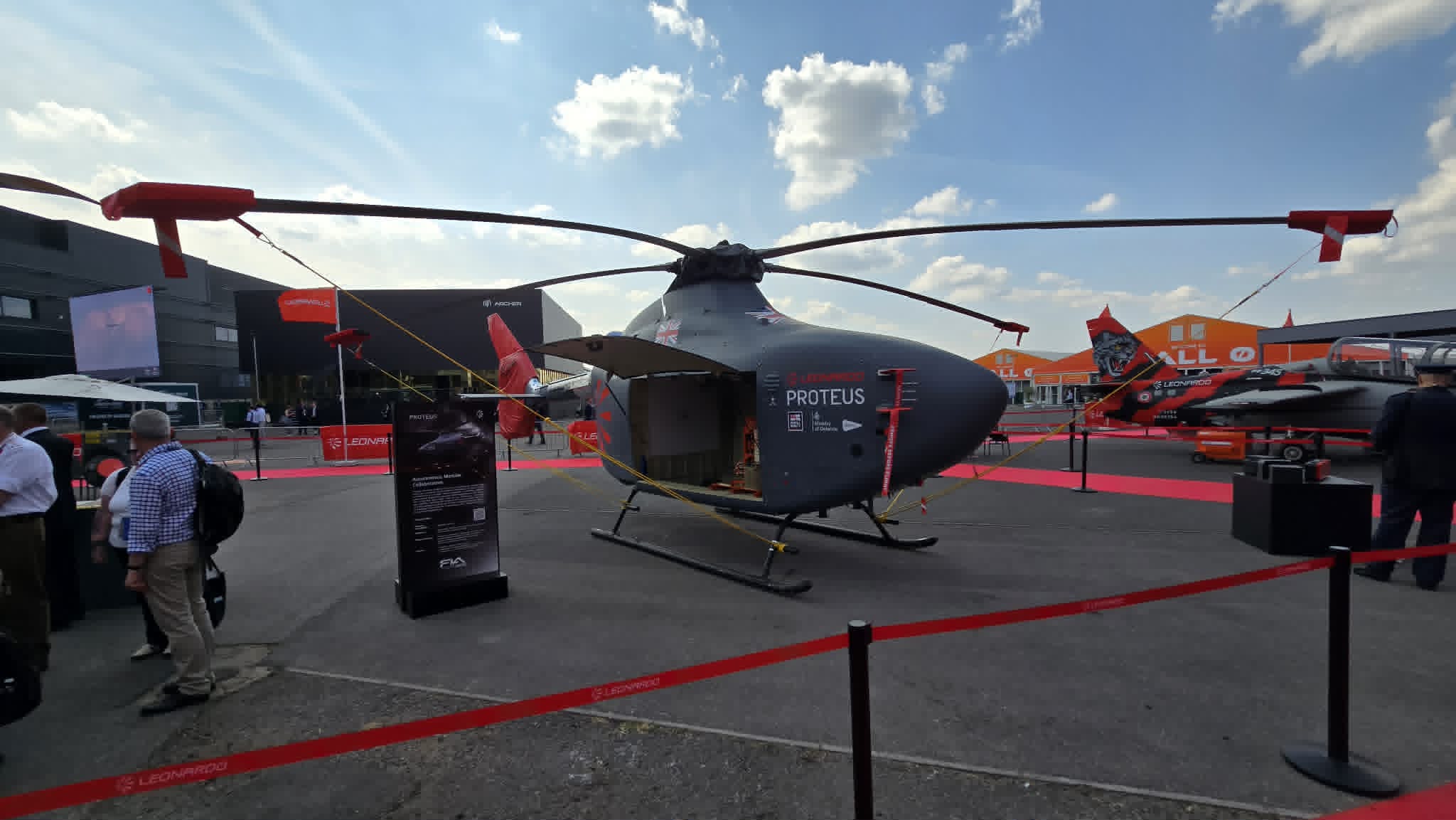 Photo: Jakub Link-Lenczowski, MILMAG
The Proteus project was unveiled on January 7, 2025. It was developed in cooperation with the Future Capability Innovation team of Defence Equipment & Support, the procurement and support agency of the UK Ministry of Defence, and the Royal Navy. A contract worth 71 million GBP was awarded in June 2022 for the development of the helicopter, with the technology demonstrator’s first flight originally planned for mid-2025.
The aircraft ultimately made its maiden flight on January 16 this year, following comprehensive ground testing at Predannack Airfield near Mullion on Cornwall’s Lizard Peninsula.
The approximately three-tonne unmanned helicopter, with a payload capacity of one tonne, can carry various types of equipment thanks to its innovative modular payload bay. It incorporates more than 40 components made from advanced composite materials. It is designed to operate in the maritime environment and in demanding weather conditions, including high sea states and strong winds.
Proteus was designed to perform a range of missions, including supporting anti-submarine warfare operations, maritime patrol, and the use of information supplied by a network of allied ships, helicopters, submarines, and systems tasked with detecting hostile underwater vessels. Its development program supports the Maritime Aviation Transformation strategy, which covers the evolution of Royal Navy maritime aviation through 2040, including in the area of anti-submarine warfare capabilities.
The project demonstrates the feasibility of large uncrewed maritime aircraft operating in the naval environment and will serve as a testbed for the development and demonstration of autonomous capabilities. These include flight-control algorithms for large autonomous vertical takeoff and landing aircraft.
Proteus is distinctive because of its modular payload bay, designed to provide flexibility across different missions, including the ability to exchange an auxiliary fuel tank for a mission payload. The rapid integration of mission-specific payloads is intended to provide a broad range of options from a single aircraft type. This is both operationally useful and cost-effective, avoiding the need to procure and maintain several different aircraft fleets.
Proteus was built at Leonardo UK’s Yeovil facility, where 23 AgustaWestland AW149 medium multirole helicopters will also be produced under the New Medium Helicopter program.
In the current international context, multi-role ships are becoming increasingly strategic platforms due to their ability to operate in different domains, integrating surveillance, defence, and operational command capabilities. #Leonardo is contributing to their effectiveness… pic.twitter.com/qBHdGx15NG
— Leonardo (@Leonardo_live) July 22, 2026
Autonomy is shaping the future of rotary wing aviation.
At the @FIAFarnborough Airshow, we spoke with Mike Roberts, Product Marketing Specialist at @LDO_Helicopters UK, about #Proteus.
Proteus is a technology demonstrator advancing autonomous rotary wing capability for the UK.… pic.twitter.com/VAjDxhmrQA
— Leonardo (@Leonardo_live) July 24, 2026