



























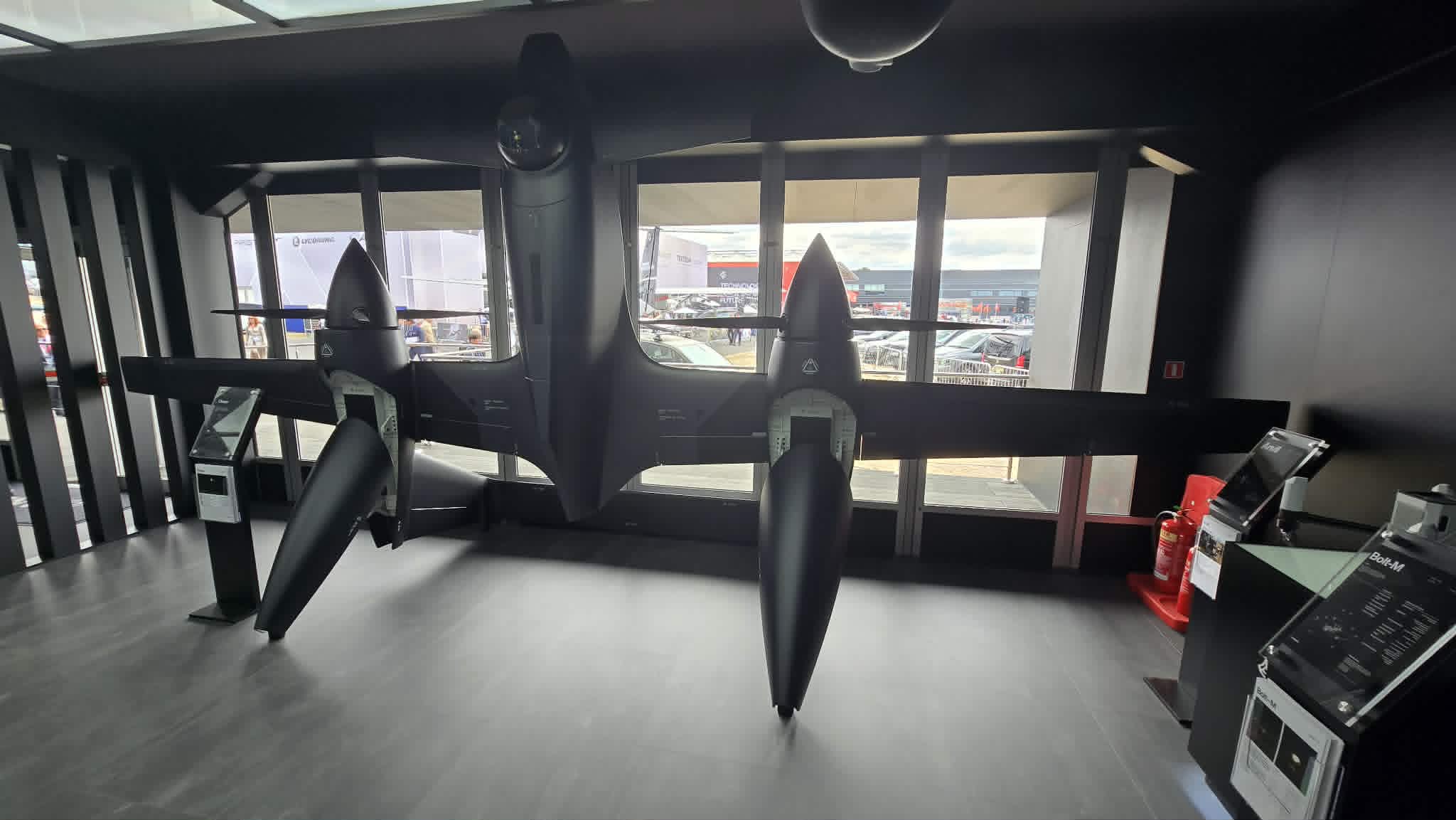
U.S. company Anduril Industries showcased the Omen hybrid vertical takeoff and landing (VTOL) unmanned aircraft at the Farnborough International Airshow 2026, held in the United Kingdom from July 20 to 24.
 Photos: Jakub Link-Lenczowski, MILMAG
The company began developing the autonomous Omen platform in cooperation with the United Arab Emirates’ industrial group EDGE in 2019. Just one year later, it flew the first subscale technology demonstrator, and according to information released in November 2025, more than 30 prototypes had been built for flight testing.
EDGE and Anduril Industries established a joint venture in the UAE called the EDGE-Anduril Production Alliance. Omen will be manufactured there, while the UAE has ordered the first 50 aircraft. Serial production is scheduled to begin in late 2028. EDGE is investing approximately 200 million USD in the project.
Omen is classified as a Group 3 unmanned aircraft, with a maximum takeoff weight not exceeding 600 kg, or 1,320 lb. It stands approximately 3 m tall in its takeoff configuration. Its exact tactical and technical specifications have not been disclosed, but its range is estimated at thousands of nautical miles. It is expected to carry several payloads with a combined weight of hundreds of pounds. These figures are several times greater than the capabilities of comparable Group 3 unmanned aircraft.
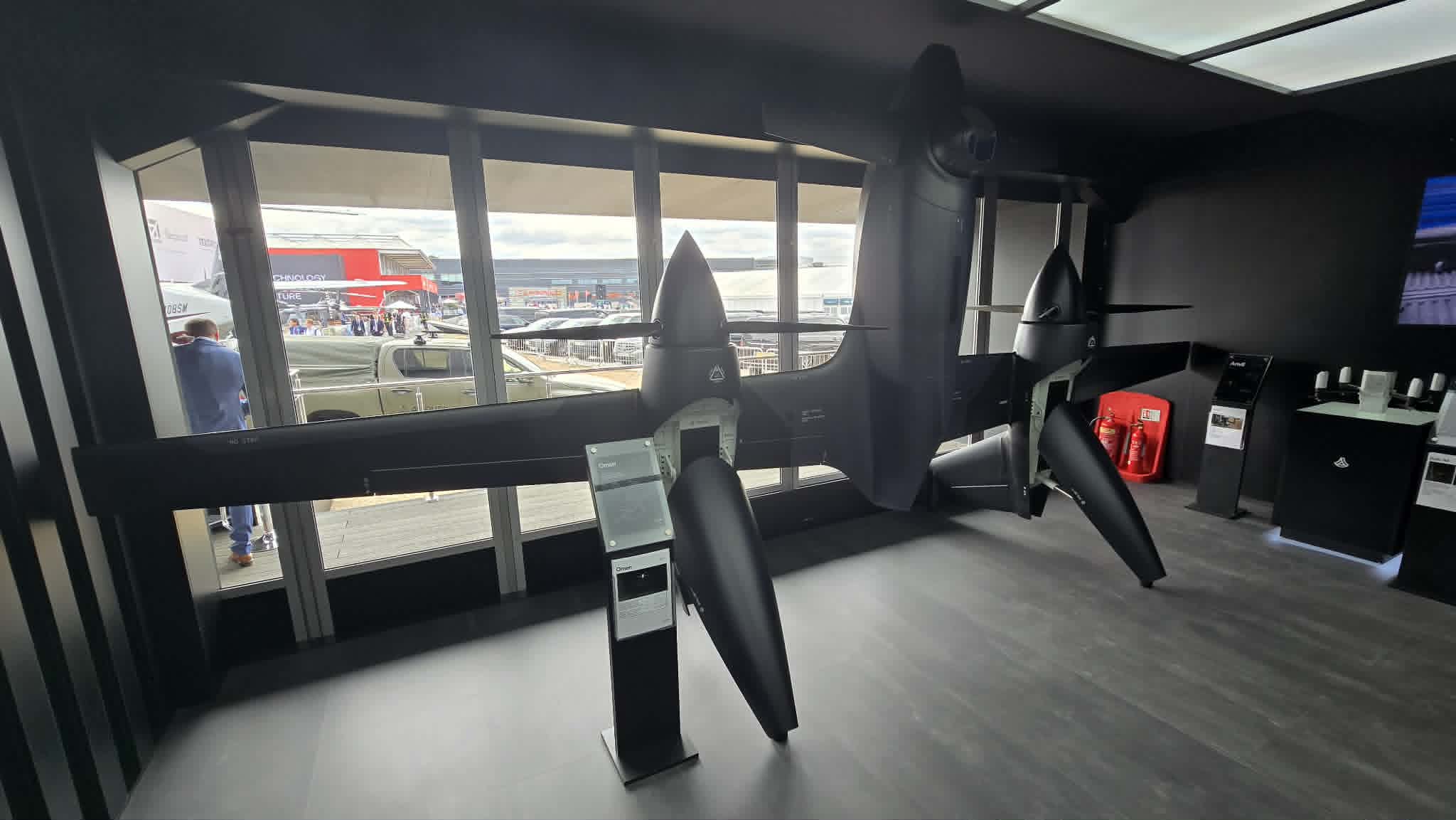
For transport, the unmanned aircraft can be folded to less than half its operational size. Two people can assemble or disassemble it within minutes, resulting in low logistical requirements. It can be transported in a standard ISO container or in the cargo hold of a V-22 Osprey tiltrotor aircraft. Its hybrid propulsion system comprises electric motors for flight and an Archer Midnight generator for recharging the batteries and enabling long-endurance operations.
The aircraft is controlled by Anduril’s Lattice mesh-networking, communications, and data-transfer software, which is designed to operate in GPS/GNSS-denied and electromagnetically contested environments. The aircraft can take off from and land on confined areas, including ship decks. Its modular design enables rapid payload changes, including electro-optical/infrared sensors, synthetic aperture radar, signals intelligence sensors, communications relay equipment, sonobuoys, and potentially smaller drones.
Omen is not just a concept.
Anduril started building Omen in 2019, flew the first Omen demonstrators in 2020, and has logged hundreds of flight hours across 30+ prototypes.
Today, Omen is the first tail-sitter airplane with a mass-production contract. pic.twitter.com/QmzlALpbBY
— Anduril Industries (@anduriltech) November 14, 2025
Early Omen transition testing didn’t always go to plan when we relied on COTS autopilots. In this incident, the software flipped from ‘hover mode’ to ‘airplane mode’ before the vehicle was fast enough to cruise like one – compounded by a propulsion/rotor droop that kicked off the… https://t.co/AscxYphcH9 pic.twitter.com/H0BHxLexiA
— Anduril Industries (@anduriltech) November 14, 2025