














UCCA Valkyrie and Ravenstorm
Another unmanned program whose progress was discussed by Jean-Brice Dumont was the Uncrewed Collaborative Combat Aircraft (UCCA). Under this program, Airbus Defence and Space is developing autonomous systems designed to support Eurofighter operations and multiply their combat capabilities. They are intended to provide a scalable increase in the number of combat aircraft, improve the survivability of pilots flying crewed platforms, and provide greater flexibility to enhance mission effectiveness.

UCCA U740 Valkyrie based on a Kratos unmanned aircraft
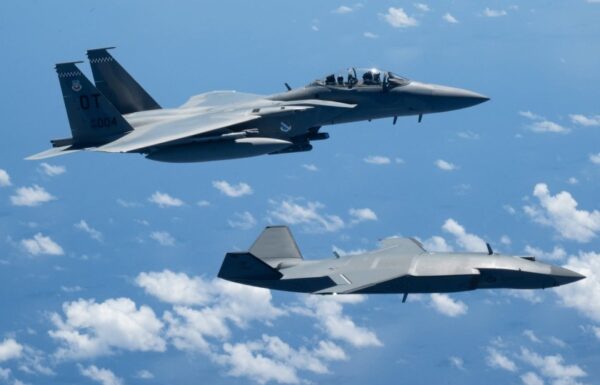
One of the unmanned aircraft intended to operate alongside Eurofighters is the U740 Valkyrie. It is designed as a low-cost solution based on technologies developed in the United States. The Valkyrie will cooperate with Eurofighters using Airbus’s Multiplatform Autonomous Reconfigurable and Secure mission system.
The Valkyrie is expected to have a range of 5,400 km. It will reach a maximum speed of Mach 0.85 and cruise at Mach 0.72. Its maximum takeoff weight will be 2.7 tonnes, including a 0.6-tonne internal payload. The system is being developed for the German Air Force, which is expected to receive its first Valkyrie aircraft in 2029.
Another solution being developed under the UCCA program is the U760 Ravenstorm, an unmanned aircraft intended to provide Europe with an independent capability in the field of collaborative combat aircraft operating alongside crewed platforms. The aircraft will also be managed using Airbus’s MARS system. Ravenstorm is expected to have a range of more than 900 km. It will operate at transonic speeds and, with a maximum takeoff weight of 6 tonnes, will carry an internal payload of more than 0.5 tonnes.

UCCA U760 Ravenstorm
Ravenstorm will operate alongside Eurofighters in air combat, ground-attack, and electronic warfare missions. The first production aircraft are expected to be ready in 2032.
Counterdrone Bird of Prey
The U680 Bird of Prey counter-unmanned aircraft system was also presented. It is designed to employ low-cost, reusable interceptor drones to repel mass attacks by loitering munitions. Classified as a medium-range system, it is intended to counter unmanned aircraft weighing between 150 and 600 kg and operating at altitudes of up to approximately 5,000 m.
The system is based on the repeated use of interceptor drones, reducing engagement costs compared with systems employing expendable interceptors. In addition, mass production of the interceptor aircraft and effectors is expected to lower unit costs.

Missile launch during trials of the U680 Bird of Prey unmanned aircraft
To improve effectiveness, autonomy, and safety, the system will be supported by artificial intelligence. The interceptor drones will operate fully autonomously, independently detecting, tracking, and neutralizing targets. The system can also incorporate a human into the decision-making loop to authorize the interception and destruction of a hostile unmanned aircraft. Bird of Prey can be readily integrated with NATO air-defense systems.
What’s new with Eurodrone?
During the press conference, Jean-Brice Dumont also discussed progress on the Eurodrone program, which is being jointly pursued by Germany, France, Italy, and Spain. Dumont acknowledged that development had taken a long time, but noted that the program had recently gained fresh momentum. This followed the signing of a memorandum of understanding between Kawasaki Heavy Industries and Airbus Defence and Space to examine potential cooperation on a Japanese variant of the medium-altitude, long-endurance unmanned aircraft adapted for anti-submarine warfare.

Eurodrone, a European MALE-class unmanned aircraft / Photos and illustrations: Airbus Defence and Space
Jean-Brice Dumont was asked why the Eurodrone uses two turboprop engines. According to the Airbus Defence and Space executive, engine failures have been the most common cause of losses among single-engine MALE-class unmanned aircraft. The twin-engine configuration therefore serves as a safety feature. He also stated that, when greater endurance is required during the transit phase to the patrol area, one engine can be shut down to reduce fuel consumption and extend mission duration.