



















 Photos: Jakub Link-Lenczowski, MILMAG
Jakub Link-Lenczowski, MILMAG: On the second day of the Eurosatory exhibition, we’re at the PGZ booth. We’re speaking with the Vice President of the PGZ Management Board, Mr. Jan Grabowski. Mr. President, there’s a lot of your equipment here, including the heavy tracked Borsuk. What’s most important for you during this year’s edition
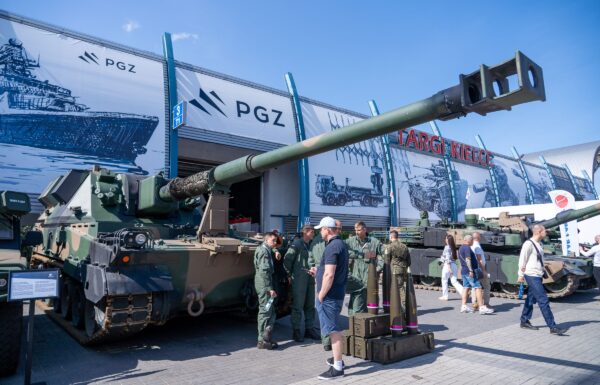
Jan Grabowski, Vice President of the Management Board of Polish Armaments Group: Eurosatory is the largest trade exhibition in our industry in Europe, and Polish Armaments Group, as one of the largest armaments groups in Europe and the largest in Central Europe, couldn’t be absent from the Paris exhibition. During this year’s edition, 11 companies from the PGZ Group are present.
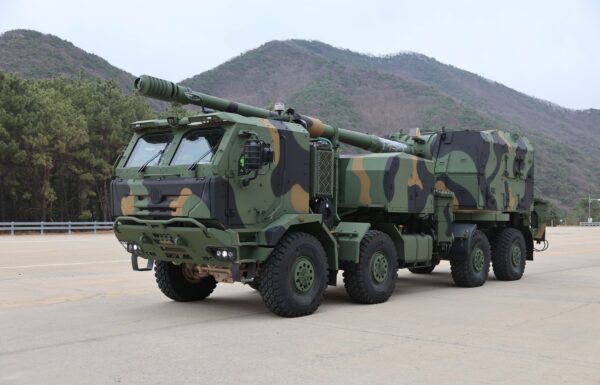
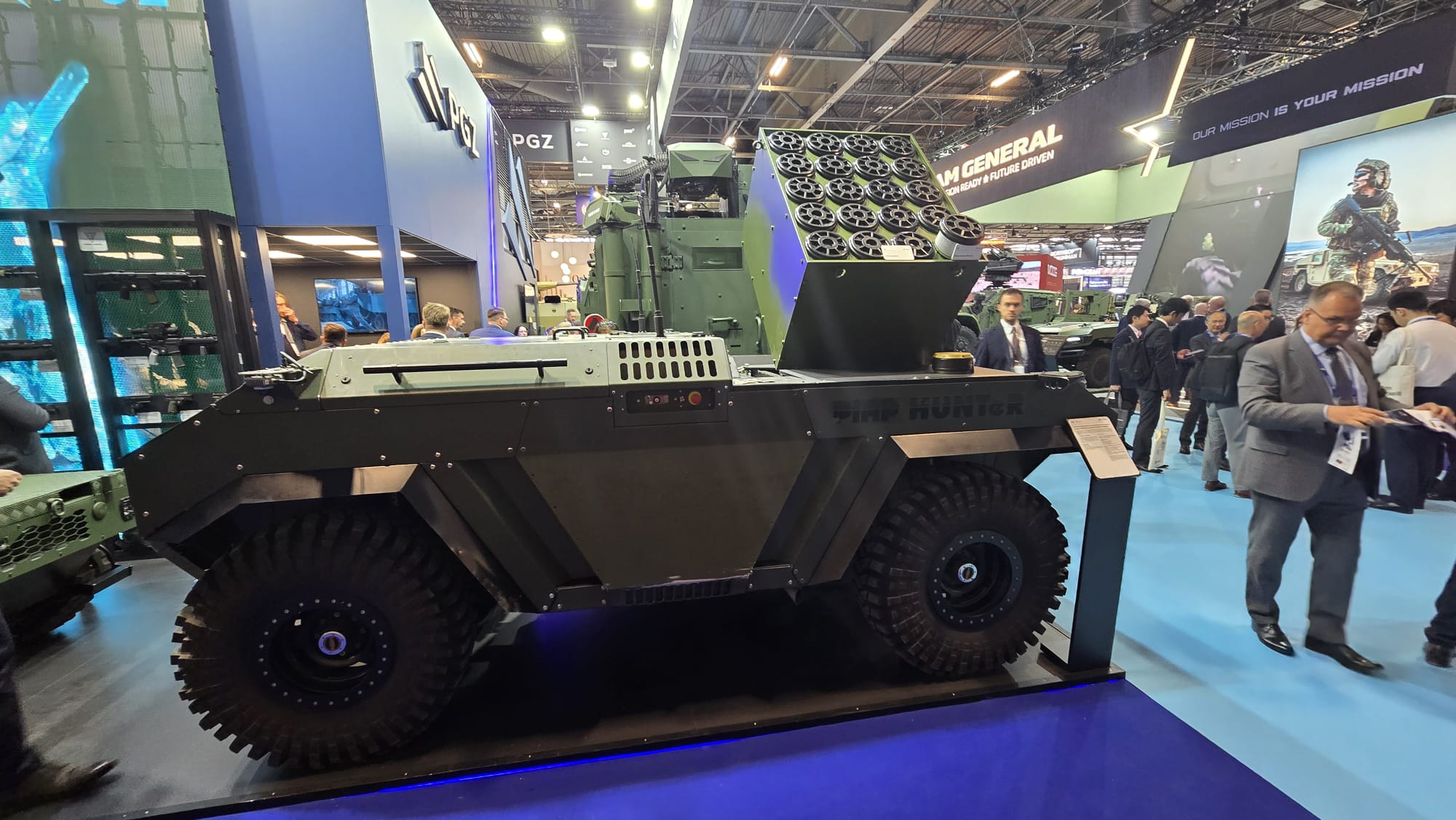
We’re showcasing, among other things, ammunition from Mesko, mines and a scatterable mine-laying system manufactured by Belma, which at Eurosatory is mounted on the Hunter, a Polish unmanned vehicle from PIAP. We’re also exhibiting the UMPG platform, meaning the proven chassis known from the Borsuk, integrated with the Slovak Turra-30 turret. We previously showed this export variant of the Borsuk at the Bratislava exhibition. It’s generating significant interest among visitors here.
This is a strictly export-oriented proposal, which we’re discussing with at least two clients from Europe. We’re also showing the Waran 4×4 here with a 30 mm ZSMU remote-controlled weapon station.
This isn’t a vehicle aimed strictly at the French market or even neighboring markets, but we’re demonstrating what Polish Armaments Group is capable of. And it must be said, we’re experts when it comes to producing armored vehicles, both wheeled and tracked.
The important thing here, however, isn’t so much what we’re exhibiting, but what we’ve brought with us. And we’ve brought good news, because on Monday, June 15, the ceremonial signing of a joint venture agreement between Mesko and Eurenco took place. Eurenco is a major French company, a very important European player in the production of 155 mm ammunition. For the first time in its history, PGZ has signed a production joint venture agreement. So we now have an established company in which PGZ holds 51% of the shares, and the French side holds 49%.
The company has 13 months to build its building infrastructure, and according to the schedule, it will begin operational activity in mid-2027, with production starting at the end of 2027. So this JV will be operational in terms of production in just under 18 months.
It’s worth emphasizing one important thing here. The year 2026 is a special year for the entire sector, because we have a great many orders that are to be financed under the SAFE instrument.

Jakub Link-Lenczowski: You’re in Paris at a time when “the second phase of SAFE is coming into effect,” meaning Common Procurement orders, where partners from at least two countries must be involved. As I understand it, your offer is also designed to encourage partners from France, Germany, and other European countries to act together. What’s most important for you here?
Jan Grabowski: We’re talking not only with France, Germany, or Belgium, but also, for example, with Lithuania. Yesterday we discussed both missile-related topics and mine-related topics with Lithuanian representatives. The SAFE element comes up here as well.
The SAFE instrument is an important element of our European cooperation, because Polish Armaments Group is one of the largest beneficiaries of SAFE in the entire European Union. Actually, it’s not so much Polish Armaments Group as the Republic of Poland, because the Ministry of National Defence, represented by the Armaments Agency, signed agreements worth over 110 billion PLN with Polish Armaments Group in May. These include both new contracts and refinanced contracts, meaning ones we signed earlier that have now gained different financing.
In fact, every branch of the Polish Armed Forces will be able to count on new weaponry that will come from Polish Armaments Group factories and will be financed through the SAFE Instrument. These include topics for the Navy, artillery topics, topics for the Land Forces, as well as new uniforms for the Armed Forces. There’s a great deal of this.
We don’t discuss Common Procurement only at Eurosatory. Earlier we also took part in talks when we accompanied Minister Magdalena Sobkowiak-Czarnecka, Government Plenipotentiary for the SAFE Instrument, and Minister Konrad Gołota, Undersecretary of State at the Ministry of State Assets, during the so-called “SAFE tour” of Europe. This “tour” hasn’t ended yet, so I believe that, together with other companies from the sector, we’ll continue accompanying the ministers in the intergovernmental talks they’ll be conducting.
Jakub Link-Lenczowski: From the perspective of the PGZ Management Board, although of course one can guess this from what’s on display here today in Paris, what are the strategic directions in which the PGZ Group, after analyzing the specifics within SAFE, could be a leading entity?
Jan Grabowski: We’re talking with Bulgaria, Lithuania, Italy, and Greece. As far as the demand from our foreign partners is concerned, it’s genuinely substantial. Industrial cooperation is a challenge, because for many years Polish Armaments Group didn’t really engage in export cooperation with European partners, and certainly didn’t cooperate with them on a partnership basis. We tended to buy ready-made solutions rather than co-develop them together.
Today, June 16, an agreement, a cooperation memorandum, was signed between Mesko and Thales Belgium concerning 70 mm rockets. We also signed agreements before the exhibition, and we’ll be signing further agreements after it. I think the summer-fall period will be important when it comes to cooperation with our partners from the Nordic countries.
Regarding the security mechanism, Sweden is very important here, since Poland is buying submarines from Sweden under the Orka program. This involves three modern vessels, decidedly more advanced than what’s currently in service with the Navy. Production of these vessels will take place in Sweden, but their servicing and maintenance will be on the Polish side. Polish industry is pushing to be responsible for maintaining the submarines throughout their life cycle.
We can’t imagine vessels in service with the Polish Navy being serviced by foreign industry. Within the framework of industry and country cooperation, the Swedish Navy is interested in what we’re building at PGZ Stocznia Wojenna in Gdynia, namely a rescue ship. The rescue ship currently in service with the Swedish Navy is already a fairly aged unit, for which modernization isn’t particularly cost-effective.
We’ve created an offer for FMV, the Swedish counterpart to the Armaments Agency, regarding the outfitting of such a vessel. The Swedish side is also talking with shipyards that aren’t part of the PGZ Group. I’m referring here to Remontowa Shipbuilding, since the minesweepers built in Gdańsk are also of interest to the Swedish side.
Cooperation with the Nordic countries in the maritime domain is very important. We’re cooperating with Norway, for instance, on the Miecznik program, because NSM missiles produced by Kongsberg are and will be part of the equipment on our Polish frigates. Kongsberg is also an important partner for the Polish Armed Forces when it comes to the C-UAS Shield, namely the new San program.

Jakub Link-Lenczowski: Finally, I have one more question. How much can this European presence change the PGZ Group, Polish Armaments Group, over the next 3-4 years? What kind of PGZ, in your view, might we be dealing with during that time?
Jan Grabowski: Polish Armaments Group, this might sound somewhat naive, changes every day. It changes dynamically every day. For years, the bane of the Polish defense industry was the budget of the Ministry of National Defence, drawn up, like the entire state budget, on a 12-month basis. Procurement plans created by the General Staff of the Polish Armed Forces covered a three-year horizon, and today, thanks to the SAFE instrument, we have certainty of orders and a decidedly longer procurement and payment horizon.
Let’s remember that the SAFE instrument covers the period up to December 31, 2030. By that time, products or product components must be delivered, as specified in the agreements. This provides financial security when it comes to contracting.
We’re also changing every day because every day we’re hiring new employees across our Group. Polish arms manufacturing used to be perceived quite differently. When I started working in the Polish defense sector, sixteen years ago, my friends and business partners viewed this line of work with considerable skepticism and asked why I wanted to work in something that was collapsing.
Today the situation is completely different. PGZ is an attractive employer that offers attractive compensation and creates interesting development prospects for new employees. Today we’re doing great things. I’m not afraid to use such words. We’re doing great things, because there has never before been such a serious modernization of the Polish Armed Forces, one in which the Polish defense industry is involved, as there is today. There has never before been such extensive involvement of Polish industry in the modernization of the Polish Armed Forces. There have never before been such major and serious geostrategic challenges facing Poland, facing the Polish security system, of which the Polish defense industry is an inherent element.
As the Management Board of Polish Armaments Group, together with the Management Boards of our companies within the Group, we’re tasked with developing the business and hiring the right people. At the same time, to ensure a steady inflow of new personnel, we cooperate with secondary schools and universities. We’ve implemented programs encouraging people to work in arms manufacturing or showing what the defense sector is about. We’re also present at education fairs and job fairs throughout Poland.
A good example of such activities can be found in the maritime domain. PGZ Stocznia Wojenna in Gdynia cooperates with, among others, the Polish Naval Academy. Many graduates of the Polish Naval Academy work at PGZ, sharing their experience from military service and now co-responsible for programs and projects carried out within the PGZ Group for the Navy. Let’s remember that 10 years ago our Shipyard was a company in liquidation bankruptcy. Today it’s one of the most dynamically developing plants in the PGZ Group. We’re living proof that PGZ and the Polish defense industry are developing.
I’d also point out that as we develop, we’re strengthening relations with private industry. We’re currently halfway through organizing a cycle of 10 regional defense industry forums. The purpose of these meetings is to involve Polish private entrepreneurs in the defense sector supply chain and to increase domestic production capabilities. Last week such a forum took place in Gdynia, attended by more than 250 private entrepreneurs interested in cooperating with us. In the past, a great deal of encouragement was needed; there were really very few entrepreneurs open to cooperating with the sector. Today, voluntarily, in Gdynia alone, more than 250 companies showed up, in Szczecin more than 100, in Opole the numbers were similar, and we still have five more meetings ahead of us: one before the summer break, the next ones after the summer break. Our regional forums and the inclusion of Polish companies in the defense sector supply chain are also a practical implementation of the government’s Local Content program.
So we see this momentum, this willingness, and that’s exactly what PGZ is. PGZ is, today, the change, and one of the flywheels of the Polish economy.
Jakub Link-Lenczowski: Thank you very much.