



















On Monday, January 19, 2026, the German company Helsing issued a statement saying that, contrary to reports published the same day by the American news agency Bloomberg, deliveries of HX-2 strike drones to the Armed Forces of Ukraine are continuing.
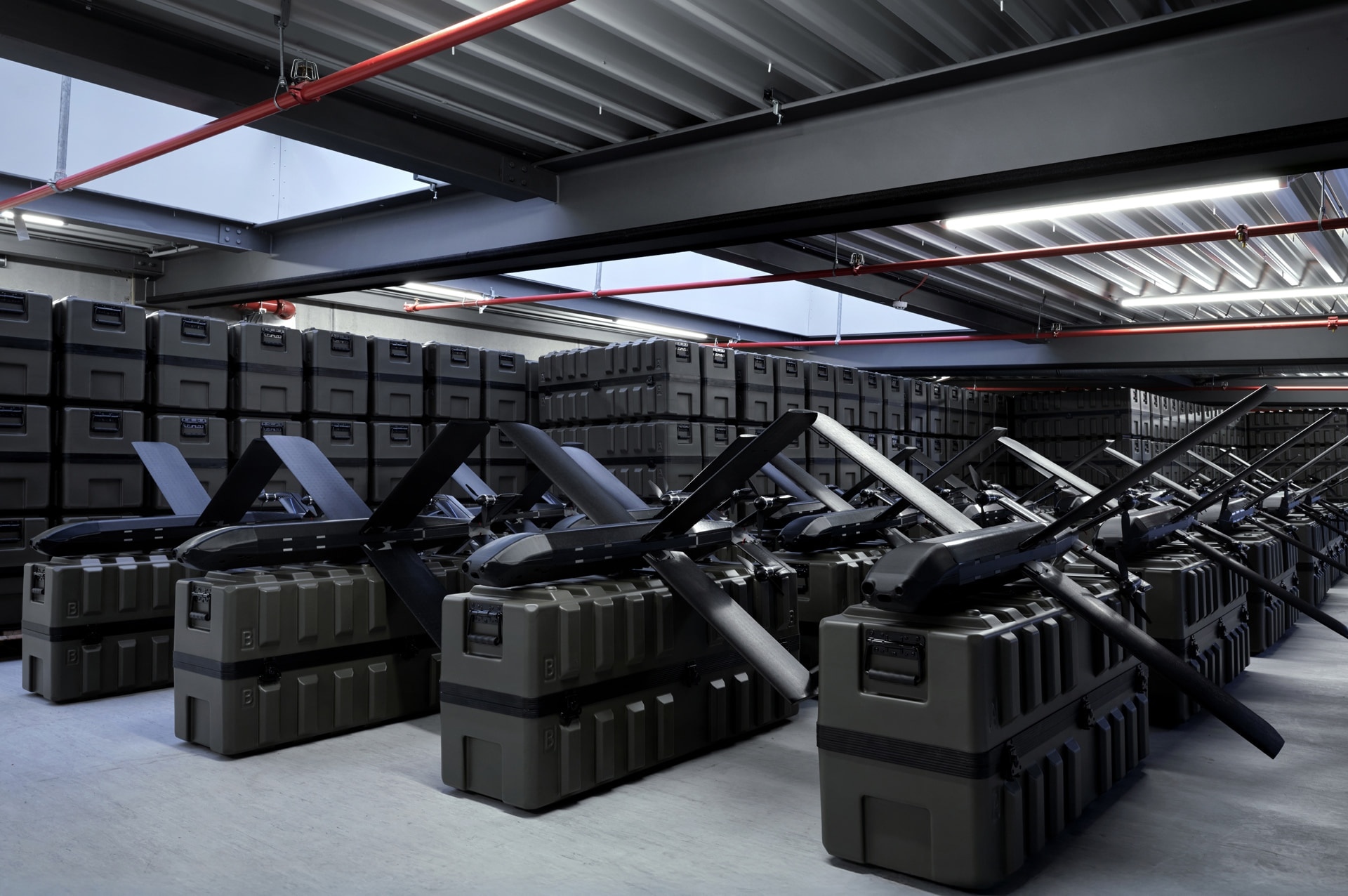 HX-2 / Photo: Helsing
Yesterday morning, a U.S. news agency reported, citing anonymous Ukrainian sources, that the Ministry of Defense of Ukraine had suspended execution of a contract for the delivery of another batch of German loitering munitions due to their vulnerability to Russian electronic warfare (EW) measures. According to the reports, operators repeatedly lost communications with the drones, and some of the delivered systems were allegedly missing features listed as standard in the specifications.
Several hours later, the manufacturer, the German company Helsing, issued a statement responding to the article published by Bloomberg. It stated that “the reality is different: there are concrete requests from more than six units within the Ukrainian army to order the HX-2. In fact, after the recent frontline testing, the unit that tested the system requested more than 1,000 drones additional for combat missions.”
Further, we can read that “The HX-2 has been successfully tested in frontline operations in Ukraine and the performance of the system has been documented. Following these tests, HX-2 was approved for frontline use. It is also now listed in an official central ordering system of the Ukrainian army. Helsing is currently delivering several hundred drones per month to Ukraine.”
“HX-2 has consistently scored hit rates very close to or of 100% during military tests in Germany, the UK, and Kenya. This is well documented in several news articles, including in the FT, and Handelsblatt.”
“We welcome scrutiny, and we are grateful for genuine feedback. But we can not tolerate misleading reporting on our company and on our many employees working to keep Europe safe.”
On February 13, 2025, the German company Helsing announced it would deliver 6,000 of its latest HX-2 strike drones to Ukraine. This followed earlier cooperation with the Ukrainian defense industry, under which 4,000 units of the older HF-1 drones had been supplied. The HX-2 drones are produced at the newly opened RF-1 (Resilience Factory) facility in southern Germany.
Unveiled on December 2, 2024, the HX-2 is an electrically powered precision loitering munition built in a cruciform configuration, with a strike range of up to 100 km. Its control system uses machine-learning (artificial intelligence) algorithms which, according to the manufacturer, provide full resistance to enemy electronic warfare (EW) systems. The drone travels at a speed of 220 km/h and has a maximum takeoff weight of 12 kg, carrying anti-tank, multi-purpose, or concrete-penetrating warheads of undisclosed weight.
The system is compatible with Helsing’s proprietary Altra recce/strike reconnaissance-and-strike software, allowing HX-2 drones to operate in swarms controlled by individual operators. The HX-2 design was developed to enable mass production at a significantly lower unit cost than conventional systems, thereby addressing a growing capability gap in modern warfare.
The manufacturer declares that starting in January 2027, serial production of the HX-2 at the RF-1 facility will reach 1,000 units per month, with the long-term goal of producing tens of thousands, assuming additional production lines are opened. The company has ambitious plans to build similar facilities in other European countries.
See also: