




















The development of the Arrowhead 140 design is closely linked to the Royal Navy’s program for new frigates. After 2006, the British fleet retained 17 ships of this class, but after 2013, when the last four Type 22 Batch 3 frigates were withdrawn from service, this number fell to 13 Type 23 frigates. They belonged to a series of 16 ships commissioned between 1990 and 2002, three of which were sold to Chile in 2005, and were scheduled to be progressively retired beginning in 2023.
In 2010, it was decided that the Type 23 would be replaced by a vessel developed under the Global Combat Ship program, which resulted in the Type 26 frigate design. The original plan called for all of the older frigates to be replaced by 13 new ships entering service from 2023, with the series to be completed in the mid-2030s. Of these, eight were to be built in a variant specialized for anti-submarine warfare, while the remaining five were to be configured as multirole ships. The new vessels, however, proved too expensive. Their cost was estimated at more than 1 billion GBP per ship, which led to a decision in 2015, even before the first vessels had been ordered, to reduce the Type 26 program to eight ships, all in the anti-submarine warfare variant.
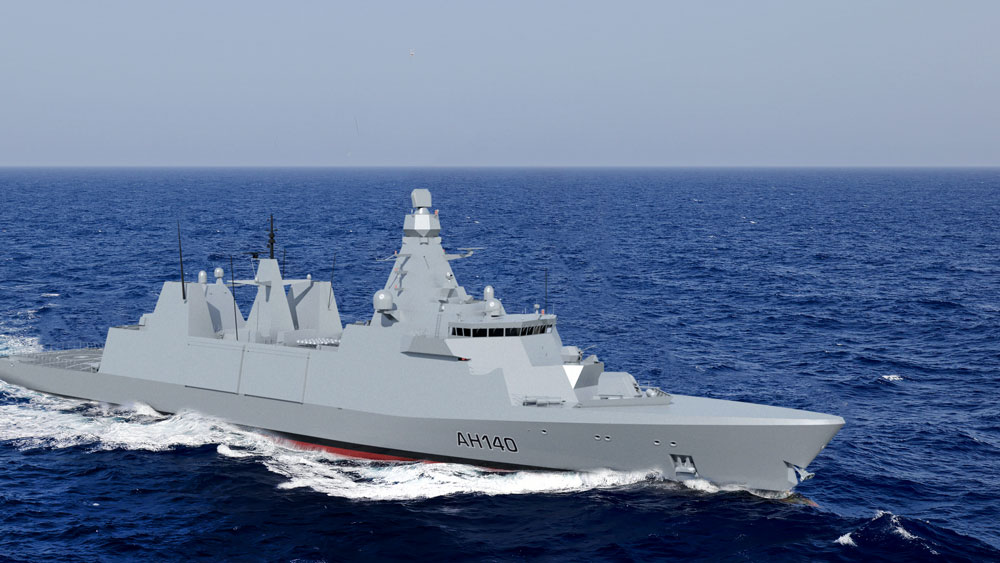
The five remaining multirole frigates were to be replaced by a new, smaller, and significantly cheaper design, initially expected to cost just 250 million GBP per ship, developed under the General Purpose Frigate (GPFF) program and designated Type 31e. The “e” stood for export, reflecting the intention that the design should be versatile and adaptable from the outset to meet the requirements of different customers.
In the summer of 2016, proposals for the GPFF program were submitted by BAE Systems, with the Avenger and Cutlass designs; BMT Group, with the Venator 110; and Babcock International, with the Arrowhead 120. All envisaged ships no more than 110 meters long and displacing less than 4,000 tonnes. Since the Royal Navy wanted larger vessels displacing around 6,000 tonnes and none of the proposals met its requirements, the program temporarily stalled despite requests for information being issued to defense companies in September 2017.
Following a redefinition of the requirements, in December 2018 the UK Ministry of Defence awarded contracts to three consortia to develop competing frigate designs:
– Team 31, comprising Babcock International, BMT Group, and Thales, which proposed the Arrowhead 140 based on the Danish Iver Huitfeldt-class frigate design;
– BAE Systems and Cammell Laird, with the Leander design derived from the Khareef-class corvettes built for Oman;
– Atlas Elektronik UK together with thyssenkrupp Marine Systems, offering a design from the MEKO A-200 family.
Team 31 and its Arrowhead 140 frigate were announced as the winner in September 2019, and on November 15 of the same year a 2 billion GBP framework agreement was signed for the design, construction, and delivery of five Type 31 ships.
It should also be noted that the original plans for a smooth replacement of retiring Type 23 frigates with new vessels have completely failed. To date, no new Type 26 or Type 31 frigate has entered service, with the lead ships of both classes not expected before 2027. Meanwhile, between 2021 and 2026, eight Type 23 frigates have already been retired, leaving the Royal Navy with just five ships of that class.
Arrowhead 140
As noted above, the Arrowhead 140 was based on the design of the Danish Iver Huitfeldt-class frigates developed by Odense Maritime Technology between 2005 and 2007. It inherited their overall dimensions, which in the baseline configuration were 138.7 meters in length and 19.8 meters in beam. Draft in the new design was to be reduced to 4.8 meters from the original 5.3 meters, while displacement was approximately 5,700 tonnes compared with 6,645 tonnes for the Danish frigates. These parameters change to some extent as the design is adapted to specific customer requirements. The displacement currently quoted for both the Type 31 and the Polish Project 106 is approximately 7,000 tonnes. The propulsion system, comprising four MTU 20V 8000 M71 diesel engines with a combined output of 32,800 kW, was intended to give the frigate a speed of more than 28 knots.
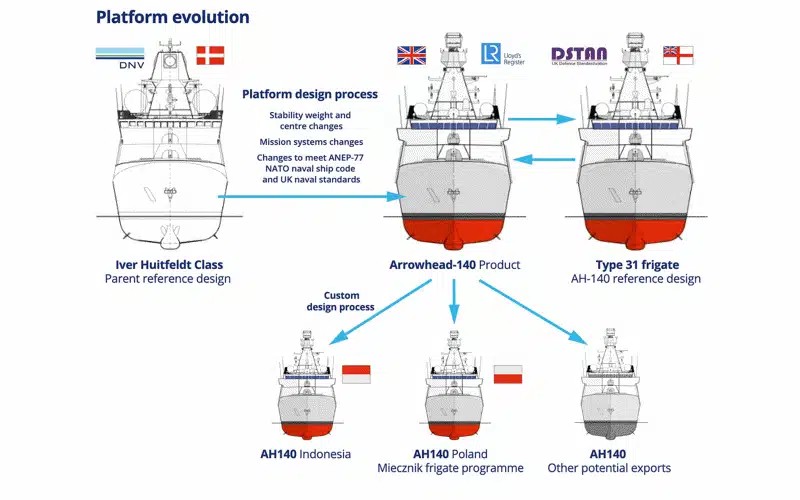
The weapons and equipment configuration depends on the requirements of the individual customer. The baseline design envisaged the installation of a gun of up to 127 mm caliber on the bow, with additional guns of up to 76 mm caliber mounted on the superstructure above. Amidships, where space is reserved for a vertical launch system, a wide range of launchers can be accommodated, from the relatively small 24-cell CAMM launchers used on British ships to a 32-cell Mk 41 Strike launcher, as on Poland’s Miecznik, capable of housing the largest missiles, including the RGM-109 Tomahawk, RIM-161 Standard Missile 3 (SM-3), and RIM-174 Standard Missile 6 (SM-6).
Depending on the specific configuration, different radar systems can be selected together with the corresponding masts carrying their antennas.
The flight deck and spacious hangar located aft allow the ship to operate helicopters of various sizes, ranging from smaller types such as the AW159 Wildcat, through the MH-60R Seahawk and NH90, to the much heavier AW101. The flight deck is also capable of accommodating helicopters as large as the Boeing CH-47 Chinook, although in that case the aircraft cannot be housed inside the hangar.
Type 31
These assumptions quickly began to translate into practical differences between individual ships. British requirements were relatively modest in terms of weapons and equipment. The Type 31 frigates’ gun armament consists of a single 57 mm Bofors Mk 3 (Mk 110) gun on the bow, two 40 mm Bofors 40 Mk 4 anti-aircraft guns, and 12.7 mm heavy machine guns. Missile armament is currently limited to the Sea Ceptor air-defense system with 24 MBDA CAMM missiles. The ships are also expected to receive Kongsberg NSM anti-ship missiles in the future. The Type 31 frigates, however, are not intended to carry dedicated anti-submarine weapons other than torpedoes and depth charges carried by their embarked helicopters.
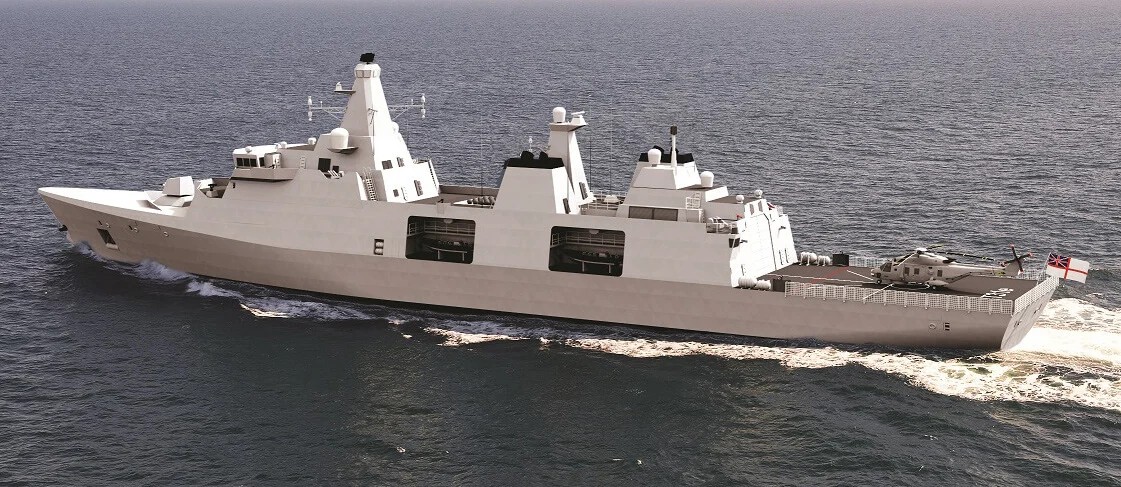
/ Images: Babcock
All of the ship’s weapons are controlled through the Thales Nederland TACTICOS combat management system. In terms of radar equipment, apart from navigation radars, the ship is fitted only with the Thales NS110 long-range radar, which has an air-target detection range of up to 280 km. The ship will also carry the Thales Artemis 360 infrared search and track system and two Thales Mirador Mk 2 electro-optical systems for target tracking and fire control.
Fregat Merah Putih
Project 106 Miecznik – Poland’s variant of the Arrowhead 140
Another successful tender for Babcock was the Polish procurement for the construction of three multirole frigates under the Miecznik program. The selection of this proposal was announced in March 2022. As the launch of Poland’s first frigate approaches, the ship will be christened Wicher on August 12, we will return to the subject in greater detail (Future Polish Navy frigate ORP Wicher rolled out ahead of launch).
Here, we will briefly characterize the Polish variant of the Arrowhead 140. As in the Indonesian case, the Polish configuration differs significantly from the British baseline and is a fully multirole warship. Its gun armament is somewhat lighter than that of the Indonesian ships, consisting of one Leonardo 76 mm Super Rapid Strales gun, two 35 mm AM-35K anti-aircraft guns, and four heavy machine guns, including two mounted in remotely controlled weapon stations. The ship’s surface-to-air missile armament will be housed in a 32-cell Mk 41 Strike vertical launch system, comprising four eight-cell modules and capable of accommodating up to 128 MBDA CAMM short-range missiles. Its anti-surface armament is to consist of eight Kongsberg NSM anti-ship missile launchers, with provision to increase that number to 16. Anti-submarine warfare armament will comprise 324 mm torpedoes launched from two twin EuroTorp B515/2V launchers.
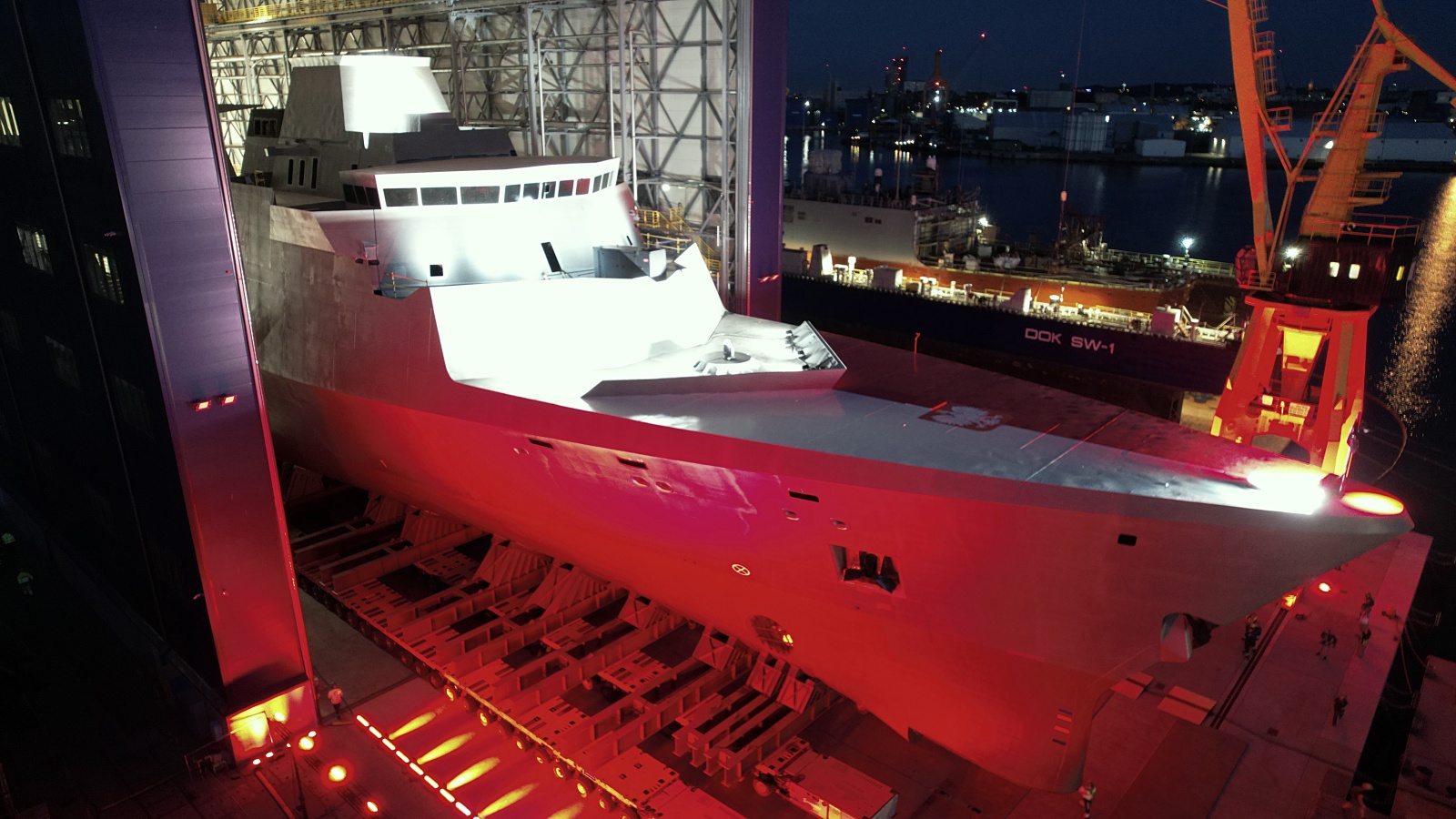
The future ORP Wicher ready for launch / Photo: Jakub Link-Lenczowski, MILMAG
As on the British ships, the Miecznik frigates will be equipped with the Thales Nederland TACTICOS combat management system. Their radar suite will be more extensive, comprising the Thales Sea Master 410 long-range multifunction radar, a Thales NS50-series medium-range radar with a range of 180 km, and the Thales STIR 1.2 EO Mk 2 fire-control radar. Submarine detection will also be supported by Thales sonar systems: the Blue Hunter hull-mounted sonar and the CAPTAS-2 towed sonar.
/ Film: Jakub Link-Lenczowski, MILMAG
See also:
– Poland: Construction Begins on Huragan, the Third Miecznik-Class Frigate
– Rohde & Schwarz cooperation with ELT Group in the Miecznik and F124 programs