

























On Thursday, July 23, 2026, the BTVT.INFO Telegram channel reported that Russia’s Arsenal Machine-Building Plant (Mashinostroitelny Zavod Arsenal) in St. Petersburg had received a patent from the Federal Service for Intellectual Property (Rospatent) for a new self-propelled coastal artillery system based on the 130 mm A-192M Armat naval gun.
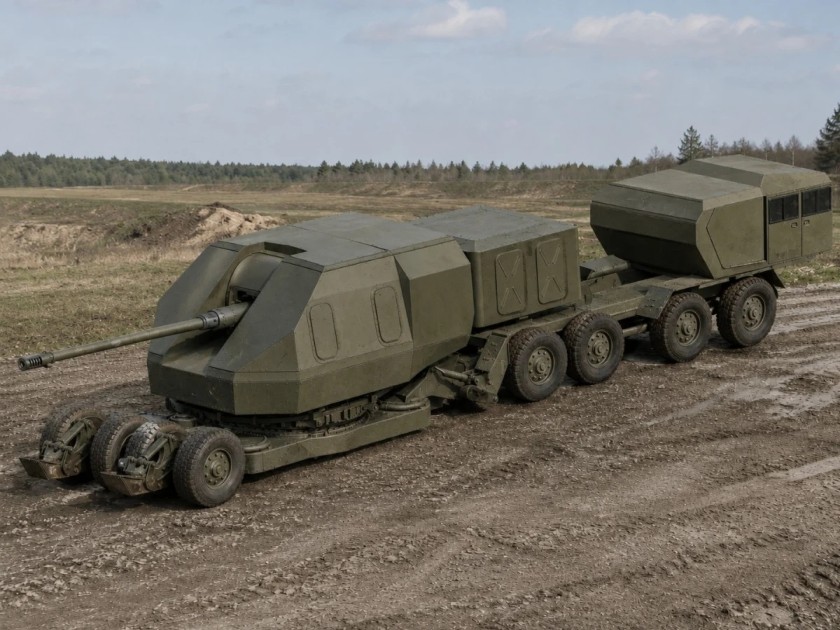 AI-generated visualization based on the patent drawing
Patent description:
The rotating mount [of the weapon system], fitted with tracks and enclosed by a protective shield, is installed on a semitrailer platform, providing horizontal traverse for the gun. The semitrailer is equipped with four rotating supports, two of which are fitted with two road wheels similar to those used on off-road vehicles. The ammunition-feed system comprises a ready-use ammunition magazine, a feed mechanism, and a reloading mechanism. The ready-use ammunition magazine is a conveyor consisting of guide tubes arranged around a frame mounted on the rotating platform behind the gun barrel. The reloading mechanism consists of a pendulum supported on the artillery gun’s trunnion axis and grippers attached to the pendulum. These provide the pendulum’s reciprocating, working, and return movements, driven by the corresponding actuator.
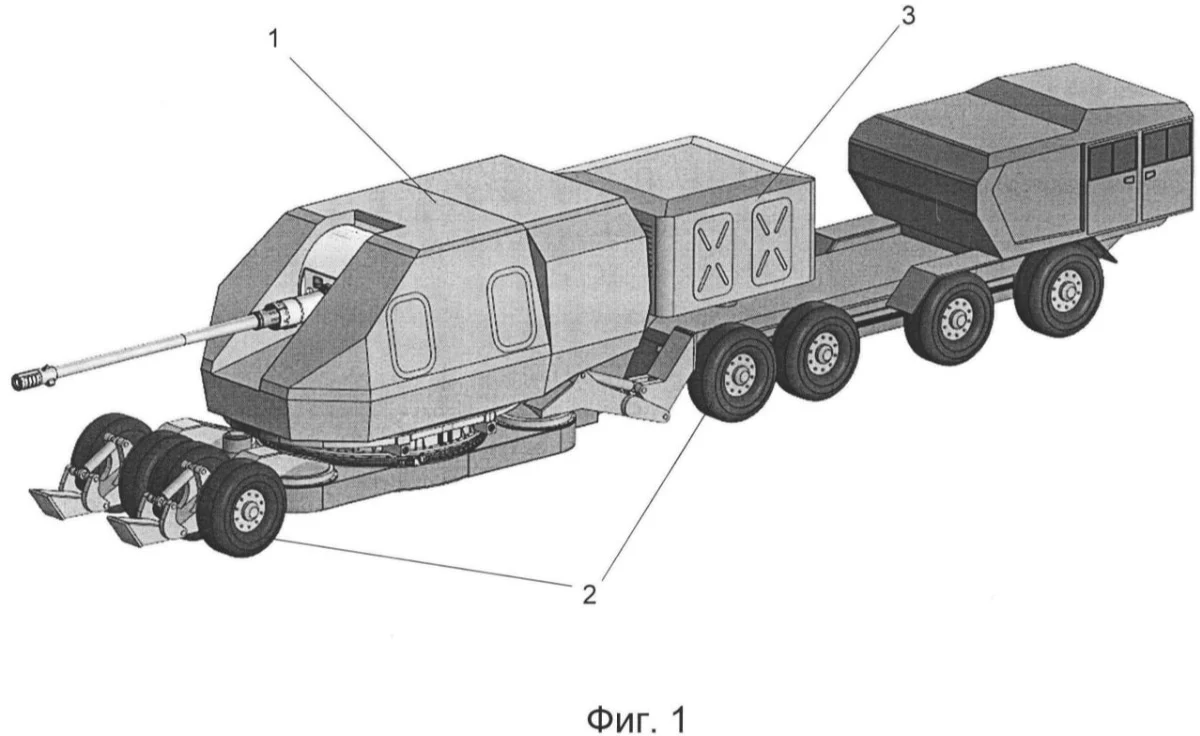
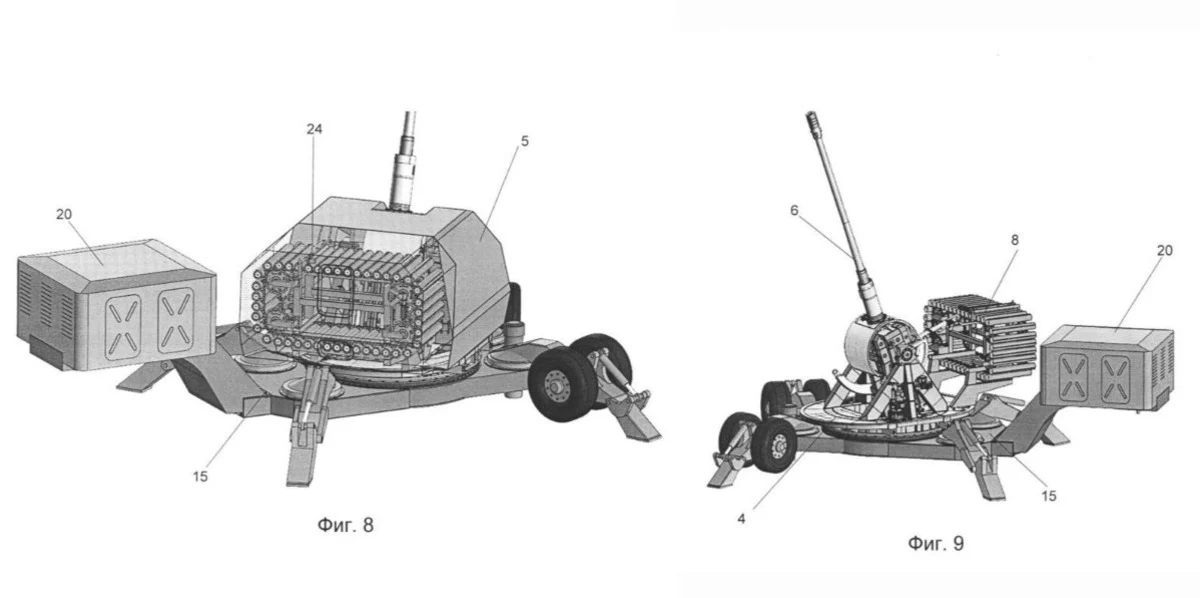
Drawings: Rospatent
The coastal troops of the Russian Navy (Voyenno-Morskoy Flot, VMF) currently operate A-222 Bereg 130 mm coastal artillery systems equipped with the AK-130 gun on the MAZ-543M chassis, built by what is now the Titan-Barrikady Federal Research and Production Center in Volgograd. They entered service in 1988 with the 11th Independent Coastal Artillery Brigade of the Black Sea Fleet in Novorossiysk. A total of 36 systems were built. In 2024, reports emerged that they might be assigned to the reconstituted Dnieper Flotilla.
Meanwhile, the Arsenal Machine-Building Plant, which has its own KB Arsenal design bureau, has developed and manufactured naval guns ranging from 57 mm systems to larger weapons, including the 100 mm AK-100, 130 mm AK-130, 76.2 mm AK-726, and 130 mm A-192M. The latter has entered service aboard Project 22350 Admiral Gorshkov-class missile frigates and the modernized Project 1144.2M Orlan-class nuclear-powered missile cruiser RFS Admiral Nakhimov (080).
The A-192M Armat itself represents a major engineering advance over the older twin-barrel AK-130 naval gun. The total weight of the weapon system was reduced from approximately 90 tonnes to around 25 tonnes while retaining the same caliber. Its ammunition provides an effective engagement range of approximately 23 km, or 14 nautical miles, against surface targets. The system completed qualification testing in 2021 and is being introduced aboard the vessels listed above. Its theoretical rate of fire is 30 rounds per minute.
Adapting a proven naval gun for land use is not a new concept in the development of Russian artillery. During the Soviet era, design bureaus sought to share gun designs, ammunition, and components between naval and land applications rather than develop entirely separate systems for each branch of the armed forces.
In its post, BTVT.INFO expressed skepticism about the usefulness of this particular system on the modern battlefield, writing that although a niche exists for such platforms, it is difficult to regard it as a priority. Its analysis suggested that the main motivation for obtaining the patent had more to do with corporate strategy than with an actual requirement from the Russian Ministry of Defence, serving more as an attempt to promote a particular solution than as a reflection of coherent modernization priorities or lessons learned from the war against Ukraine. “Incidentally, this is the final farewell to the interservice—or whatever it was called—2S35 Koalitsiya-SV system,” BTVT.INFO concluded. It is worth noting that a naval version, designated Koalitsiya-F, had also been planned. The Koalitsiya-SV program itself has shown no visible progress since 2023, when completion of state trials was announced.
See also: