





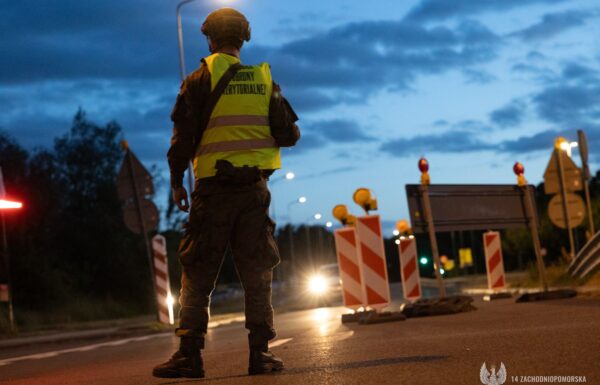


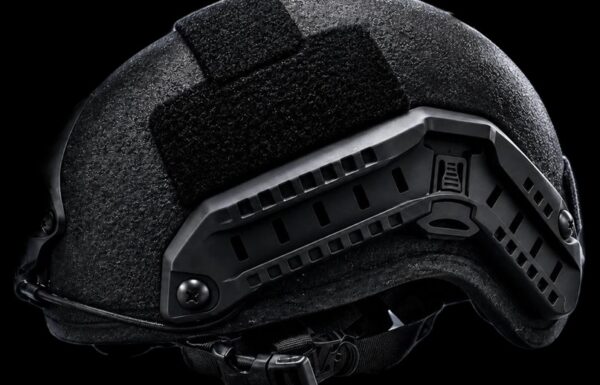


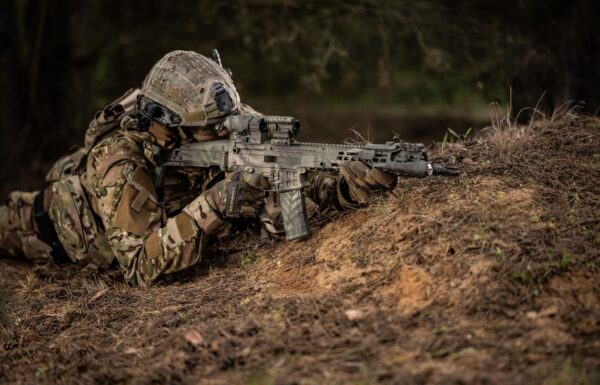













HBT-02 is a Polish ballistic helmet developed by Przedsiębiorstwo Sprzętu Ochronnego MASKPOL of Konieczki, a company belonging to Polish Armaments Group (PGZ). It was developed in response to the needs of the Polish Armed Forces under the Tytan Advanced Individual Combat System program. This means that the HBT-02 is not just another standalone ballistic helmet, but an element of a broader soldier-equipment system covering protection, uniforms, load-bearing equipment, and compatibility with additional individual equipment.

HBT-02 with a mounted mandible guard / Photo: Jakub Link-Lenczowski, MILMAG
According to MASKPOL’s declarations, the helmet was to enter serial production in 2025 and then become the new-generation standard helmet of the Polish Armed Forces.
The most important feature of the new head protection is the combination of ballistic protection and a modular design. The helmet is intended to provide a high level of protection against the effects of bullets and fragments. The aramid HBT-02 provides protection against K2-class bullets and O3-class fragments in accordance with the PN-V-87001:2011 standard. This is important because, in the Polish classification, the O3 level denotes high fragmentation resistance, while the K2 class refers to protection against specific handgun bullet threats. In addition, Polish standards, including those concerning backface deformation, are more restrictive than some NATO standards. (MSPO 2025: Maskpol with ROCK 4.0 and Protective Equipment for Civilians)
Unlike high-cut helmets, the HBT-02 has been developed as a helmet with a larger protective surface. What draws attention here is its distinctive attachable mandible and face guard. This solution is intended to increase the level of protection for soldiers carrying out particularly exposed tasks, such as door gunners. This shows that the helmet was designed not only as standard head protection for an infantryman, but also as a protective platform that can be configured depending on the user’s role or tasks.
An important element of the HBT-02 is its compatibility with individual equipment. The helmet’s design allows a gas mask, protective clothing, active hearing protectors, and eye and face protection devices to be used at the same time. This is particularly important in the Tytan program, as its premise was to create an integrated soldier system, rather than a set of randomly selected components. The helmet must therefore work with chemical protection, communications equipment, face guards, and observation devices, without excessively limiting the user’s mobility or situational awareness.
Compared with earlier work on a helmet for Tytan, the HBT-02 can be regarded as a more mature stage in the development of Polish head protection. The long development process of this design shows that the HBT-02 did not appear in a vacuum, but is the result of many years of experience in designing a system helmet for the soldier of the future.
In practice, the HBT-02 should therefore be treated as a helmet designed for mass users (soldier) but with features known from more specialized designs: modularity, the ability to attach additional face and mandible protection, and compatibility with hearing protectors and protective equipment. One thing is certain: the HBT-02 is intended to increase soldier survivability, while at the same time not preventing the use of other elements of individual equipment.