
















MILMAG: What are the key technological features of Arbel, and what clearly differentiates it from competing fire-control and counter-UAS solutions?
IWI: Arbel is a soldier-centric, situational-awareness system designed to significantly increase hit probability against both ground targets and low-signature aerial threats, including small drones. Its core technological features include real-time sensing and micro processing to suit the shooter’s operational scenario best. Thus, achieved without intervening with the fundamental controls and interaction with the rifle, it doesn’t dictate anything in terms of optics used, and does not require a change of ammunition.

What clearly differentiates Arbel from competing solutions is its integration at the individual weapon level rather than as a standalone counter-UAS product. Arbel enables standard infantry weapons to engage, day or night, complex targets such as small and/or maneuvering drones, as well as other “traditional” threats on the battlefield, without requiring special optics, ammunition, or products. At the tactical level, it enables a super-quick response to threats because it does not require changing the tool the soldier is already holding. At the practical level, it enables quick deployment of troops and simplifies equipping large portions of the force with this crucial capability.
There are different solutions for different types of drone threats, such as jamming or missiles to take down large drones. The Arbel has become the solution for European countries (as well as others around the world) who are looking for solutions for tactical drones which can be used for surveillance or attack – by carrying grenades, small payloads etc. ( IWI BOOST – integrated power source for assault rifles )
Which user profiles and operational roles was Arbel primarily designed for, and how flexible is the system across different mission types?
Arbel was primarily designed for infantry soldiers, sharpshooters squad leaders, and light forces operating in complex and dynamic environments. Its design philosophy assumes limited time, high cognitive load, and rapidly evolving threats at the tactical edge. The primary mission, in the developer’s eyes, was to hit a challenging target multiple times in a very short time.

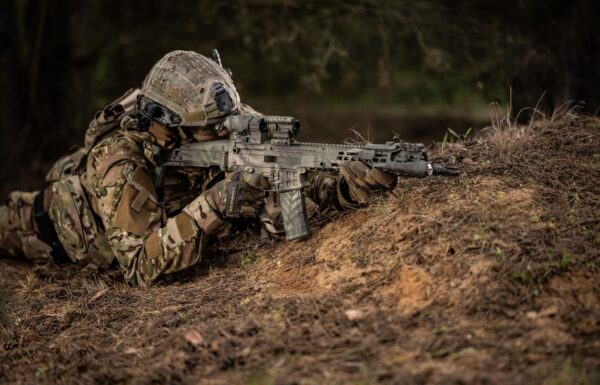
/ Photos: via IWI
The system is highly flexible and supports a wide range of mission types, including conventional infantry operations, force protection, urban combat, border security, and counter-UAS defense. Arbel can be employed as a primary fire-control aid for standard engagements or as a specialized capability against asymmetric threats, such as commercial drones used for reconnaissance or attack. In fact, this is what’s unique about the Arbel -its versatility. It allows the user to engage tactical drones and other threats, so he can still operate his main rifle without changing anything in his setup or way of operation when he faces a hostile tactical drone.
How does Arbel integrate with existing soldier equipment and weapon platforms, and is integration with the Grot rifle already underway or planned?
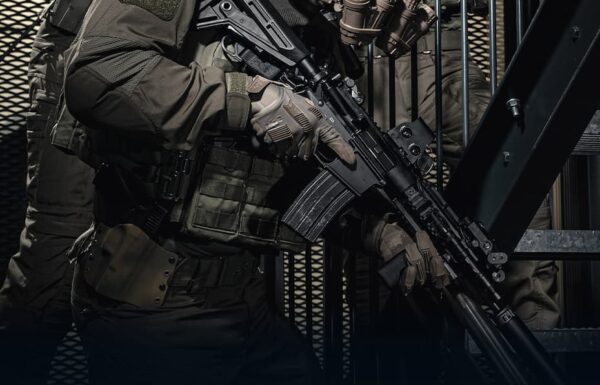
On the technical level, the Arbel is integrated into the rifle’s lower receiver. The implementation of the system is as easy as replacing the lower receiver of an existing operational rifle. So it works seamlessly with any other equipment the soldier already has, just like the existing rifle.
The Arbel could be implemented as part of the complete IWI Arad rifle (a versatile 5.56x45mm/300BLK short-stroke-piston-based rifle). It’s great on its own. However, the Arbel is designed and already available off-the-shelf for AR-15 design rifles. Adopting different rifle designs, such as the Grot, is relatively straightforward and mainly involves mechanical adaptations. Upon concrete interest, it could be deployed in a timely manner.
Have recent global events and ongoing conflicts influenced IWI’s approach to the development, deployment, or prioritization of Arbel?
As we see it, the tactical drone threat is relevant to any country nowadays. Whether it’s used on the frontline during an active conflict, by terrorist organizations, by organized crime, or in cross-border smuggling. The understanding of the rise in the threat certainly drew attention to IWI. The fact that Arbel is an excellent solution to this kind of aerial threat, as well as other battlefield threats, makes it the best choice for any operative, regardless of their primary mission.
Since much of the hostile uses of this kind of drones are attacking, as we see it, kinetic “last resort” interception is the only way to defend the operative and his surroundings in case of such an attack, so it’s no different from equipping the operative with a helmet and a bulletproof vest. These drones are the new bullets in the modern battlefield.
Are specialized versions of Arbel planned for specific operational environments, such as dense urban combat or dedicated counter-UAS missions?
Arbel was designed from the outset as a scalable, configurable system rather than as multiple fixed variants. This allows the same core architecture to be optimized for different operational environments through software profiles, sensor configurations, and weapon integration choices.
While dedicated configurations for dense urban combat or focused counter-UAS missions are technically possible, the primary approach is to maintain a common system baseline that can be adapted to mission requirements without fragmenting logistics or training.
The main idea is to stay on the operator’s primary rifle, keeping the same tool for all missions.
How would you describe IWI’s current presence in Europe in terms of sales, partnerships, and long-term market strategy?Europe is known for its competitive market, with many high-quality, well-respected competitors. Companies differentiate based on quality and unique features. IWI has a lot to offer to European needs with its top-of-the-line products, including the Arad, Arad 7, Negev family, and, of course, Arbel systems.
These unique propositions have already secured interest and led to successful projects with European customers. We are willing and actively seeking to increase our presence further to meet the rising requests from European countries for high-quality equipment, as well as their regulatory and supply-chain security needs.
What cooperation models does IWI prioritize in Europe direct engagement with armed forces, system integrators, public tenders, or industrial partnerships?
IWI applies a multi-track cooperation model in Europe. This includes direct engagement with armed forces, participation in public tenders, collaboration with system integrators, and selective industrial partnerships where local value creation is required or advantageous.
The chosen model depends on national requirements, regulatory frameworks, and the program’s maturity. Flexibility in cooperation is a key element of IWI’s European approach.
How does IWI address the diverse legal, regulatory, and procurement frameworks across EU and NATO countries?
IWI addresses Europe’s regulatory diversity through close coordination with national authorities, adherence to EU and NATO standards, and cooperation with local partners who understand country-specific procurement and compliance requirements.
The company has extensive experience navigating export controls, certification processes, and offset or industrial participation requirements, ensuring that IWI platforms can be offered responsibly and lawfully across different jurisdictions.
What strategic role does Central and Eastern Europe play in IWI’s European plans, and how do the region’s operational needs differ from those in Western Europe?
As we can see, practically all European countries are paying much attention to strengthening their power, modernizing their militaries, and scaling their homeland security capabilities. This is due to several factors, such as the Russia-Ukraine war, the expansion of defense budgets in NATO countries, and the recognition that the threat of war or open conflict warrants attention.
In that regard, we can see these trends across Europe, from East to West alike, with no fundamental distinction in technical or operational needs. Some countries are moving processes more quickly than others, but all are seeking good solutions. They require reliable, long-lasting products that have already proven their performance not only in technical terms but also in battle, and the ability to deliver them with high-quality control, short delivery times, and a fair price at large scales. IWI meets exactly these points flawlessly.
What specific advantages does Arbel offer to CEE countries facing hybrid threats and the growing challenge of hostile drones?
Arbel offers an immediate counter-drone capability embedded directly in the infantry’s main weapon. Thus, not compromising any of the fundamental abilities of the personal rifle, with the understanding that the drone threat, no matter how big it is – is still just a threat alongside the main mission of the operative, that needs to be able to respond to various threats on the mission level, and cannot, and would not use a specific solution to every different threat. In addition, the seamless, cost-effective solution of the Integrated Arbel system equips large portions of the force with anti-drone capabilities. It ensures successful interception in a short time at a low cost, while minimizing risk to the forces or infrastructure around them.
How do you assess the potential for cooperation with the Polish defense industry, including joint testing, demonstrations, or possible local integration?
Poland has a strong and capable defense industry and a highly operationally focused armed forces community. This creates meaningful potential for cooperation in areas such as joint testing, demonstrations, and localized integration. We believe that Poland can be a significant partner and user of IWI’s portfolio.
Is IWI considering investments in local R&D, production, or integration capabilities in Europe, and does Arbel fit into EU-funded initiatives such as PESCO or the European Defence Fund?
IWI continuously evaluates opportunities for local R&D, production, and integration in Europe, particularly where these activities enhance operational relevance, supply security, or alignment with European defense priorities.