























A drone without a stable, resilient, and interoperable control system remains only one element of a broader operational framework. Today’s operators need tools that enable them to maintain operational continuity, work with real-time data, and adapt hardware configurations to changing mission scenarios.
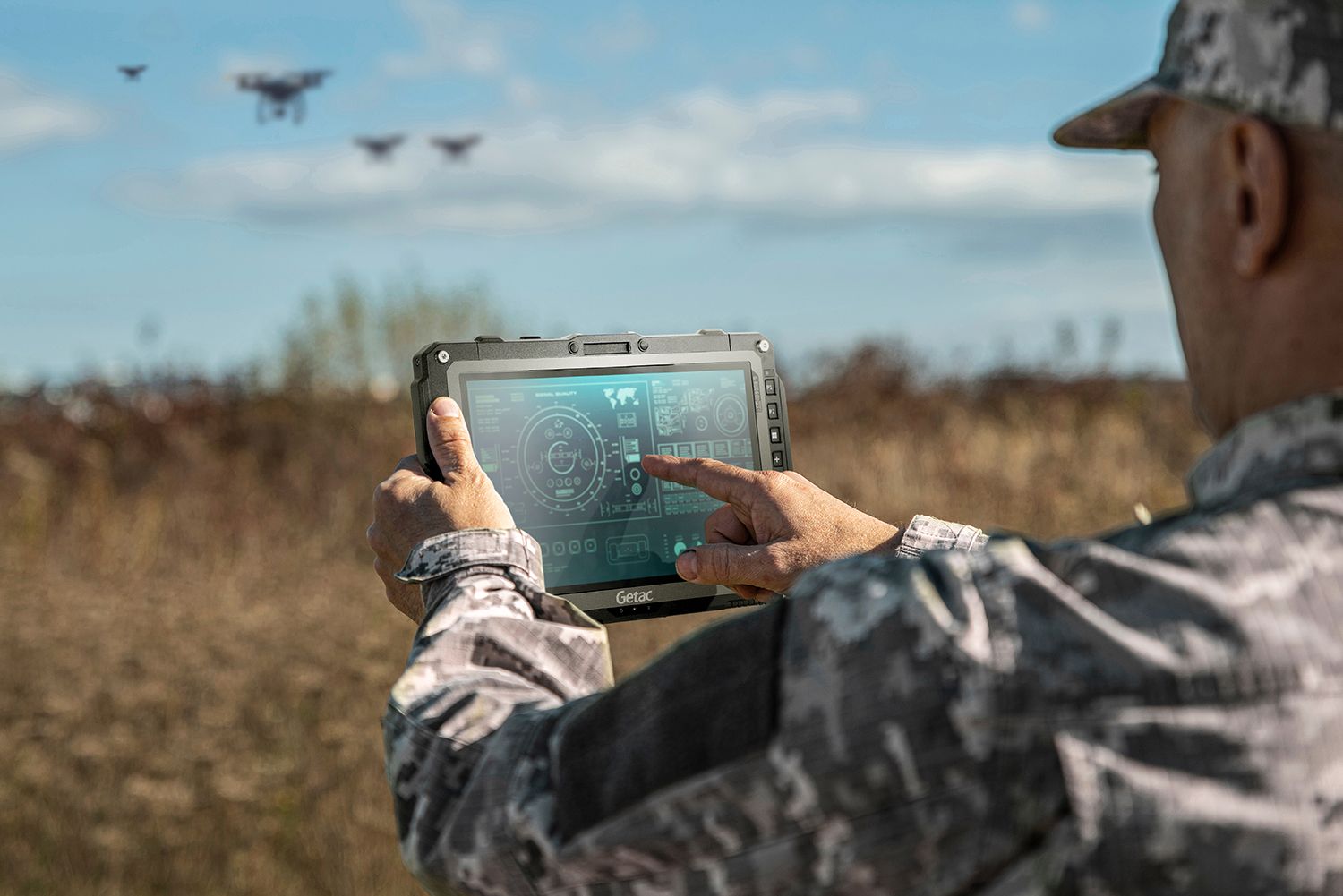 Image: Getac
Unmanned operations are becoming increasingly complex
In defense, drones support intelligence, surveillance, and reconnaissance operations. In public safety, they assist with responses to fires, floods, disasters, and search-and-rescue missions. In utilities and critical infrastructure, they support inspections of power lines, pipelines, wind farms, and difficult-to-access sites.
Each of these scenarios has different requirements, but they all have one thing in common: operators need reliable access to data, stable control, and equipment capable of withstanding real-world working conditions. As a result, the focus is shifting from the individual platform to the entire operational workflow—from system control and data analysis to integration with other technologies.
The problem of closed ecosystems
One of the challenges in unmanned operations is the fragmentation of the working environment. Different types of drones, sensors, communications systems, and applications often require separate controllers, interfaces, or procedures. In mission-critical conditions, every additional device can increase operational complexity, the logistics burden, and the risk of error.
Open, modular, and interoperable solutions are therefore becoming increasingly important. They allow organizations to select the platform and configuration best suited to a particular mission instead of being restricted to a single closed ecosystem. In environments where requirements change rapidly, this flexibility becomes one of the conditions for operational effectiveness.
CommandCore as a control environment
In this context, Getac positions CommandCore as a rugged ground-control solution for UAV, USV, and UGV operations. The solution has been designed for professionals working in demanding environments where durability, mobility, and the ability to tailor the configuration to a specific scenario are essential.
CommandCore combines a Ground Control Station with hardware accessories to create an environment for real-time control, monitoring, and data processing. Its role is not limited to piloting a drone. The objective is to provide a more integrated operator workspace capable of supporting remote operations, data analysis, mission-parameter control, and integration with various technologies.
Modularity is a key feature. Users can choose from different configurations, ranging from portable solutions and integrated tablets with control elements to more extensive suitcase-style systems with additional displays and control options. This approach makes it possible to adapt the working environment to the required level of mobility, mission scale, and the needs of a specific organization.
Edge AI and data processing closer to the point of operation
Modern unmanned systems generate increasing amounts of data, including high-resolution imagery, thermal data, sensor information, and mapping data. In critical scenarios, it is not always possible to wait for data to be transmitted to the cloud, processed elsewhere, and returned to the operator.
This is why edge AI, meaning local data processing closer to where the data is generated, is becoming increasingly important. In a ground-control station, it can support image analysis, object detection, anomaly identification, terrain mapping, and faster decision-making. For the military, emergency services, and critical-infrastructure operators, this means shorter response times and less dependence on stable connectivity with external systems.
Ruggedness as an element of mission continuity
In unmanned operations, the failure of a ground-control station, controller, battery, or display can interrupt the entire workflow. In defense, emergency-response, or infrastructure environments, this is not merely a technical problem but a genuine operational risk.
A rugged ground-control station must therefore meet the same challenges as other technologies used in the field, including shock, vibration, dust, moisture, extreme temperatures, prolonged operation, and frequent transportation. Equipment ruggedness is not simply a technical specification. It is one of the conditions necessary to maintain operational continuity.
“A drone is only one element of a mission. The real value emerges when operators have a stable control environment, access to real-time data, and equipment that performs reliably in the field. This is why the future of unmanned operations will depend on the entire ecosystem surrounding the platform,” said Jerry Huang, Vice President of Global Market Development at Getac Technology Corporation.
The future of unmanned operations is an entire ecosystem
The development of unmanned operations will not be limited to increasing the number of drones. Equally important will be how organizations integrate them with command systems, data analysis, communications, cybersecurity, and field devices.
In practice, the advantage will belong to teams capable of combining equipment ruggedness, interoperability, local data processing, and deployment flexibility. The drone will remain an important part of the mission, but its effectiveness will increasingly depend on how well the entire ecosystem surrounding it operates.
About Getac
Getac Technology Corporation is a global leader in rugged mobile technology and intelligent video solutions, including laptops, tablets, software, body-worn cameras, in-vehicle video systems, digital evidence management, and enterprise video analytics solutions. Getac’s solutions are designed to provide the best possible user experience for professionals working in demanding environments. Getac currently serves customers in more than 100 countries, delivering technologies for the defense, public safety, emergency medical services, firefighting, energy, automotive, industrial, transportation, and logistics sectors. In 2024, Newsweek named the company one of the World’s Most Trustworthy Companies.
Sponsored Conent