





















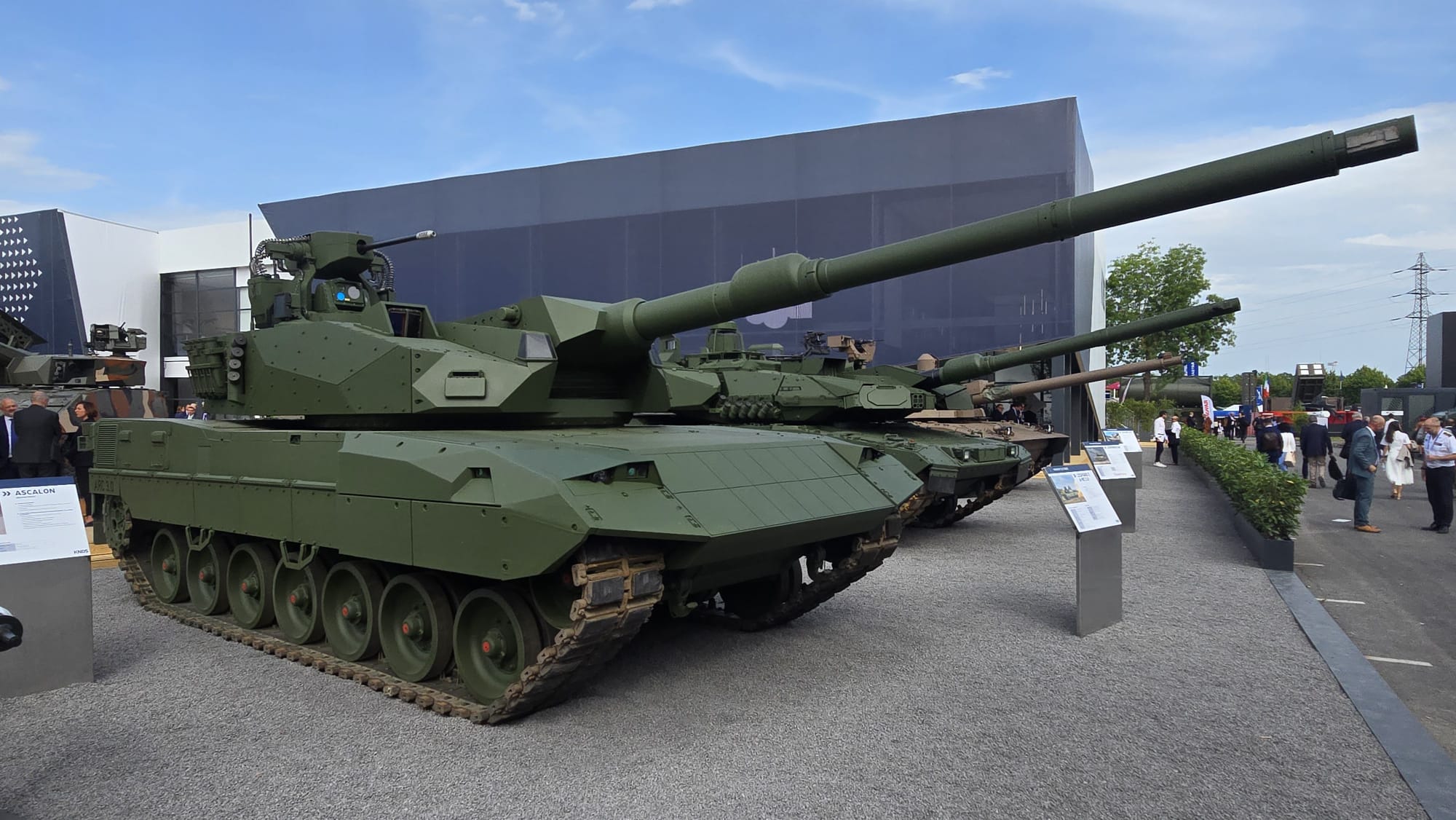
During the 29th edition of Eurosatory 2026, the international defense industry exhibition organized by Coges Events and taking place on June 15–19 this year at Paris-Nord Villepinte near Paris, the German-French joint venture KNDS, comprising France’s KNDS France and Germany’s KNDS Deutschland, unveiled a new version of the Leopard 2A-RC 3.0 tank technology demonstrator.




Photos: Jakub Link-Lenczowski, MILMAG
The original Leopard 2A-RC 3.0 with an unmanned turret, offered as an upgrade package for the Leopard 2 tank, was revealed on June 12, 2024, and made its public debut at Eurosatory 2024.
Compared with the previous model, the most visible changes include a redesigned front hull section which, like the CAPINT technology demonstrator displayed alongside it, received a higher level of ballistic protection, as well as changes to the turret design. The latter now appears to feature different radar sensors for detecting unmanned aerial vehicles and other threats, replacing the previously used Trophy system.
In addition, according to the manufacturer, the vehicle’s combat weight is now less than 62 tonnes, whereas two years ago the figure was given as below 60 tonnes, although it was noted at the time that this depended on the configuration.
Because the turret is unmanned and the crew consists of three personnel: commander, gunner and driver, with no loader, the vehicle uses a high-performance autoloader capable of firing three rounds in 10 seconds, with a modular ammunition magazine. The fire control system is intended to allow targets to be engaged both in direct line of sight (3D LOS) and beyond line of sight (NLOS).
The turret system allows different types and calibers of main armament to be adapted. The technology demonstrator on display is fitted with the classic 120-mm Rh-120 L55A1 smoothbore gun, but according to the brochure, at the customer’s request it can be integrated with any NATO-standard 44- or 55-caliber gun, as well as newly developed 130-mm guns. There is no mention of a 140-mm gun, unlike previously.
The secondary armament remains unchanged and consists of a remotely controlled weapon station with a 30-mm automatic cannon firing 30 mm x 113 programmable ammunition for counter-UAV missions, a multipurpose LOS/NLOS missile launcher of an undisclosed type, and smoke/aerosol grenade launchers. The vehicle lacks both a coaxial 7.62-mm machine gun and conventional crew periscopes, meaning the crew must rely entirely on the camera system.
As before, the hull is 7.95 m long, while with the current gun the overall length is 11.17 m. The vehicle is 3.77 m wide and 2.44 m high to the turret roof, or 2.84 m including the PERI observation and sighting devices. It is powered by an 1,100-kW (1,500-hp) diesel engine, probably the classic MTU MT883 Ka-500/501 V12, providing a maximum speed of more than 65 km/h and a driving range of up to 460 km. Ground clearance under the hull is 500 mm.
A new feature is the modular electronic architecture, capable of managing unmanned aerial and ground systems beyond line of sight (NLOS), as well as an electronic control system using X-by-wire technology.
The tank has been equipped with an advanced sensor suite to improve the crew’s tactical and situational awareness, including a laser warning system, optical sensors and radar sensors. It also features a digital mission control system and a 4D fire control system.