


























On Sunday, June 21, 2026, China’s state television military channel CCTV-7 published for the first time video footage of exercises on the Gobi Desert, during which DF-17 (NATO reporting name: CH-SS-22) ballistic missiles carrying Wu-14/DF-ZF hypersonic glide vehicles were launched.
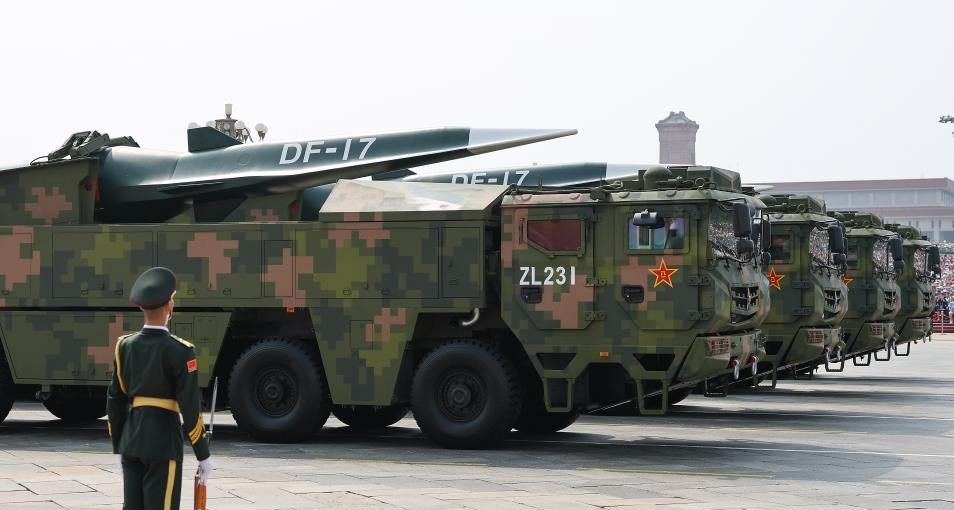 DF-17 launchers during a parade in Beijing, September 3, 2025 / Photo: Chinese internet
While the DF-17 missiles had previously been displayed statically or during military parades in Beijing (October 1, 2019 and September 3, 2025), footage has now been released for the first time of live-fire exercises conducted by a unit of the People’s Liberation Army Rocket Force (PLARF) at a firing range on the Gobi Desert in Inner Mongolia.
According to CCTV-7 commentator Du Wenlong, the system may be an upgrade of the DF-26B intermediate-range ballistic missile (DIA/NATO reporting name: CSS-5 Mod-4), with an estimated range of 3,000-4,000 km. This would be a significant observation, as the range of the DF-17, as a carrier and a separate weapon system developed by state-owned company CALT (China Academy of Launch Vehicle Technology), had until now been estimated at 1,600-2,500 km, placing it in the medium-range category, as it was believed to use the propulsion unit from the DF-16B missile. The missile is reported to be 11 m in length with a launch weight of 15 tonnes.
As for the weapon system carried by the DF-17, the DF-ZF hypersonic glide vehicle, designated Wu-14 by the US Department of Defense, was first flight-tested on January 9, 2014. It subsequently conducted further flights on August 7 and December 2, 2014; June 7 and November 27, 2015; April 2016; and twice in November 2017. It achieved speeds in the range of Mach 5 to 10. It entered operational service in 2019.
While Beijing claims it is a conventional weapon, the US asserts it may also carry a thermonuclear warhead, with American military installations on Japan’s Okinawa and all of Taiwan within range.
It is worth adding that China has also developed the DF-21D hypersonic missile with an extended range from 1,450 to 3,000 km, and in October 2020 unveiled the KF-21 (NATO/DIA reporting name: CH-AS-X-13) air-launched ballistic missile (ALBM). While the designation suggests it is a derivative of the DF-21D, it visually resembles the DF-17 – it is possible that two warhead configurations exist. Last year, China unveiled another weapon of this class: the KD-21, which was intended to enter service on Xi’an H-6K strategic bombers. It is assumed that the lighter KD-21 and heavier KF-21 serve both for striking ground and surface targets, as counterparts to the Russian Ch-47M2 Kinzhal aeroballistic missiles.
China’s DF-17 missile live launch footage revealed for the first time #CoolChina pic.twitter.com/9AVVfSNMts
— CGTN (@CGTNOfficial) June 23, 2026
DF-17 launch:
Footage shows a unit assigned to the Chinese PLA Rocket Force launching DF-17 hypersonic missiles during a joint training exercise in the Gobi Desert. #PLA #PLARocketForce #DF17 #DF26 #HypersonicWeapons #HGV#PrecisionStrike #AllWeatherStrike… pic.twitter.com/ayFBmKcPUZ
— China Military Bugle (@ChinaMilBugle) June 23, 2026
Finally a clear photo of a DF-17 ready for launch.
The DF-17 could be said as one of China’s most strategic weapon.
Why?
It Carries a HGV Warhead, gliding at MACH 10, nearly impossible for modern weapons to intercept.
A deadly weapon with pinpoint accuracy. pic.twitter.com/gAmvOrl1rv
— PLA Military Updates🇨🇳 (@PLA_MilitaryUpd) June 23, 2026