


























A Bit of History
A New Yet Familiar Model – Shell, Construction, and Features

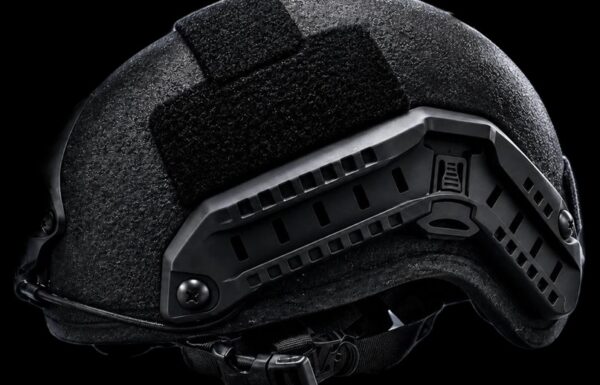
The new Danish design, marketed under the trade name PGD-ARCH Helmet (ballistic helmet), is almost the same age as the latest version of the Polish HP-05 head protection helmet from Maskpol. The helmet follows a classic and well-established construction. Its slightly flattened shell features a four-point chin strap mounting system attached with screws. It is also equipped with a three-point front mount interface and two side rails, fixed with the same screws that secure the Y-shaped chin strap. The shell is made from Kevlar aramid fiber produced by DuPont. The cut and curvature of the side mounting rails resemble the well-known American design from Gentex — the Ops-Core FAST SF High Cut Helmet. Although the cutout for active hearing protection devices has a different profile and size compared to its American counterpart, it is fully compatible with equipment such as 3M Peltor, Sordin, Ops-Core AMP Arms, Earmor, and Unity Tactical. Two side rails and the front mount are attached to the shell with screws, serving the same purpose as in other modern combat helmet models. The dimensions of the rectangular slot in the front mount and the internal spacing of the rails are standardized to accommodate widely used helmet accessories from various manufacturers. The PGD ARC rails and front mount are made of glass-fiber-reinforced nylon, which enhances impact resistance. While the geometry and exterior design of the rails, including material recesses and locking holes for adapter couplers, closely resemble those of many other models, trained eyes will notice subtle differences.

Left side of the ARCH High Cut helmet, with the black sleeve housing two BOA system tension wires clearly visible in the earcup cutout


Front of the helmet featuring a distinctively shaped front mount

Right side of the Danish helmet, showing the D-FLEX 01-1 JL buckles.
For reference, depending on the mission and tactical requirements, the front mount and side rails can be equipped with a variety of accessories, including front, side, or strobe lights, cameras, NVG devices, side covers, hearing protection, visors, gas masks, adapters, and more. Sixteen pieces of hook-and-loop fasteners in various shapes are affixed to the outer surface of the shell. Their placement and form are intentionally designed to facilitate the mounting of helmet accessories in a layered manner, allowing cables, cords, straps, or power wires from mounted devices to be routed in a clean and unobtrusive way. In practice, the mirrored arrangement of hook-and-loop patches is a distinguishing feature specific to each manufacturer, contributing to the helmet’s recognizability among the many available designs and configurations on the market. In this case, the pattern on the surface of the ARCH High-Cut helmet clearly sets it apart as a unique model. Emerging from under the front ends of the side rails, as is common in many similar designs, are green elastic bungee cords with black hooks attached to the edges of the front mount. The entire shell is coated with a layer of polyurea paint, which protects the helmet from rain, moisture, and oils. At the same time, the coating helps prevent UV fading and preserves the ballistic properties of the shell.

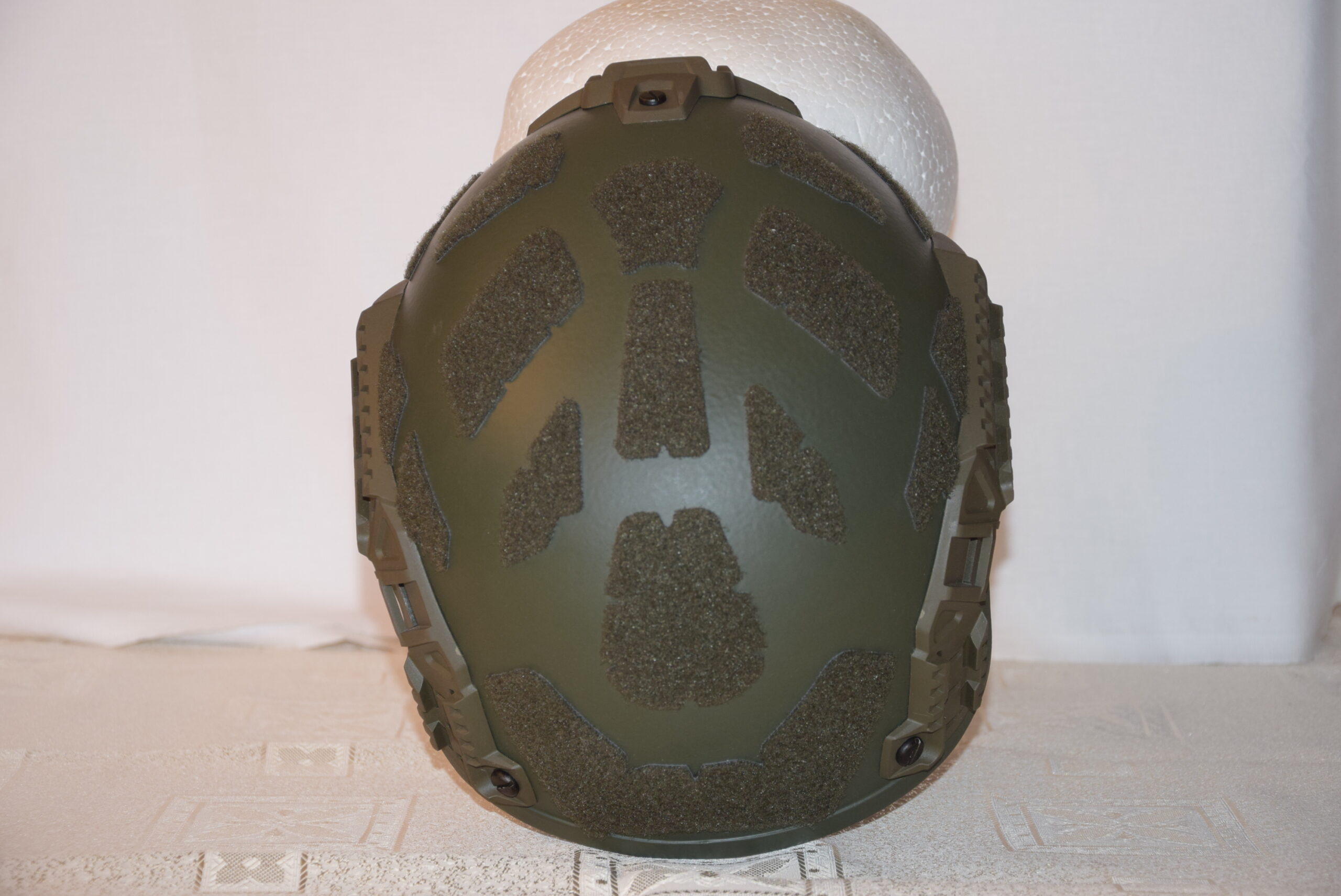
Shell covered with 16 pieces of hook-and-loop fasteners

An example showing that the hook-and-loop fasteners on the helmet can also serve as an identification surface

Interior of the ARCH High Cut featuring 10 internal padding cushions
The interior of the ARCH High Cut shell is lined with 19 round hook-and-loop fastener patches, each 42 mm in diameter, affixed to the inner surface. These serve as mounting points for 10 internal padding cushions. The round fasteners are symmetrically arranged on both sides of the shell. The cushioning pads come in square (1 piece) and oval shapes (8 small and one large frontal pad). The inner material of the pads is made using the Memory Foam Pads system. The specially developed PGD-10 memory foam technology is designed to reduce injuries caused by blunt impact while ensuring a high level of comfort during helmet use. The foam, which retains its shape, was initially developed by NASA to provide protection from impact forces. After the helmet is removed, the pads gradually return to their original thickness and are not compressed, such as in the frontal, rear, or side areas, regardless of head shape or width.
The pad covers are made from two-tone materials: the surface that contacts the hook-and-loop fasteners is black, while the sides and the surface facing the wearer’s head are black with white horizontal stripes. The thickness of the pads in the tested size XL helmet is 20 mm. The shell walls measure 10 mm thick (measured at the edge trim—effectively 8 mm). A crimped edge band protects the edges of the shell, joined at the rear.

Three types of internal pads in the ARCH High Cut helmet: from top to bottom – large oval (frontal), small oval, and square
Helmet adjustment is achieved by adding or removing pads and utilizing the built-in BOA system, which enables smooth regulation of the fit. This system adjusts the circumference via two sleeves on the sides and back of the head, each containing dual tension wires, as well as an occipital pad equipped with a mechanism for tightening and loosening. The two wire loops are anchored at the front, beneath the screws securing the chin strap, and at the back, inside the occipital pad, which features a BOA dial and is attached to short rear straps under the chin strap mounting screws.

Rear of the shell with the BOA system dial pad
This is a well-established system, replicated in many helmet models, including the Polish HP-05. Turning the dial clockwise tightens the fit by reducing the circumference, pressing the helmet snugly against the head. Lifting the dial’s knob instantly releases the tension, allowing the wires to extend. To readjust the fit, the knob must be pushed back in and the dial turned again. In practice, achieving the correct fit involves a brief process: you hold the helmet in place with one or both hands, turn the dial with your fingers, then remove the helmet when the knob recesses into the shell, readjust the system’s circumference while resting it on your knees, place it back on your head, and tighten it again. It’s not a difficult task, but it does require a bit of time and attention. As usual, manufacturers tend to describe the adjustment process as trivial, but in reality, it involves a moment of patience and precision.

Additional internal components that must also be used when fitting the helmet to the head include the temporal and occipital chinstrap straps, attached to the shell in a Y-shaped configuration. The front straps are secured to the shell with front screws, while the two rear segments are secured with rear screws, creating a four-point attachment system.
The front straps are mounted through holes in the straps using three flat-head screws with slots for a flat-head screwdriver. These allow the strap length to be adjusted to fit the wearer’s face and head shape. The rear mounting system is identical, except the straps have only two holes each. In general, adjusting the length of the temporal and rear straps is done by tightening and locking the Duraflex plastic tongue buckles. This type of chinstrap has no loose ends. Tightening the buckles and determining the correct eyelet through which the mounting screw passes enables precise helmet adjustment on the head. However, this process can be time-consuming if the screws need to be removed. The chinstrap is fastened using PGD buckles made from materials supplied by ITW Nexus and Duraflex. In the described helmet, the buckle used is the UTX D-FLEX M-SS-5/8″ model, while the tongue buckles are D-FLEX 01-1 JL. On the extended right-side strap segment, a two-part chin cup is located, which wraps under and over the chin. The buckle is located on the left cheek. The chinstrap segments are made from 14.5 mm-wide synthetic webbing. The chin cup and cheek strap, featuring a buckle, are lined on the inside with soft, black suede-like material that feels pleasant against the skin and absorbs sweat.
Ballistic properties
As previously mentioned, the helmet shell is made of aramid fiber under the trade name Kevlar, produced by the American company DuPont. The Danes have manufactured the helmet with a declared protection level of IIIA, in accordance with the requirements of the American standard NIJ 0106.01.

The manufacturer also confirms the shell’s ballistic resistance against .44 Magnum, .357 SIG, and 9 mm ammunition. The ballistic resistance against a standard 17-grain (1.1 g) fragment, measured according to the STANAG 2920 standard, reaches up to 700 m/s. Ballistic tests have also shown that the backface deformation (BFD) area after impact remains within a diameter of up to 75 mm, with a depth of up to 9 mm, compared to the average reference value of 11.2 mm.
These results indicate that the design developed by Danish engineers and designers meets the expectations of users who choose this product, as their lives ultimately depend on it.
Sizes, Colors, Weight
Assessment: General and Personal Impressions
It’s time for an – admittedly subjective – assessment of the described model. At first glance, the product stands out for its precise craftsmanship. The surface is smooth, with a very subtle “salamander” texture in a matte green color, complemented by a grainy finish reminiscent of cream stirred into soup. To the touch, the surface feels smooth, and the grain is not perceptible under the fingers. The hook-and-loop patches are arranged in a perfectly symmetrical pattern across the shell. The front mount, attached to the shell with three screws, sits securely and firmly in place. The side rails are flawlessly fitted to the curvature of the shell, with no gaps or spacing between the spherical shell and the rail’s cutout. You couldn’t slide even a sheet of paper between the elements. However, between the front mount and the shell, specifically above and below the mount’s arms on the sides, a sheet of paper can be fitted. This isn’t a flaw, but when compared to the precision of the rail fitment, it does stand out.
After intensive use, the white stripes on the pad covers will turn black. In practice, it’s worth buying a new set at that point, because after another wash, the stitching will likely give out, or the thin, worn material will tear in places due to wear. This happens with nearly all pads: although the material wicks away sweat (for a while), it offers no protection against friction and dirt.
In terms of wearability, the helmet performs well. There are no perfect helmets, so “well” here means “comfortably.” As always, the key is to achieve an almost perfect fit to the shape of the wearer’s head, as previously mentioned. The correct number of pads inside the shell, their placement, and density are the first step. The second step is to adjust the circumference using the BOA system with the appropriate tension. The third is setting the correct length of the temporal and occipital straps. It’s important to note that the right and left sides of the chinstrap are not equal in length: the right segment, from the crossing point to the start of the chin cup, is 10 mm longer than the left. As a result, the proper placement of the locking buckles on the occipital straps won’t be symmetrical. Incorrectly adjusting the buckles will cause the chin cup to rest on the edge of the chin, not fully cradling it. In my opinion, the opening of the chin cup should be slightly larger and better suited for oval faces. Pointed or narrow chins fit the tested model perfectly, but rounder faces not so much. On the bright side, this is a common issue even with helmets from top-tier manufacturers.
I keep repeating this: when the helmet is fitted correctly to the head, it won’t interfere with long-term wear, especially if the user intends to add accessories, possibly mounted asymmetrically. A counterweight won’t help if the helmet already tilts forward from the start due to incorrect strap length. It’s important to understand that the chinstrap system operates by tension, not compression. Therefore, manufacturers’ claims of instant helmet adjustment and fit, for example, using the BOA system with one hand, should be taken with a large grain of salt. The BOA dial pad, recessed at least halfway under the helmet rim, doesn’t easily allow fingers to slip under the shell and turn the knob without resistance. It’s doable, yes, but far from effortless. Turning the dial from above is, by definition, impossible. Without any added accessories and with proper adjustment, the helmet remains stable, shifting neither forward, backward, nor sideways.

What else? When buying something, we always hope to receive a perfectly crafted product. This one has its flaws and minor imperfections that should be mentioned. I generally have concerns about the precision of the cut along the shell’s side profile; the cut area above the ears often shows irregularities and errors resulting from manual trimming with a saw. On the tested unit, the edges on both sides are unevenly cut. There are visible bulges on the edge (the cutter’s hand slipped, causing a bump that wasn’t properly trimmed). The edge band does not conceal these flaws—it highlights them. Unevenly distributed glue, once hardened, also contributes to the effect. The edges above the ears are cut at an angle. At the front, back, and behind the ears, the saw cut perpendicular to the shell; above the ears, it went in at an angle. When the edge band is pressed on, this defect becomes even more visible. In other words, the inside of the shell sits closer to the ear, while the outside edge is higher. It may seem like a small thing, but I notice it. To put it in car terms (since everyone understands cars): it’s like a door that touches the frame on the inside, but from the outside, there’s a wide gap.
When properly pressed on, the edge band reveals these manufacturing flaws. The fit of the components is acceptable; the distances and spacing between elements are almost consistent. However, you can still spot differences in the alignment of the rail bases relative to the top of the band. On the left side, it’s higher; on the right, lower. That’s yet more proof of uneven cutting. I would also adjust the front mount, which is slightly tilted to the left.
Some might say that what I’ve observed doesn’t affect the helmet’s combat performance. True, it doesn’t. However, the manufacturer claims to produce high-quality helmets with 100% European provenance, offering an alternative to cheap Chinese imports, so the build quality should be just as high.
The synthetic strap segments of the chinstrap are made from what feels like plastic webbing (as is common in many similar designs). With sweat and dirt, it stiffens and loses its ability to wick moisture. Cotton or natural-fiber blends behave similarly but do absorb sweat. Plastic, in contact with the skin, feels unpleasant and irritates freshly shaved skin. Cotton is noticeably gentler.
Problems can also arise when fastening or unfastening the chin buckle. The components are small and may be challenging to handle while wearing gloves. Only bare fingers can reliably locate and manipulate the flexible buckle parts. Tightening the buckles on the temporal straps often requires two hands, one to pull the buckle, the other to hold the strap, or vice versa.
Despite these drawbacks, I still give the Danish ARCH High Cut helmet a good rating.
The helmet is priced at 520 euros directly from the Danish manufacturer. In the Strefa Celu store, the listed price for the described model is 2,599.00 PLN per unit.
Sincere thanks to Jammas Sp. z o.o., owner of the Strefa Celu store and distributor of Protection Group DK in Poland, for providing a sample helmet for comparative testing and evaluation.
All product tests are conducted independently. The opinions expressed are solely those of the author. Advertisers do not influence the content of the review.