
















Let us recall that on 9 November of this year, information emerged that a few weeks earlier the Ministry of National Defence had sent the United States a Letter of Request (LoR) regarding the possible acquisition of Strykers by Poland to fill the gap left by the hundreds of BWP-1s and Rosomak APCs delivered to Ukraine. The Americans were said to have proposed transferring a batch of vehicles free of charge through the EDA (Excess Defense Articles) procedure, in connection with plans to restructure their forces in Europe (as it turned out, related to the new National Security Strategy published on 5 December). Later, the defense ministry confirmed that the General Staff of the Polish Armed Forces recommends taking over the vehicles, but only after a detailed inspection of their technical condition.
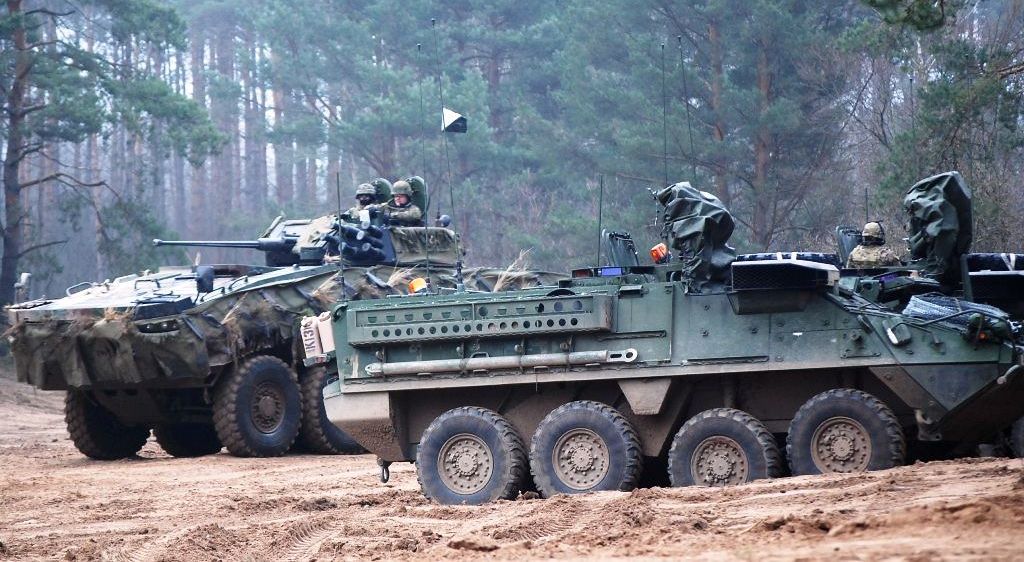 Photo: captain Jan Błaszczak, 12th Mechanized Brigade
Technical parameters
The KTO Rosomak in its baseline version, the Finnish-licensed Patria AMV (Armoured Modular Vehicle), is 7.75 m long, 2.83 m wide, 2.35 m high (hull), and has a mass ranging from 16 to 24 metric tones. It is powered by a Scania DI 12 compression-ignition diesel engine producing 480 hp (360 kW), which allows for a top speed of over 100 km/h on paved roads (up to 10 km/h in water thanks to two waterjets) and a range of up to 700 km. The vehicle can ford water obstacles up to 2 m deep, cross anti-tank ditches 2.1 m wide, climb vertical obstacles 0.7 m high, and has a maximum approach angle of 63° and a side slope capability of 58%.
The baseline Stryker ICV in the M1126 infantry carrier version, derived from the Canadian LAV III, is 6.95 m long, 2.72 m wide, 2.64 m high (hull), and weighs 16.47 metric tones. It is powered by a 7.2-liter turbocharged Caterpillar C7 diesel engine producing 350 hp (260 kW), enabling a top speed of up to 97 km/h on paved roads and a maximum driving range of up to 500 km (as part of the upgrade to the M1256 ICVV variant, engine power was increased to 450 hp). The vehicle can ford water obstacles 1.32 m deep without preparation (1.98 m with a deep-ford kit), cross anti-tank ditches 2.06 m wide, climb vertical obstacles 0.61 m high, and offers an approach angle of 31° and a side slope capability of 30%.
Specialized variants
The KTO Rosomak entered service with the Polish Armed Forces in early 2005. The basic version was the wheeled infantry fighting vehicle equipped with the Leonardo OTO Melara Hitfist-30P turret system (now being replaced with the Polish 30 mm Remote-Controlled Turret Systems).
Specialized variants include: the Rosomak-M1 and Rosomak-M1M with QinetiQ RPGNet protection against shaped-charge projectiles; the Rosomak-M2/M3 troop carrier with an open weapon mount; the Rosomak-S Spike missile carrier; the Rosomak-WEM medical evacuation vehicle; the Rosomak-WRT technical reconnaissance vehicle; the Rosomak-WPT technical support vehicle; the Rosomak-RSK CBRN reconnaissance vehicle; the Rosomak AWR artillery reconnaissance vehicle; the M120K Rak 120 mm self-propelled mortar; the Rosomak WD command vehicle (including the new Kroton-bis and Zawilec versions); and the Rosomak-NJ driver-training vehicle. Prototypes have also been developed of the multi-sensor reconnaissance and surveillance system Rosomak-WSRiD, the Rosomak R reconnaissance vehicle, the Wilk fire support vehicle, as well as the latest MLU modernization variant, from which the lengthened Rosomak-L with the ZSSW-30 turret is derived.
The Stryker ICV entered U.S. Army service in 2002. In addition to the aforementioned basic M1126 ICV infantry carrier, the following variants were developed: the M1127 RV reconnaissance vehicle; the M1128 MGS fire support vehicle (wheeled tank destroyer); the turretless M1129 MCV mortar carrier; the M1130 CV command vehicle; the M1131 FSV fire support vehicle; the M1132 ESV engineer support vehicle with the LWMR mine roller; the M1133 MEV medical evacuation vehicle; the M1134 ATGM anti-tank guided missile vehicle; the M1135 NBCRV CBRN reconnaissance vehicle; and the M1126 ICV-Dragoon infantry fighting vehicle.
On the modernized Stryker A1 with a Double V-Hull (DVH), designated Stryker DVH A1 or ICVV-A1, additional variants were developed: the M1265A1 Sgt Stout (M-SHORAD) short-range air defense system; the M1251A1 FSVVA1 fire support vehicle; the M1252A1 MCVVA1 mortar carrier; the M1253A1 ATVVA1 anti-tank vehicle; the M1254A1 MEVVA1 medical evacuation vehicle; the M1255A1 CVVA1 command vehicle; the M1256A1 ICVVA1 infantry carrier; the M1257A1 ESVVA1 engineer support vehicle; and the M1304 ICVVA1-30mm infantry fighting vehicle (under development). Numerous experimental modifications and test variants have also been produced.
Service
Outside Poland, where an estimated more than 860 KTO Rosomak and their derivatives are in service, the baseline Patria AMV has entered the armed forces of Finland (62 XA-360 infantry carriers and 18 XA-361-AMOS self-propelled mortars), Sweden (113 Pansarterrängbil 360 infantry carriers with an option for 113 more), Croatia (126 vehicles, including BOV-P12.7 / BOV-Mk19 carriers, BOV-ZP command vehicles, BOV-POB anti-tank vehicles, BOV-P30 infantry fighting vehicles, BOV-San medical evacuation vehicles, and BOV-Log technical recovery vehicles), South Africa (22 out of 254 Badger vehicles in the following variants: 30 mm combat, 30 mm combat support with ATGM, 60 mm mortar, command, ZT3 Ingwe ATGM tank destroyer, and optionally 120 mm gun and medical evacuation), Slovenia (30 SKOV Svarun, 20 of which are equipped with the Protector RCWS, plus 106 next-generation Patria AMV XP ordered), and the United Arab Emirates (45 export Rosomak chassis with an option for 50 more, fitted with BMP-3 turret systems and NEMO mortars under the name Rabdan). The AMV has also been unsuccessfully offered in Australia (as the AMV35 in cooperation with BAE Systems), to the U.S. Marine Corps (as Havoc in cooperation with Lockheed Martin), and to Canada, Germany, the United Kingdom, the Czech Republic, Romania, Lithuania, Denmark, Spain, Qatar, Norway, Estonia, Bulgaria, and Ukraine.
Meanwhile, the U.S. Army fields an estimated 4,500–4,700 Stryker ICVs, and for many years the vehicles were not exported. Only in recent years have they begun to be delivered abroad, to Thailand (130 units, all now delivered), North Macedonia (initially 54 units, reduced to 42 in 2024), Bulgaria (183 units—deliveries not yet started), and Argentina (8 ordered out of a planned 207; deliveries have begun). They have also been sent to war-torn Ukraine as U.S. government military aid (over 400 delivered, of which 82 have been destroyed, damaged, abandoned, or captured). The type is also being considered in Chile as a replacement for the Mowag Piranha I, and for licensed production in India, although New Delhi abandoned its procurement plans according to information from July this year. Strykers have been unsuccessfully offered to Canada, Israel, and Lithuania.
