
























On Thursday, 11 December 2025, the American company Northrop Grumman announced that, together with the U.S. Air Force (USAF), it had conducted the first separation test of the new anti-radiation missile codenamed SiAW (Stand-in Attack Weapon) from an F-16 multirole fighter aircraft. Ultimately, the missile is to be integrated with fifth-generation F-35A Lightning II multirole fighters.
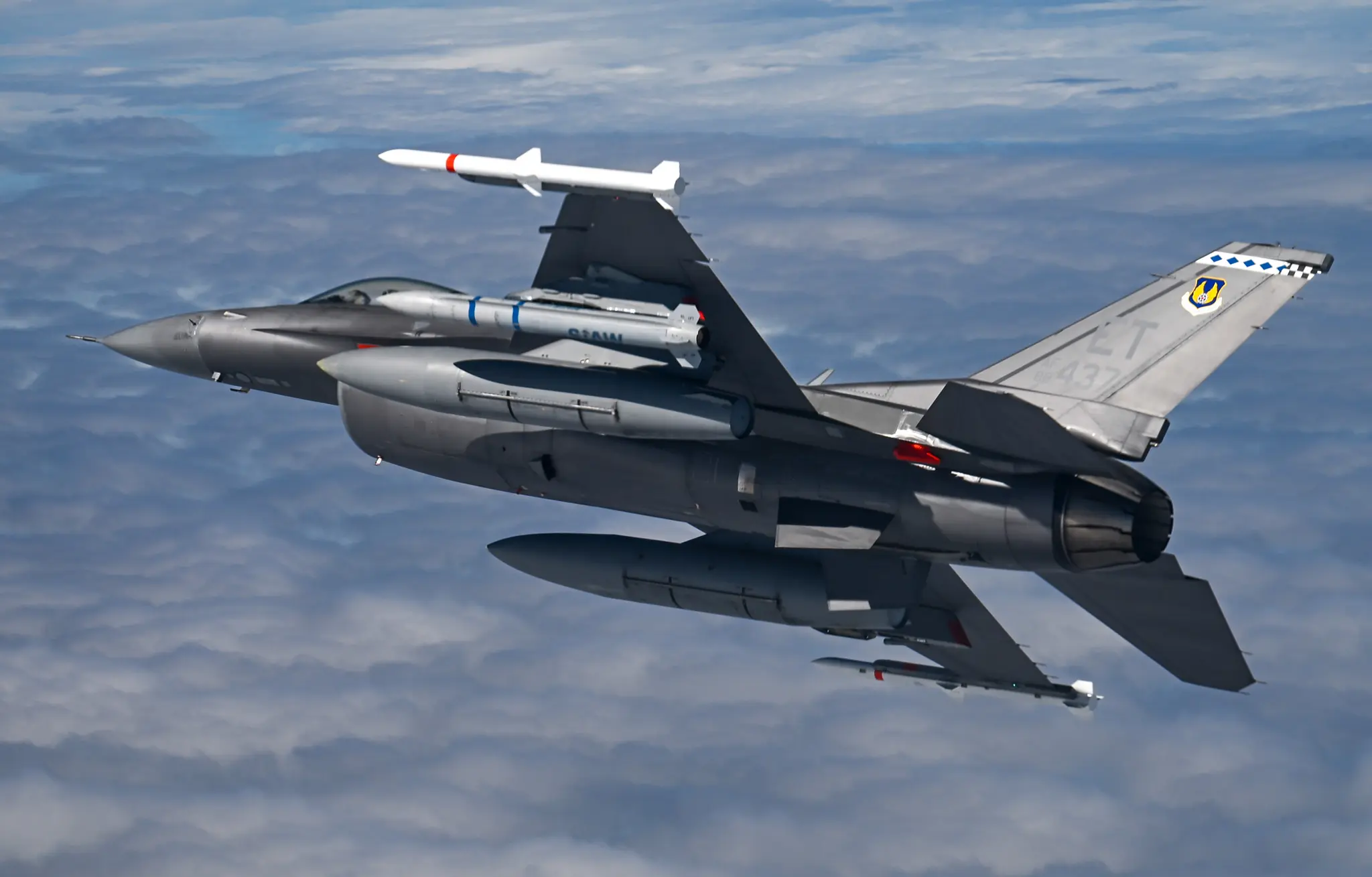 Photo: USAF
According to the information released, the recently conducted test was intended to verify the flight safety and aerodynamic characteristics of the SiAW missile and to demonstrate progress toward integration with its intended platform. The first deliveries of test missiles and inert mass-and-dimension simulators began in November 2024, when the initial flight tests of the latter were carried out.
Col. Gary E. Roos, senior materiel leader, Adaptive Weapons Division, Air Force Life Cycle Management Center:
“The separation test of SiAW from the F-16 is intended to provide the United States Air Force validation of the weapon’s safe separation characteristics and also generate invaluable data for optimizing its performance. The results can reinforce SiAW’s ability to provide a critical advantage to warfighters in the face of evolving threats.”
Chuck Johnson, vice president, advanced weapons, Northrop Grumman:
“This milestone is a key step forward for the SiAW program. With the insights from the separation test, we will continue missile development and ultimately, deliver a critical capability to the warfighter. Our work ensures the U.S. Air Force will have a highly survivable precision strike weapon that will meet current and future mission needs.”
The aim of the tests is to verify the correctness of the missile’s integration with the carrier aircraft, which opens the way to subsequent stages, namely the live firing of the missile itself.
Meanwhile, on 9 December this year, the U.S. Air Force Life Cycle Management Center (AFLCMC) of the USAF Air Force Materiel Command at Eglin Air Force Base in Florida awarded Northrop Grumman a 100 million USD contract to support the production, research, and development of the SiAW missile.
 AGM-88G AARGM-ER carried by F-35A Lightning II / Photo: Northrop Grumman
SiAW
It should be noted that on 25 September 2023 the company won the SiAW program, defeating a competing bid from Lockheed Martin, and received a contract worth approximately 705 million USD. A request for information (RFI) in this matter was published on 9 January 2020.
Under Phase II of the program, lasting 36 months, the company is to continue developing the missile system, carry out integration with the platform, and finalize the flight-test program to enable rapid prototyping in preparation for entry into service. The work is being carried out at the company’s facility in Northridge, California, and at a manufacturing plant in Allegany Ballistics Laboratory in West Virginia, where serial production is to take place in the future.
As part of Phase II of the SiAW program, the USAF plans to declare initial operational capability of the system by 2026. This phase consists of Stage 2.1, covering captive-carry flight tests, and Stage 2.2, involving three additional flight tests with missile launches, as well as the delivery of prototype SiAW missiles and test assets.
SiAW is intended for combat use in Suppression of Enemy Air Defenses (SEAD) operations and will be capable of engaging surface-to-air and missile defense systems, ballistic and cruise missile launchers, GPS jamming systems, and anti-satellite systems in heavily contested anti-access/area-denial (A2/AD) environments.
SiAW is based on a modified airframe of the extended-range AGM-88G AARGM-ER (Advanced Anti-Radiation Guided Missile–Extended Range), which was developed by Northrop Grumman for carrier-based F-35C aircraft under a U.S. Navy contract, with work initiated in 2016. The first successful firing of an AGM-88G AARGM-ER from a U.S. Navy F/A-18E Super Hornet test aircraft took place on 2 August 2021.
In addition to the U.S. Navy, Australia has also decided to procure the AGM-88G AARGM-ER (63 missiles in the first batch and 100 in the second), Finland (150 missiles), and Poland (according to the Ministry of National Defence, more than 200 missiles were ordered; unofficially, the figure is said to be 240 under approval for 360). In April last year, the Kingdom of the Netherlands received approval to acquire 265 missiles.
The missiles are currently being produced in three initial batches featuring a new propulsion unit and an improved warhead, based on newly manufactured guidance systems comprising a passive radar signal receiver, satellite and inertial navigation systems, and a millimetre-wave radar. This differs from the baseline AGM-88E AARGM, in which the propulsion unit and warhead are sourced from stockpiled AGM-88 HARM (High-speed Anti-Radiation Missile) missiles of the previous generation.
The missile received a new airframe with a diameter of 290 mm and a ramjet engine with a subsonic combustion chamber, which is expected to double the range from 110 km to approximately 220–250 km. The maximum speed is also expected to increase.
We completed a separation test of the Stand-In Attack Weapon from an F-16 with the @usairforce ! This milestone highlights SiAW's flight safety, aerodynamic performance and progress toward integrating with fifth-generation platforms like the F-35. Read more:… pic.twitter.com/jtwWgBwsY3
— Northrop Grumman (@NGCNews) December 11, 2025
