
















Jakub Link-Lenczowski, MILMAG: During the MILIPOL trade fair in Paris, we spoke with Maciej Kłosiński from the WB Group, who explained that speed cameras today are not merely tools of repression against drivers, but can also significantly contribute to strengthening national security.
Maciej Kłosiński, WB Group: That is an excellent starting point for such a discussion. Especially since, in principle, we are not actually talking about speed cameras, but rather, we should be talking about sensors that analyze road traffic. Some of these devices are equipped with very advanced 3D radars capable of tracking more than 200 points simultaneously. And here we can immediately move to the first interesting characteristic. The devices offered by the WB GROUP through its specialized company, PolCam Systems, responsible for road traffic management, can track 32 vehicles simultaneously across six traffic lanes. In other words, referring to the speed camera example, they could take 32 pictures at once. Of course, they do not do this because such a scenario practically never occurs.
Returning to the earlier point, sensors: modern road traffic management and monitoring systems are solutions equipped with “intelligent” cameras. Today, this is not simply a camera recording footage that someone later painstakingly analyzes for hours. Everything is fully automated. The camera can not only detect a vehicle’s registration number, but also its color and make (A Hundred SmartEye Systems for Croatia).
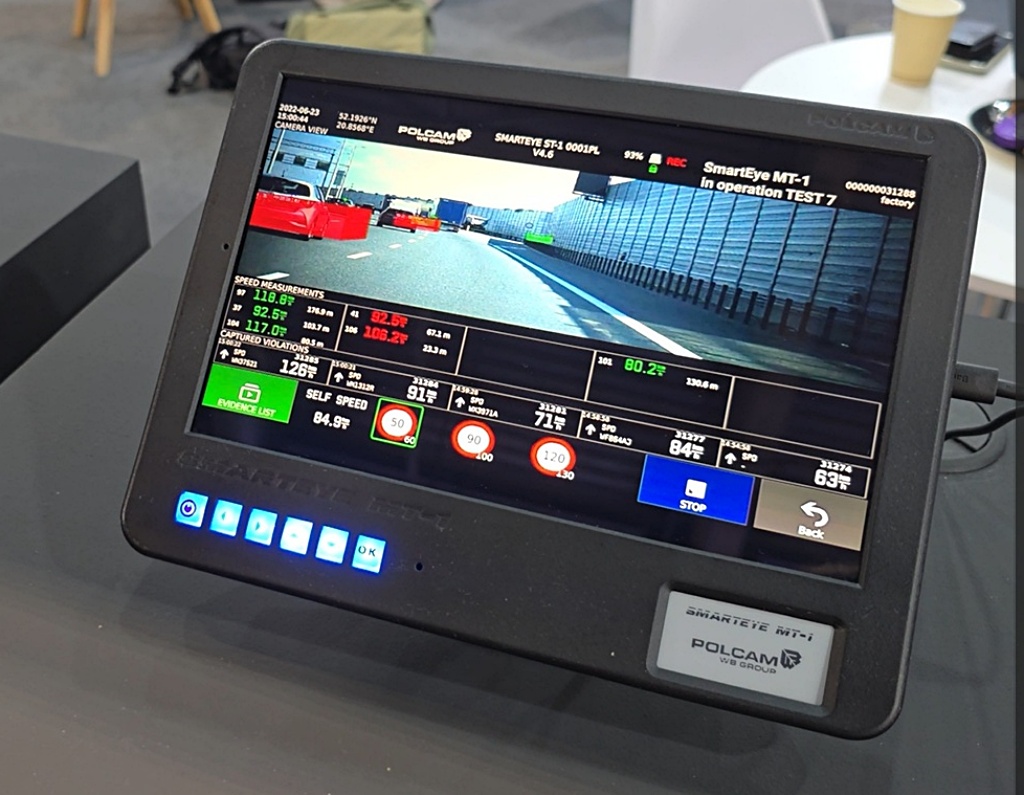 The SmartEye MT-1 device terminal displaying a recording from a test conducted under real traffic conditions / Photo: Jakub Link-Lenczowski, MILMAG
Here we move on to the less obvious functions. The obvious one is detecting when someone exceeds the speed limit. But when we can combine the data I mentioned earlier, the system itself can generate information that a Ford of a particular body color and with a given license plate number traveled in compliance with traffic regulations, but such a car does not exist in the CEPiK database, the central register of vehicles and drivers. Or that the vehicle does appear in the database, but has just been marked as stolen or wanted.
This is the first of the less obvious functions, but I am still operating within the realm of road safety. Such systems are not primarily meant to issue fines or repress drivers, but above all to ensure road safety, which is something I always emphasize.
In Poland, the primary function is prevention. That is why we have warning signs placed before stationary speed cameras. Additionally, the radar units are distinctively painted and installed in visible locations. Contrary to what one might think, this is not common practice worldwide. And this is precisely what distinguishes countries focused on repressing drivers from those that create an environment in which drivers do not exceed the speed limit or create dangerous situations.
However, our solutions are designed to support road traffic safety management. When describing what we can do with data from PolCam Systems sensors, I would prefer to give an example related to public safety and crisis management. An intelligent camera not only analyzes and provides the data I mentioned earlier, but also classifies the vehicle. In other words, it can determine whether it is a passenger car or a two-wheeler, and it can distinguish a truck from a bus.
In an extreme threat situation, such as an armed conflict, which I hope will never occur in Poland, we would be able, at specific road junctions, to extract important information from this analysis. For instance, if a column of trucks is heading east and their license plates indicate they are military vehicles. Conversely, if a massive number of cars and buses were moving in the opposite direction, significantly exceeding the average from many months or years, it could indicate that people are fleeing from eastern regions or that potential refugees are being transported (AMSTA will defend the borders).
This data is not collected or analyzed at the national level today. Yet, it already exists in the Polish Police’s central database. It would simply need to be made accessible and analyzed in a way that provides this additional value.
MILMAG: So essentially, we are talking about moving beyond the level of a single camera to a system of dozens, hundreds, or even thousands of cameras that together can analyze the characteristics and dynamics of road traffic over a large area, even an entire country, and detect and alert regarding anomalies that appear?
MK: Absolutely. And this is not a new or groundbreaking approach, because today all speed cameras and traffic-monitoring cameras, as well as municipal surveillance systems in large cities and beyond, are networked. Data flowing from them is centralized. It is only a matter of implementing the proper tools, sufficiently advanced artificial intelligence, or machine-learning systems that can extract additional value.
When we talk about networking many thousands of sensors, most of which will be imaging sensors, or cameras, we can take it a step further. I mean managing road traffic safety and public safety in crisis situations. Anonymized data would enable, over the long term, analysis of vehicle flows and their patterns by day of the week, season, specific dates, or holidays. On this basis, one can generate insights that support better, more accurate decision-making when planning road network expansion. And such investments involve vast amounts of money. They are decisions with long-term consequences. It is therefore worthwhile to support them with data.
MILMAG: Please tell us, can these types of cameras also be used, for example, to protect critical infrastructure facilities of particular importance to national security?
MK: Again, the answer is yes. I’d like to emphasize that we are still talking about the same data, analyzed from different angles and in various ways. Imagine that our systems are deployed around critical infrastructure components. This does not have to be the Police Headquarters or the General Staff, but training grounds, various types of depots, refineries, LNG terminals, and so on.
Sensors placed in appropriate locations will not only tell us when and how many vehicles passed by, but can also detect that a particular car has suddenly appeared, one that has never before been seen near a vital facility, yet in the past month has driven around it four times. Generally, if we pass by a protected installation, we do not circle it. And yet this vehicle circled it four times. By recognizing such an anomaly, the system can suggest that next time the driver appears, it may be worth asking about his intentions. This is the simplest example of how such a system could be used.
Using imagery from our system’s cameras, we can also determine the size of a traffic jam. This allows us to reroute certain vehicles, for example, military or emergency service vehicles, to alternative routes. Or, conversely, direct them precisely there. It’s not only about identifying the traffic jam itself, but also about determining which vehicles are stuck in it. The fact that traffic is stopped somewhere is something we can learn even from the commercial apps on our phones. But our system will provide information on what types of vehicles are present, whether they are military, and whether they arrived from distant regions. This may prove crucial for making the right decision.
MILMAG: A technical question, since your system reads data, in what format are these data generated? Can they interoperate with analog systems used by other operators? In Poland, the military has its systems, the Police have theirs, and abroad it’s even more complex.
MK: Different systems accept data in different formats. PolCam Systems’ solutions share a key feature with the entire WB Group: a large share of our sales is generated outside Poland. A good example in Europe is Croatia or Portugal, where the number of our deployed devices is already in the hundreds.
Each time we win a tender and begin delivering such solutions, we integrate with the central database system that is supposed to ingest this data. That is why our architecture was designed to allow us to prepare data in whatever format the end-user’s system requires, relatively easily. This, of course, is part of the technical support we provide. The customer defines the desired data format, and we adapt to it. We also have our own solutions, such as ATLES, which integrate and manage all PolCam Systems products.
A more interesting question is how much of the data we can provide, and there is genuinely a lot of it, the customer is willing or able to ingest into their system. In some use cases, the only thing the user cares about is retrieving images with license plates of speeding vehicles. But we can also distinguish the vehicle class, color, or make. We can go even further, monitoring the number of vehicles and their average speeds. All this information can be analyzed and used by various services, not only those managing day-to-day road safety.
MILMAG: So, to summarize our conversation, PolCam Systems’ solutions are not just a network of speed cameras meant to hound drivers, but primarily advanced sensors that already perform preliminary data analysis and classification, allowing the data to be used in various ways, including by special services?
MK: Exactly, and this is in fact the main direction in which the WB Group’s products are evolving. The systems can be integrated with one another and work together. The WB Group offers border-perimeter protection systems, which are precisely what we were discussing in the context of critical infrastructure security. We also provide communication-integration systems for various services. This includes not only voice communication but also streaming recordings, images, short messages, and task sending.
Within the WB Group, we aim to build an ecosystem where all this data can be gathered in one place at the same time. By analyzing them from many angles, we can extract a great deal of information. I will also mention EyeQ, an AI-assisted target recognition and classification system. It is a military solution, but it also fits within the broad spectrum of analytical systems that provide data to enable quick, accurate decision-making.
SmartEye Traffic Surveillance System
SmartEye is intended for traffic monitoring and the automatic generation of evidence materials. The device includes a tracking radar using 3D technology and a high-resolution camera. The traffic surveillance system automatically records and transmits materials to a server at the central ticket-generation service. The system architecture allows it to operate on a tripod with a touchscreen or to be installed on a fixed structure, while communication is via remote access. PolCam Back Office software is used for operation.
According to the manufacturer, SmartEye meets the current requirements for speed-measurement devices imposed by institutions that approve and accredit systems within the European Union, including approval standards. The system meets OIML R91 and WELMEC requirements.
Main Functions:
- Monitoring up to 32 vehicles simultaneously
- Speed measurement
- Distance measurement in the measurement zone from 10 to 80 meters
- Recording metadata for each detected vehicle
- Monitoring speed limits for each traffic lane
- Red-light enforcement
- No-turn enforcement
- Wrong-way driving detection
- Bus-lane enforcement
- Checking lists of vehicles without valid technical inspections
- Checking lists of vehicles without valid liability insurance
- Vehicle-type recognition
- Generating evidence materials in Full HD video and high-resolution photo formats
- Automatic camera-image adjustment to changing weather conditions
- Day and night operation enabled by a flash unit
Specifications:
- Compact and lightweight architecture
- Mounting on tripods with a height of 1–2 m
- Mounting on fixed installations at heights of 3–9 m
- Installation in any type of vehicle
- IP66 ingress protection rating (IP67 on request)
- Camera options: HD, 5 MPx, 12.4 MPx, additional IP camera
- Accuracy: ±3 km/h up to 100 km/h, ±3% above 100 km/h
Sponsored content
