
























The ceremony was attended by numerous invited guests, including Deputy Prime Minister and Minister of National Defence Władysław Kosiniak-Kamysz. This was the first time in many years that a politician of such high rank participated in the christening and launch of a new ship for the Polish Navy. The last similar event took place in September 2015, when then–Prime Minister Ewa Kopacz attended the christening of the prototype Kormoran.
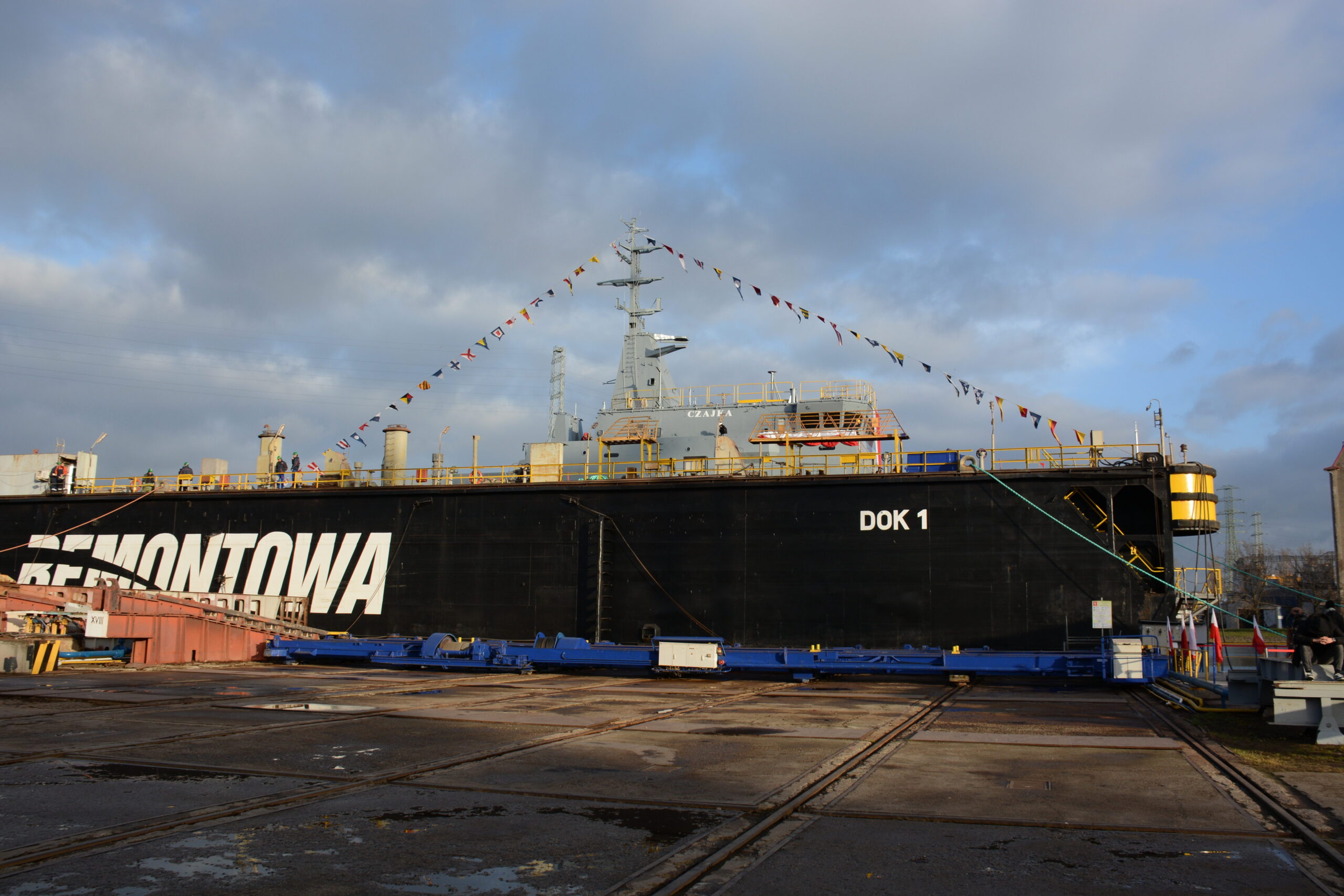
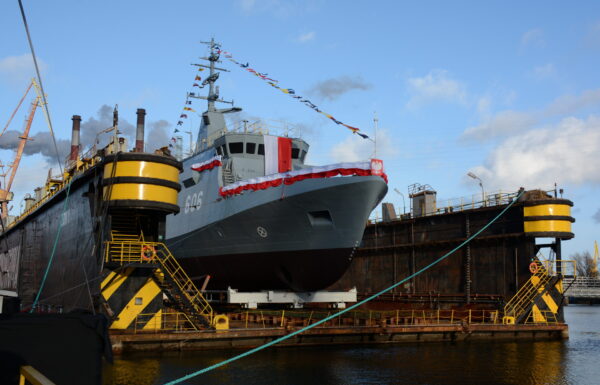
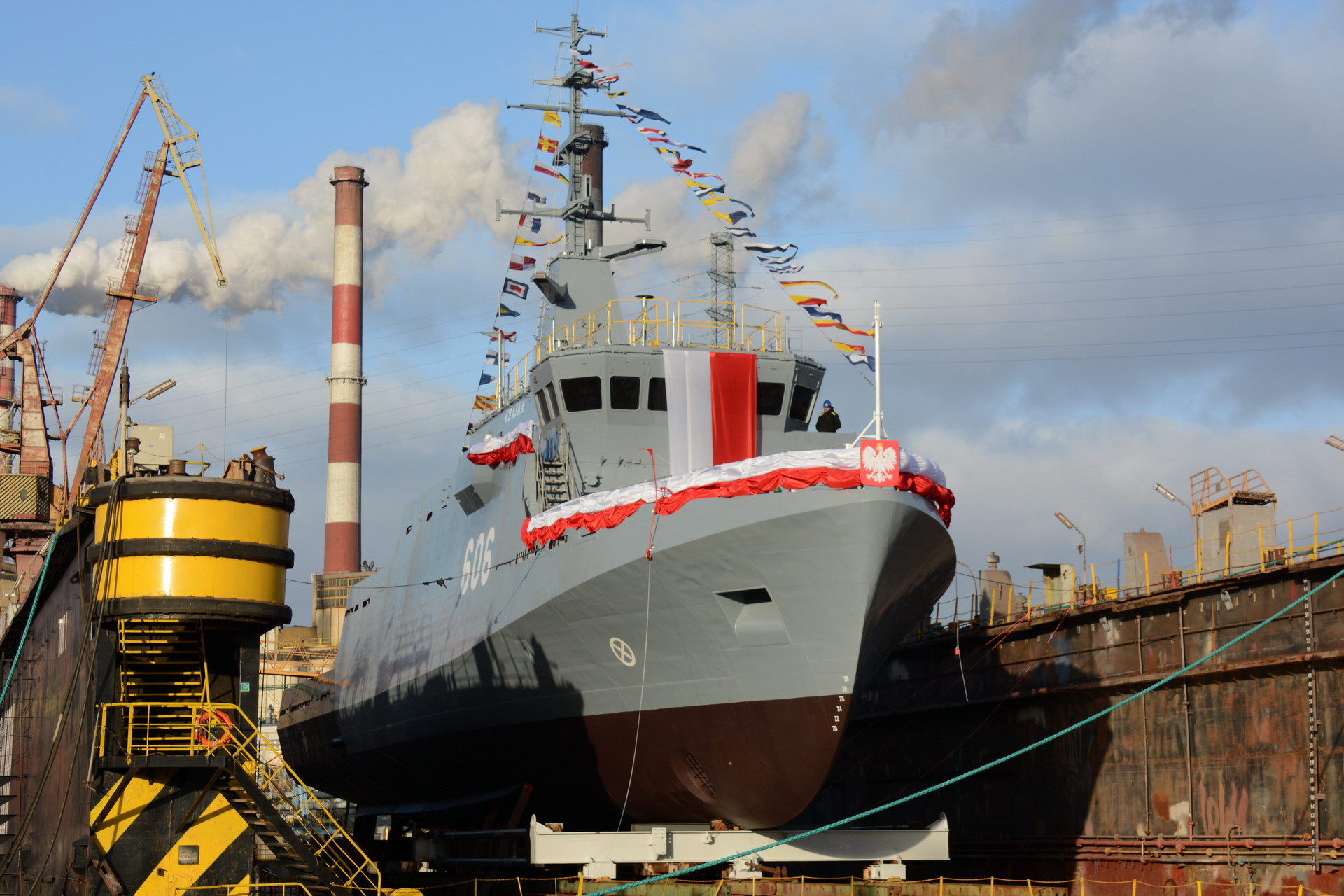 Project 258/6 prepared for launching in Dock No. 1 at Remontowa Shipbuilding / Photos: Przemysław Gurgurewicz, MILMAG
After the christening ceremony, the ship’s launching procedure began. For mine countermeasure vessels, this process is always carried out using a floating dock. It is a multi-stage operation that lasts several hours. After the dock is moved away from the quay, it begins to submerge slowly until the hull of the vessel touches the water, a moment regarded as the symbolic launch of the ship and marked by the sound of a siren. Next, after partial submersion, a watertightness check of the hull is conducted to verify that no leaks are present. Once concluded, the dock continues to submerge until the vessel is fully afloat. The final stage of the operation is towing the ship out of the dock and positioning it at the shipyard’s outfitting quay.
The future ORP Czajka is the third and final Project 258 vessel of the second series, built since 2023 and intended for the 12th Wolin Minesweeper Squadron of the 8th Coastal Defence Flotilla, based in Świnoujście. The original value of the contract, approved by the Minister of National Defence on 26 June 2022, amounted to 2.49 billion PLN. All three ships received traditional names: Jaskółka (pronounced yaskoowka), Rybitwa, and Czajka, previously borne by Polish Navy mine countermeasure vessels.
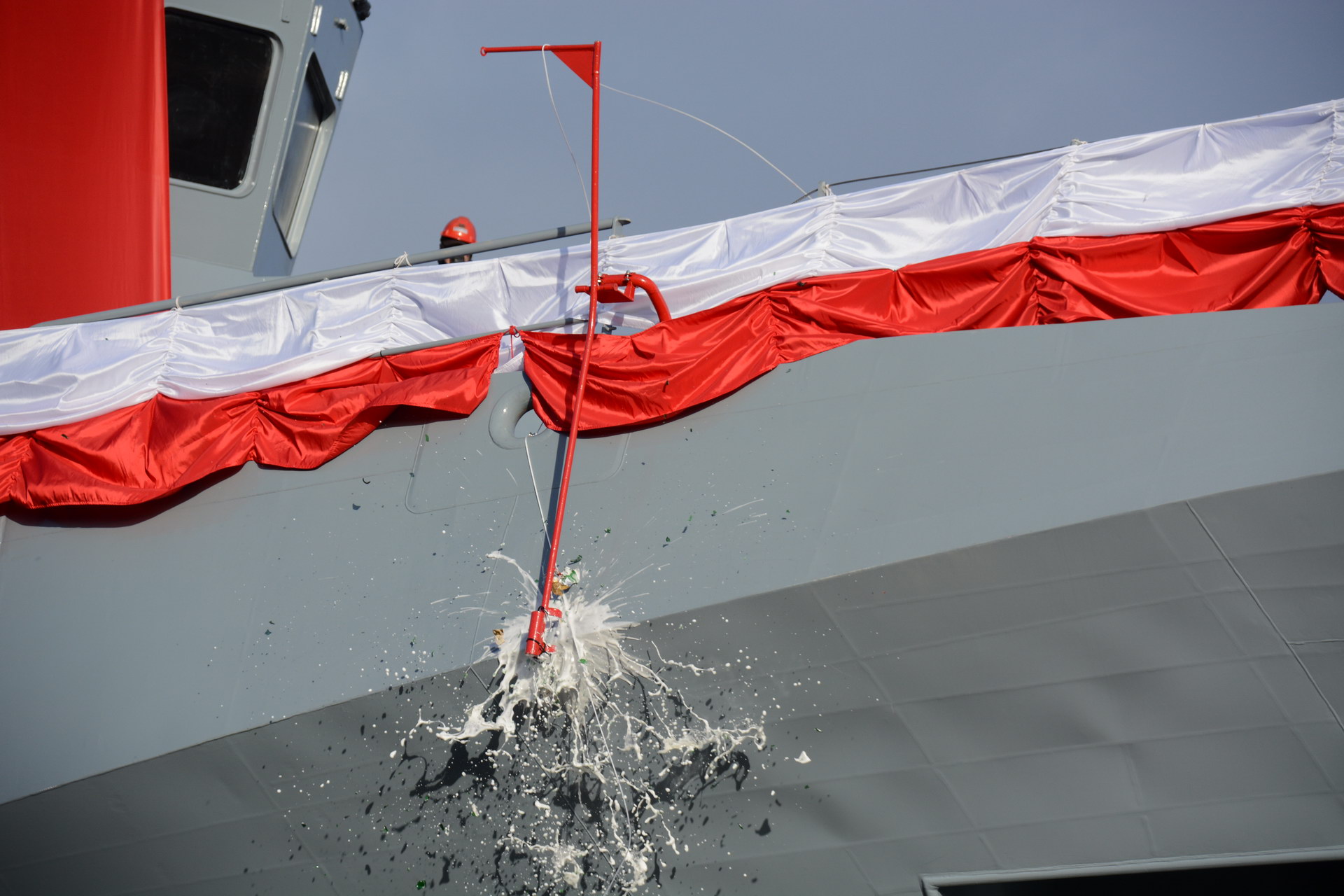 The moment the champagne bottle was smashed against the hull
Construction work on the new series began on 28 March 2023 with the cutting of the first steel plates for vessel 258/4. This was followed by the laying of its keel on 25 July 2023, and on 26 June 2024 the ship was launched and christened, receiving the name Jaskółka. The vessel is currently undergoing shipyard trials, with sea trials scheduled to begin early next year.
The construction of subsequent mine countermeasure vessels is carried out successively at intervals of approximately nine months. Work on the next vessel (258/5) began with plate cutting on 19 January 2024, its keel was laid on 20 March the same year, and twelve months later, on 19 March 2025, it was launched and christened Rybitwa.
Construction of the Czajka, christened and launched today, began on 15 October 2024 (first plate cutting), and its keel was laid on 16 December 2024.
According to the original schedule, construction and handover of all the vessels to the customer are planned for July 2026, and March and October 2027, respectively.
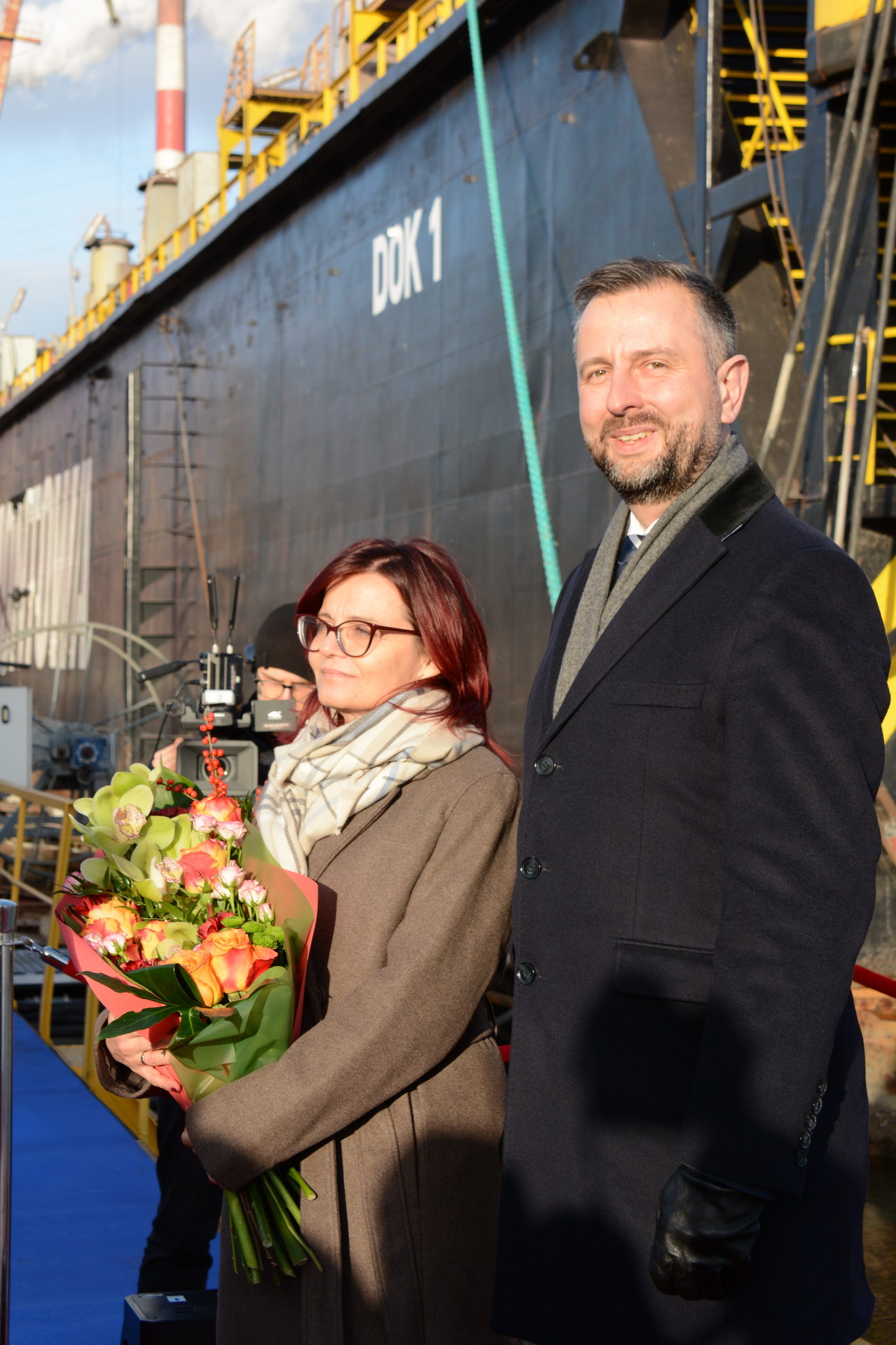 The godmother of Rybitwa, Katarzyna Sikora, together with Deputy Prime Minister and Minister of National Defence Władysław Kosiniak-Kamysz
The serial Project 258 Kormoran II mine countermeasure vessels are designed for searching, identifying, and neutralizing naval mines, primarily in the nearby waters of the Baltic Sea and the North Sea. With a standard displacement of around 850 tonnes, the ships have an overall length of 58.5 m, a maximum beam of 10.3 m, and a design draft of 2.7 m. The crew consists of 45 sailors on the first-series vessels and 48 on the three currently under construction.
To carry out their missions, the ships are equipped with an extensive range of systems for detecting and neutralizing underwater objects. Detection capabilities include the SHL-101/TM hull-mounted sonar and additional sonar systems installed on underwater unmanned vehicles carried by the ships: the HISAS 1032 on the Kongsberg Hugin 1000 autonomous underwater vehicle, and the EdgeTech 2205 side-scan sonar on the Teledyne Marine Gavia autonomous underwater vehicle. These are complemented by the Kraken Robotics Katfish-180 towed side-scan sonar. However, this system is not fitted to every vessel – only two units have been acquired, one for each minesweeper squadron. When its use is required, the selected minehunter is fitted, on the portside of the aft deck, with the ALARS (Autonomous Launch and Recovery System) for deploying and retrieving the sonar.
Detected mines are neutralized using underwater vehicles or by naval mine-clearance divers. The primary tools include:
- the SAAB Double Eagle SAROV (Semi-Autonomous Remotely Operated Vehicle), capable of carrying Toczek A explosive charges (48 kg total weight, including 40 kg of explosive) or Toczek B charges (10 kg total, including 6 kg of explosive);
- Głuptak self-propelled destruction charges – remotely operated, single-use underwater vehicles designed to destroy mines at depths of 3 to 200 meters, at distances up to 400 meters from the launch point in currents up to 2 m/s, and with a theoretical range of 1,500 meters in currents of 0–0.2 m/s.
Since last year, these systems have been supplemented by the Ocean Modules V8 M500 remotely operated underwater vehicle, used for final identification of previously detected mine-like objects and capable of destroying mines with Toczek-type explosive charges.
Mine-clearance divers have hybrid Sportis S-6200ID boats at their disposal, while their operations are supported by a six-person hyperbaric chamber installed on the ship.
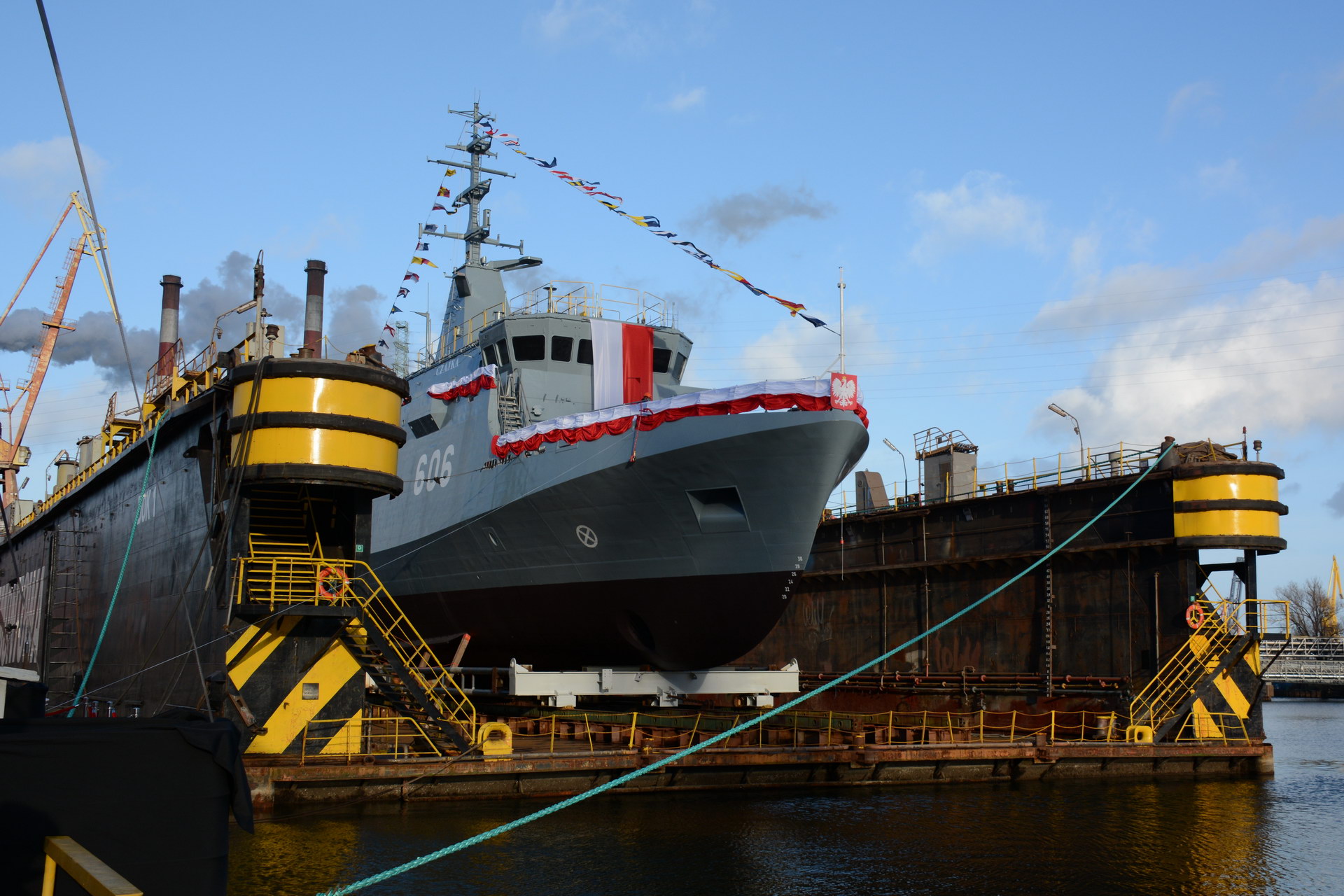 After the christening ceremony, the ship’s launching procedure began. This is a multi-stage operation that takes several hours
The artillery armament of the Project 258 mine countermeasure vessels consists of the 35 mm AM-35K naval gun, which is part of the OSU-35K naval weapon system. It is designed to engage both surface and aerial targets. It is complemented by three 12.7 mm WKM-Bm heavy machine guns manufactured by ZMT Tarnów, mounted on the bridge wings and on the stern. In addition to the gun, the ships’ air-defense capability is provided by portable Grom/Piorun man-portable air-defense systems (MANPADS).
Construction of the Project 258 vessels began with the contract signed on 23 September 2013, which included the construction of a prototype with an option for at least two serial production ships. After slightly more than four years, the flag was raised on the completed prototype, named ORP Kormoran, on 28 November 2017. Less than a month later, on 27 December 2017, a contract was signed for the construction of two serial vessels. Their construction began on 18 September 2018 and 19 June 2019. During this time, the prototype ORP Kormoran underwent operational and military trials. These allowed for conclusions to be drawn regarding changes that needed to be implemented on the serial vessels. These included upgrades to mine countermeasure systems, the SCOT-M 258 combat management system, communication and navigation systems, as well as modifications to the propulsion system and damage control systems. The selection of underwater vehicles was also changed: the Polish Morświn and the Swedish Saab Double Eagle Mk III used on the prototype were replaced with the newer SAAB Double Eagle SAROV model.
In August 2020, it was decided that the serial vessels would be equipped with the originally planned OSU-35K naval weapons system with the 35 mm AM-35K gun. This replaced the ZU-23-2MR Wróbel II 23 mm naval gun used on the prototype. Additional changes included the integration of the Kraken KATFISH 180 towed sonar system, along with its launch and recovery system.
Currently, ORP Kormoran is undergoing maintenance, during which it is being partially upgraded to the standard of the serial vessels. However, even after the work is completed, it will not be fully identical to ORP Albatros and ORP Mewa. The most visible difference is the retention of the 23 mm ZU-23-2MR Wróbel II cannon instead of the newer AM-35K.
At present, the three Project 258 mine countermeasure vessels in service belong to the 13th Minesweeper Squadron named after Fleet Admiral Andrzej Karweta, stationed in Gdynia. These are the prototype ORP Kormoran (601) and the serial vessels ORP Albatros (602) and ORP Mewa (603). The serial vessels entered service a few months apart, with their flags raised for the first time on 28 November 2022 and 14 February 2023, respectively.
The next and final trio of Kormoran II vessels, currently under construction, will join the 12th Wolin Minesweeper Squadron stationed in Świnoujście. As a result, by the end of 2027, the Polish Navy should have six vessels of this type in service – three in each of the two minesweeper squadrons located on opposite ends of the Polish coast, in Gdynia and Świnoujście.
See also:
