




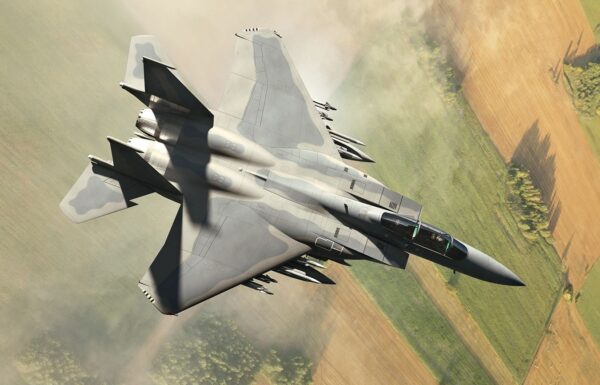




























On Thursday, August 28, 2025, the American magazine Aviation Week published a new visualization, submitted by Boeing, of the company’s proposal for the sixth-generation carrier-based multirole aircraft program, codenamed F/A-XX. It was first presented to participants of the Tailhook Symposium in Reno, Nevada, on August 21, and a week later to the public. A few days earlier, Northrop Grumman had unveiled its counterproposal (Sierra Nevada offers the Freedom Trainer to the U.S. Navy).
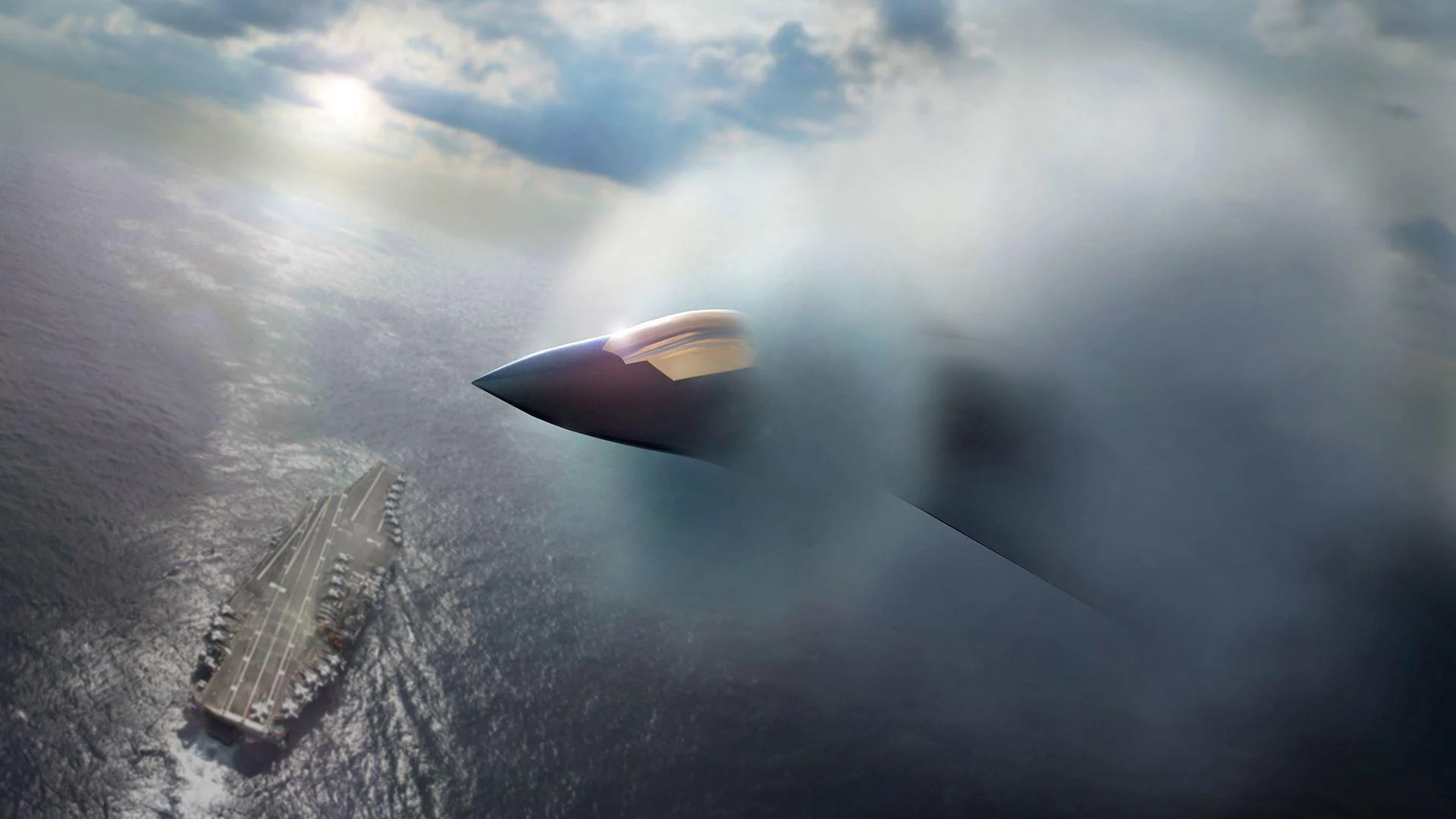 New visualization of F/A-XX / Image: Boeing
Boeing’s graphic, of course, reveals less than it conceals. However, it appears that Boeing intends to incorporate elements of its winning bid into the U.S. Air Force’s Next Generation Air Dominance (NGAD) program, unveiled on March 21 of this year. The program received the designation F-47 and will succeed the fifth-generation air superiority fighter, the Lockheed F-22A Raptor.
The visualization depicts the aircraft heavily obscured by clouds as it flies over a Gerald R. Ford–class nuclear aircraft carrier. The concept suggests the aircraft is breaking the sound barrier, which produces the so-called Prandtl–Glauert condensation cloud, deliberately masking key design features. As a result, it is impossible to discern such airframe elements as the engine intake(s), a potential canard configuration, the rear fuselage, or the wingtips. The pilot’s canopy resembles that of the F-47 visualization, but the nose section with the radar appears smaller and less sharply contoured.
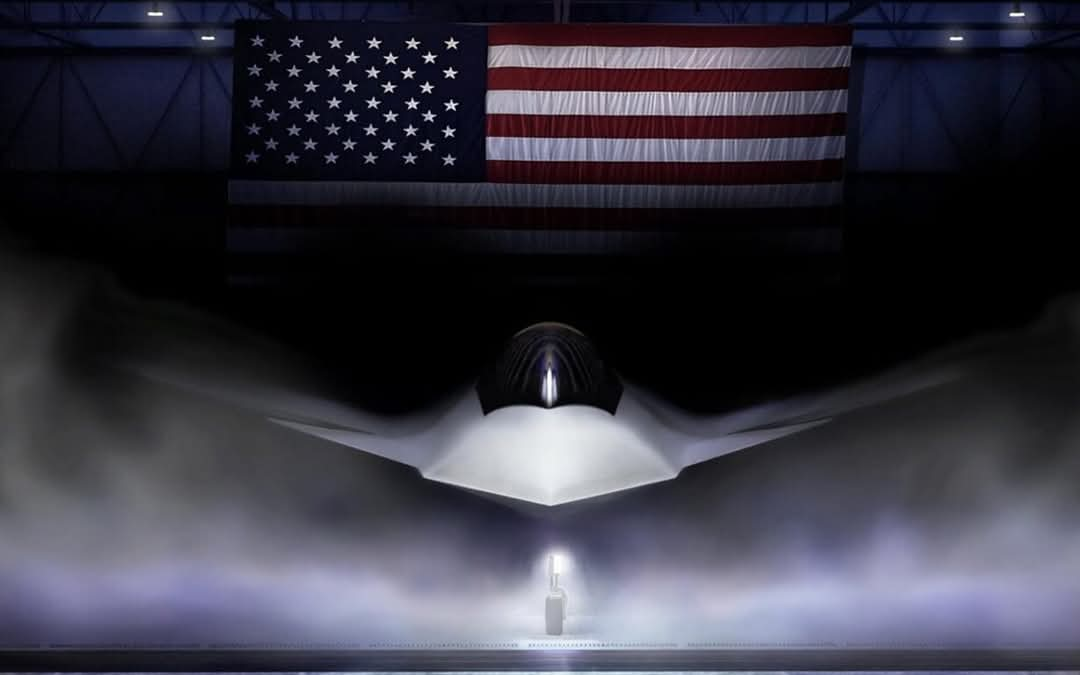 Visualization of F-47 for the NGAD program / Image: Boeing
Both the F/A-XX visualization and the two previously published images of the F-47 were designed to conceal a significant part of the aircraft’s shape. It is expected that although both are sixth-generation multirole fighters, they will differ significantly. U.S. Navy representatives told Aviation Week that the goal of the F/A-XX program is to extend the combat range of carrier-based aviation by about 25% compared to the current F/A-18E/F Super Hornet and F-35C Lightning II and to enhance crew survivability.
The F/A-XX, however, will use a derivative engine based on an existing design, unlike the F-47, which is to employ a new powerplant being developed under the NGAP (Next-Generation Adaptive Propulsion) program as a three-stream turbofan. The offerings include the XA102 from GE Aerospace (a subsidiary of General Electric Co.) and the XA103 from Pratt & Whitney (part of RTX Corporation).
It is worth noting that Boeing, both with respect to the F-47 and in anticipation of a possible win in the F/A-XX program, has invested around 2 billion USD in new research, development, and production facilities, including the Advanced Combat Aircraft Assembly Facility under construction in St. Louis for fighter aircraft assembly.
 Boeing’s earlier visualization for the F/A-XX program / Image: Boeing
Earlier, on August 17, Northrop Grumman presented its counterproposal. The company is currently engaged in another sixth-generation aircraft program, the B-21A Raider strategic bomber. Although it announced its withdrawal from the NGAD program on July 21, 2024, it has not done so in the case of the F/A-XX.
The visualization reveals far more than Boeing’s. It shows the aircraft on the deck of an aircraft carrier, with the nose, pilot’s canopy, air intakes, and the front landing gear leg clearly visible. The design evokes the company’s earlier bid, at that time in cooperation with McDonnell Douglas (now part of Boeing), for the U.S. Air Force’s fifth-generation Advanced Tactical Fighter (ATF) program: the YF-23, known as Gray Ghost and Black Widow II, which ultimately lost to the Lockheed-Boeing YF-22, later developed into the Raptor.
 Northrop Grumman proposal for the F/A-XX program / Image: Northrop Grumman
The F/A-XX program was launched in 2009, initially under the codename NGAD (Next Generation Air Dominance), but it was a separate initiative from the U.S. Air Force’s program from the outset. In 2021, the U.S. Navy published its initial tactical and technical requirements in the Navy Aviation Vision 2030–2035 document, and the FY2024 budget allocated USD 1.53 billion for the effort. The next-generation aircraft is expected to begin entering service in the 2030s, replacing the Super Hornets and their specialized EA-18G Growler variants, and complementing the F-35C Lightning II.
Analyses suggest that the F/A-XX will feature greater maximum speed and range, carry both active and passive sensors, and employ long-range missile weaponry, likely including hypersonic missiles. Earlier reports indicated a range of at least 1,000 nautical miles (1,850 km).
The Navy has also emphasized the need to develop so-called ‘Loyal Wingmen,’ the equivalent of the U.S. Air Force’s Collaborative Combat Aircraft (CCA) program, which involves unmanned aerial vehicles equipped with machine-learning-based control systems (artificial intelligence) that will support crewed aircraft under the MUM-T (Manned-UnManned Teaming) concept. In January 2020, program costs were estimated at approximately 67 billion USD to replace the Super Hornets between 2032 and 2050, and an additional 22 billion USD for the Growler successor.
