

























On Wednesday, 3 December 2025, the press service of the U.S. Army announced tests of the LUCAS (Low-Cost Uncrewed Combat Attack System) strike drone, also known as the FLM 136, conducted at the Yuma Proving Ground. The tests are being carried out on behalf of the U.S. Marine Corps (USMC).
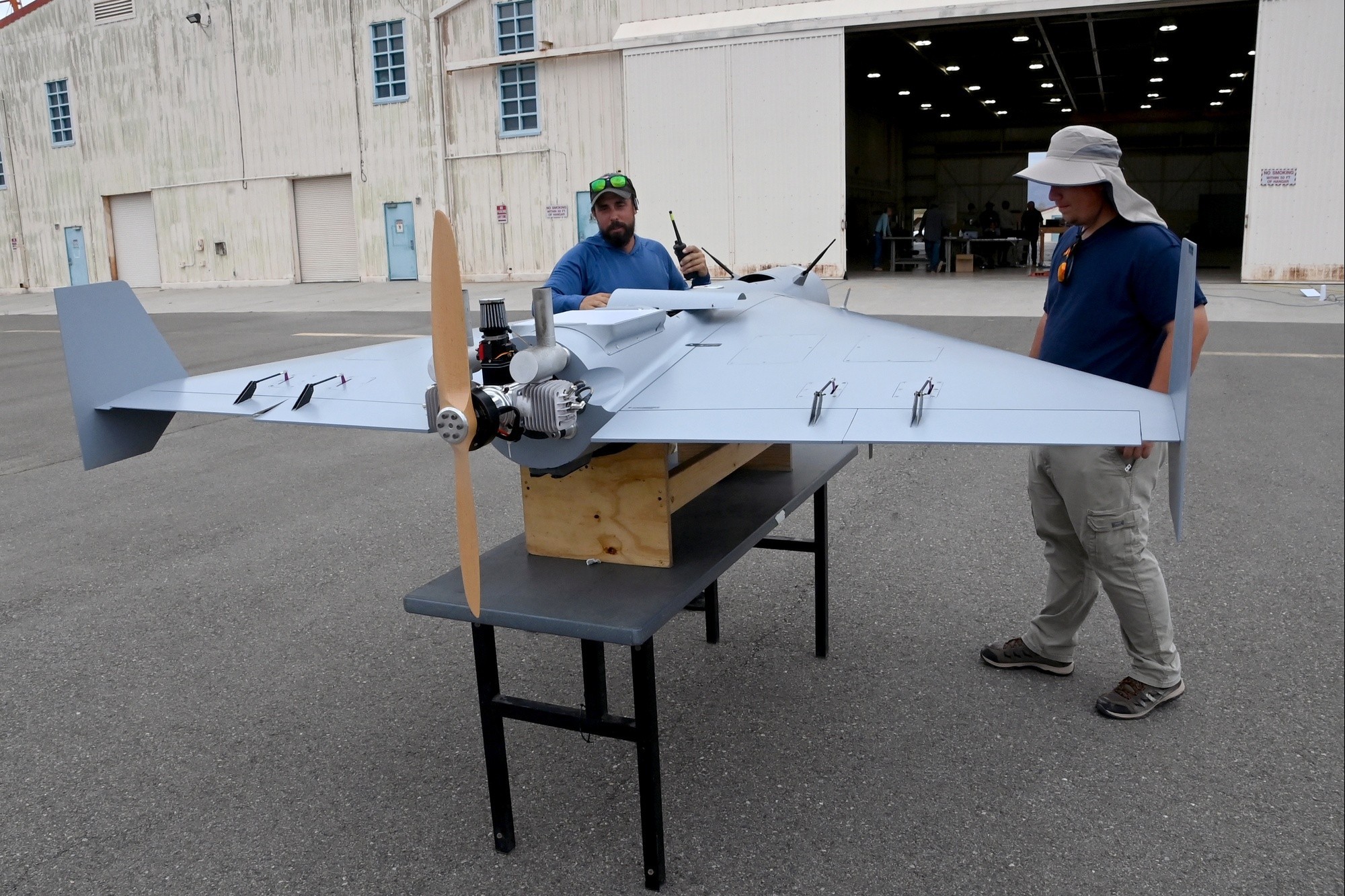 Photo: Mark Schauer, US Army
The tests of the low-cost, expendable loitering munition at the U.S. Army test range are funded from the USMC budget and therefore, in effect, from the U.S. Navy (USN). The FLM 136 unmanned strike system, developed by the Arizona-based company SpektreWorks and given the military designation LUCAS, was presented on 16 July this year among 18 types of unmanned systems to U.S. Secretary of Defense Pete Hegseth in Washington.
This was linked to plans for the large-scale introduction of drones into the U.S. armed forces, following the entry into force on 10 July of Decision No. 14307, which repealed restrictive policies that had hindered drone production. On 6 June, President Donald Trump signed an executive order aimed at accelerating the production of American unmanned systems by leveraging the latest innovative industry technologies.
As for the December tests, it is noted that—drawing on the Liberty Ship production model, under which 2,710 Liberty-class cargo ships were built in a short period during World War II (1941–1945)—testers hope that the LUCAS system will ultimately play a similar role in a new era of warfare.
“There is a price point that we want to produce a lot of these in a rapid fashion,” said Col. Nicholas Law, Director of Experimentation in the Office of the Under Secretary of War for Research & Engineering. “It’s not a single manufacturer: it’s designed to go to multiple manufacturers to be built in mass quantities.”
The warhead that will ultimately be integrated into the LUCAS system has not yet been built, but it is also intended to be inexpensive and mass-produced by multiple manufacturers. Soldiers are currently testing the LUCAS system using training payloads.
The size of the Yuma Proving Ground allows for unrestricted flight testing.
“The facility itself gives us the flexibility to do what we need, and at the same time will allow for full-fledged testing when it is ready,” said Law. “We’re getting our baby steps in before we conduct safety certification testing.”
“It really comes down to the flexibility of the airspace: If the system is weaponized, I have the ability to test that here,” said Law. “If it’s not weaponized, I have another large area that is free to maneuver within restricted airspace. It gives us multiple pathways to flight.”
“Once we start weaponization and automated target recognition, we can have a target that is a representation of a real target,” said Law.
 Photo: SpektreWorks
LUCAS
Interestingly, the manufacturer openly admits on its website that the system is the result of reverse engineering and relies on copying proven solutions – an approach that has usually been associated with U.S. adversaries. It was developed under the APFIT (Applied Small UAS Prototype Innovation Transition) program, for which the company was selected in May.
It is hard not to notice that the FLM 136, indeed, as the manufacturer’s designation itself suggests, is a copy of the Iranian Shahed-136 loitering munition, which is license-produced in Russia at the Yelabuga Machine-Building Plant, located in the Yelabuga Special Economic Zone in the Republic of Tatarstan, under the name Geran-2 (and soon also in North Korea; it has additionally entered service in Belarus as the Kochevnik).
According to available information, the FLM 136 is powered by an internal combustion engine, providing an endurance of up to 6 hours, a cruising speed of 137 km/h, a maximum speed of 195 km/h, and a range of up to 822 km. It can operate at altitudes of up to 4,572 m in winds of up to 65 km/h. The FLM 136 has a wingspan of 2.5 m, a length of 2.99 m, and a height of 0.46 m. Its maximum take-off weight is 81.65 kg, including a 18.14 kg warhead and 33.11 kg of fuel.
For comparison, the Shahed-136/Geran-2 is 3.5 m long with a wingspan of 2.5 m and has a take-off weight of 200 kg. The unmanned system carries a warhead weighing between 30 and 50 kg. It was developed by the Shahed Aviation Industries Research Center and was initially produced exclusively by the Iran Aircraft Manufacturing Industrial Company (HESA). The exact range of the loitering munition is not publicly known and is estimated to be between 970 km and as much as 2,500 km.
It is powered by a Mado MD-550 piston engine (which may be a copy of the German Limbach L550E). This is a four-cylinder, two-stroke, air-cooled internal combustion engine rated at 50 hp, manufactured by the Chinese company Wofei Technology (Shenzhen) Co., Ltd. It provides a cruising speed of approximately 185 km/h. Its drawback is its loud operation, which means that during the terminal phase of flight the approaching threat can be heard in advance. This shortcoming was addressed in the improved jet-powered variant, the Shahed-238.
As can be seen, the American copy has inferior performance parameters in most respects compared to its original. Of course, it is not known how SpektreWorks obtained a Geran-2/Shahed-136, but the most obvious source could be Ukraine, which is continuously attacked using these systems, as well as Poland (Foreign Minister Radosław Sikorski provided the United States with one example, as revealed in the article “An Iranian Drone Lands in Queens” published in The Wall Street Journal on 19 February this year), or Israel (which has previously been targeted by Iran using these drones).
The manufacturer nonetheless claims that the FLM 136 is structurally more modern, as it features a modular design and, in addition to warheads, can carry other payloads such as reconnaissance or electronic warfare systems.
Interestingly, SpektreWorks has also apparently copied the Ukrainian An-196 Liutyi strike drone, which has been designated Falcon. The company’s portfolio also includes the jet-powered CPJ 100-LE.
See also:
