


























On Saturday, 29 November 2025, as reported by the Iranian news agency Mehr, in the port of Bandar Abbas in Hormozgan Province, on the occasion of Iran’s Navy Day (Nirū-yē Dəryâyi-yē Ərtēš-ē Žomhūri-yē Ēslâmi-yē Irân, NEDAJA), the light missile frigate Sahand (74), of the Moudge class, returned to service after last year’s sinking, and the flag was also raised on a new vessel — the support ship IRIS Kurdestan (442).
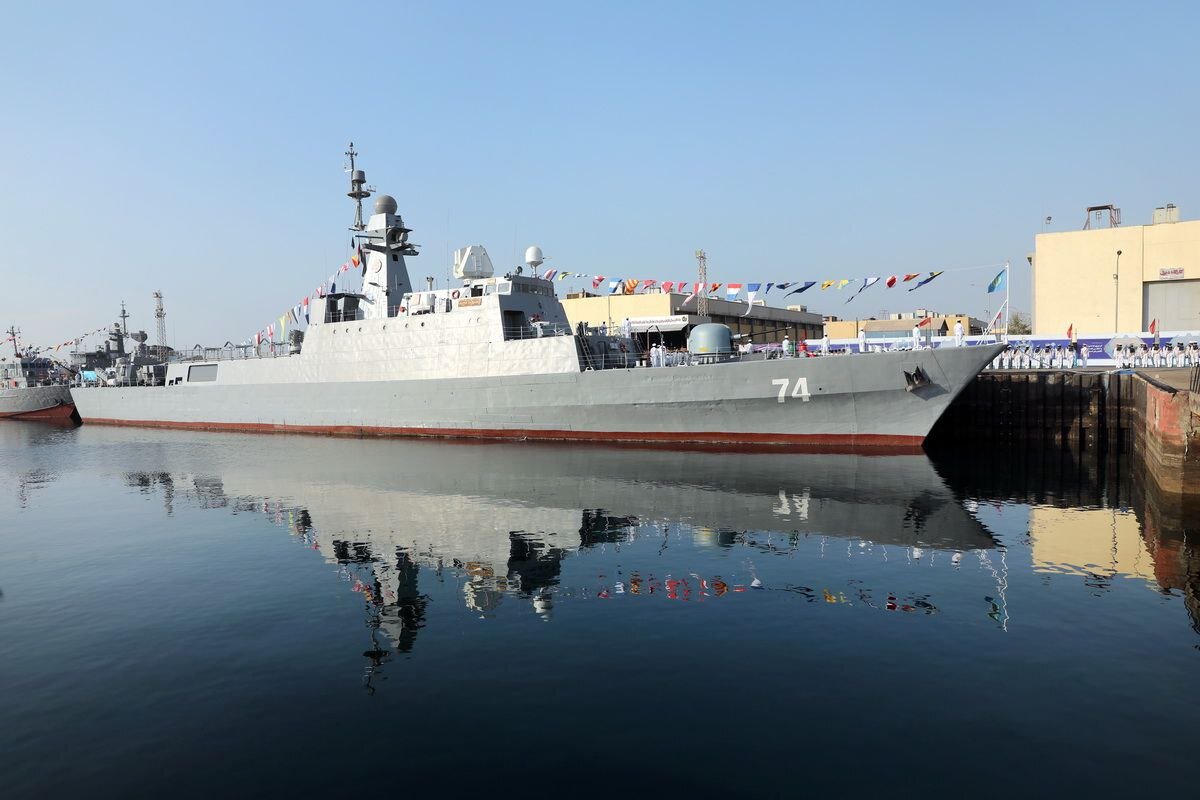 Sahand (74) / Photos: Mehr
On 7 July 2024, during maintenance work at the naval shipyard in Bandar Abbas, an accident occurred in which the Southern Fleet vessel, locally misclassified as a destroyer, capsized to port after an explosion took place on board. The ship sank and settled on the bottom of the port basin. Three sailors were killed in the accident. The vessel had been preparing for participation in another anti-piracy operation in the Indian Ocean. Iranian authorities announced that the ship would be raised and repaired – and that is exactly what happened.
The NEDAJA ensign was hoisted again on the vessel during a ceremony attended by Major General Amir Hatami as Commander of the Ground Forces, Rear Admiral Habibollah Sayyari as Deputy Chief of Staff of the Armed Forces for Coordination, Rear Admiral Shahram Irani as Commander of NEDAJA, and other high-ranking officers, as well as the governors of Sistan and Baluchestan, Hormozgan, and Kurdistan, religious leaders, members of parliament, and families of naval personnel. Three families of sailors killed in the accident were formally honored, as the event coincided with the celebration of Navy Day.
At the same time, the flag was raised on a new vessel – the newest support ship, IRIS Kurdestan (442), which was converted from the tanker Tabukan. The ship had been undergoing sea trials since May of last year.
Şahand (74) is the third of five built, and seven planned, Moudge-class missile frigates. Her keel was laid in 2010, she was launched in 2012, and entered service in 2018. On 25 July 2021, the frigate, together with the support ship Makran (441), took part in the naval parade in St. Petersburg marking the 325th anniversary of the Russian Navy, the first visit of Iranian warships to the Baltic Sea in history.
The Moudge class is 95 meters long, 11.1 meters wide, with a draft of 3.25 meters and a displacement of 1,500 tons. It is powered by two diesel engines rated at 10,000 hp (7,500 kW) each and four generators rated at 740 hp (550 kW) each, reaching a speed of 30 knots. Its main armament consists of four Nur or Ghader anti-ship missiles. Additional armament includes a 76 mm Fajr-27 naval gun, a 40 mm Fath-40 anti-aircraft gun, two 20 mm Oerlikon naval guns, four Mehrab surface-to-air missiles (a copy of the SM-1 or the naval variant of Ra’ad), two triple 324 mm ASW torpedo launchers, and two 12.7 mm machine guns. In the future, ships of this class are expected to be equipped with the naval variant of the Sajjad-2 surface-to-air missile.
Service history of this class, however, has been unfortunate. The sister ship Damavand (77), which entered service in 2013, sank on 28 January 2019 after striking a concrete breakwater at the entrance to the port of Bandar-e Anzali on the Caspian Sea on 10 January. The collision left her without propulsion, causing her to drift for an extended period; two sailors died. According to Iranian sources, the ship was raised from the seabed and at first was to be rebuilt – ultimately, this plan was abandoned.
Meanwhile, Jamaran (76) accidentally struck the Konarak (1409), a Hendijan-class multipurpose support ship, with a Nur anti-ship missile (a copy of the Chinese YJ-83/C-802) during exercises on 10 May 2020. Nineteen sailors were killed, and the heavily damaged vessel was written off.
Additionally, Dena entered service on 13 June 2021, and Deylaman on 27 November 2023, the latter replacing the lost Damavand. On 5 December 2021, the under-construction Shiraz (formerly Talaieh) slid off the keel blocks and capsized in a dry dock during flooding operations. During repairs, it was decided to convert her into an electronic intelligence (EW) vessel, and on 15 January of this year she entered service as Zagros (313). Taftan remains under construction.
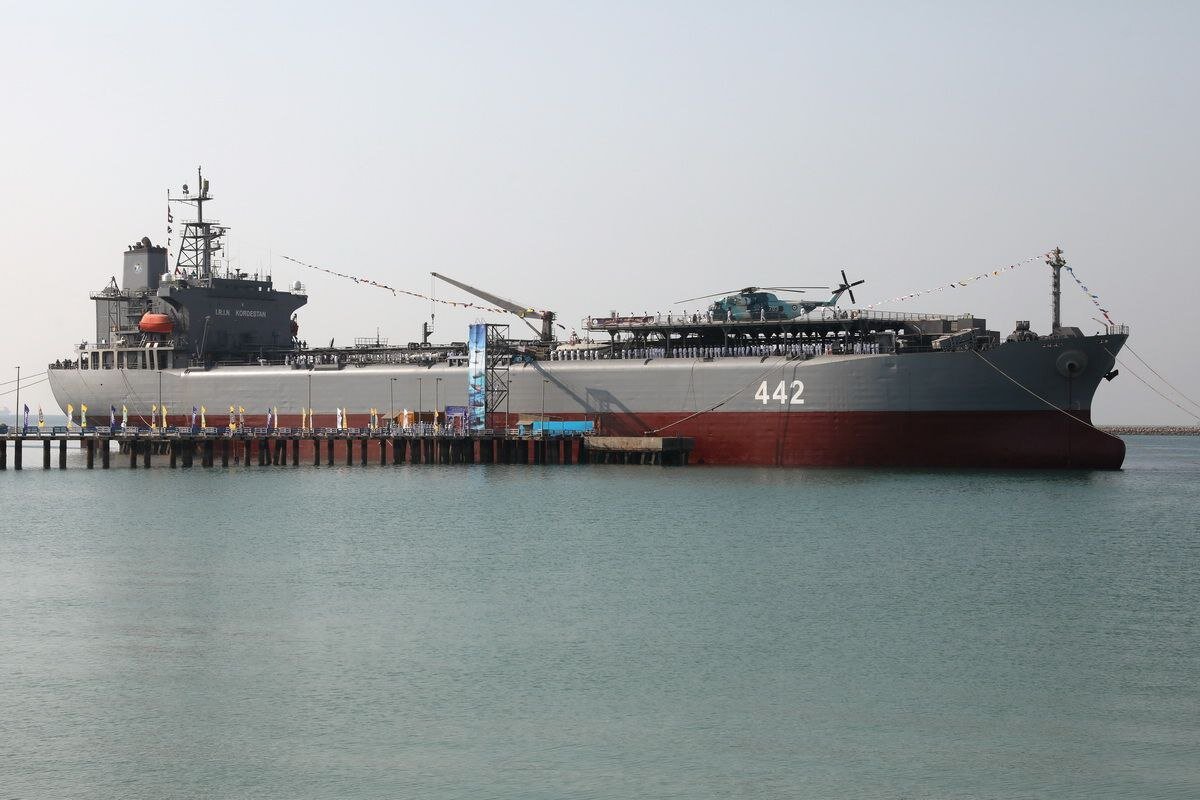 IRIS Kurdestan (442)
The support ship IRIS Kurdestan (442), originally built in 1992 as the tanker Tabukan, was converted by Iran Shipbuilding & Offshore Industries Complex at its shipyard in Bandar Abbas. The vessel is 183 meters long and 32.23 meters wide. The ship originally had a gross tonnage (GT) of 29,506, which defines its total internal volume (including all enclosed spaces), and a deadweight tonnage (DWT) of 45,425, indicating the maximum mass of fuel it could carry in metric tons. Before entering Iranian service in August 2019, it operated under the flag of Togo (from January 2013), and earlier under Panama as Tabuk (from November 2011) and Barbados as Fasirus (from October 2010).
The ship received a flight deck in the midships section, from which helicopters such as the RH-53D Sea Stallion, SH-3D Sea King, AS-61A-4 Sea King, Mi-17, and Agusta-Bell AB 212ASW, as well as unmanned aerial vehicles, will operate.
It is the fourth Iranian vessel converted to a new role from a large civilian ship.
The first was the 228-meter support ship IRIS Makran (441), which entered service on 12 January 2021 – the largest vessel in NEDAJA’s inventory following the sinking, during the night of 1–2 June 2021, of the replenishment ship Kharg (431), a modernized British Ol-class vessel, after a fire broke out on board.
The second is the 240-meter support ship IRIS Shahid Mahdavi (110-3), formerly the container ship Iran Isfahan (ex-Sarvin), which entered service with the Islamic Revolutionary Guard Corps Navy (IRGCN; Sepāh-e Pāsdārān-e Enqelâb-e Eslâmī’) on 9 March 2023.
On 6 February of this year, another 240-meter aviation ship with a full-length flight deck, IRIS Shahid Bahman Bagheri (C-110-4), capable of operating helicopters and unmanned aerial vehicles, entered IRGCN service. It was created by converting the container ship Perarin, built to a Germanischer Lloyd design.
