






























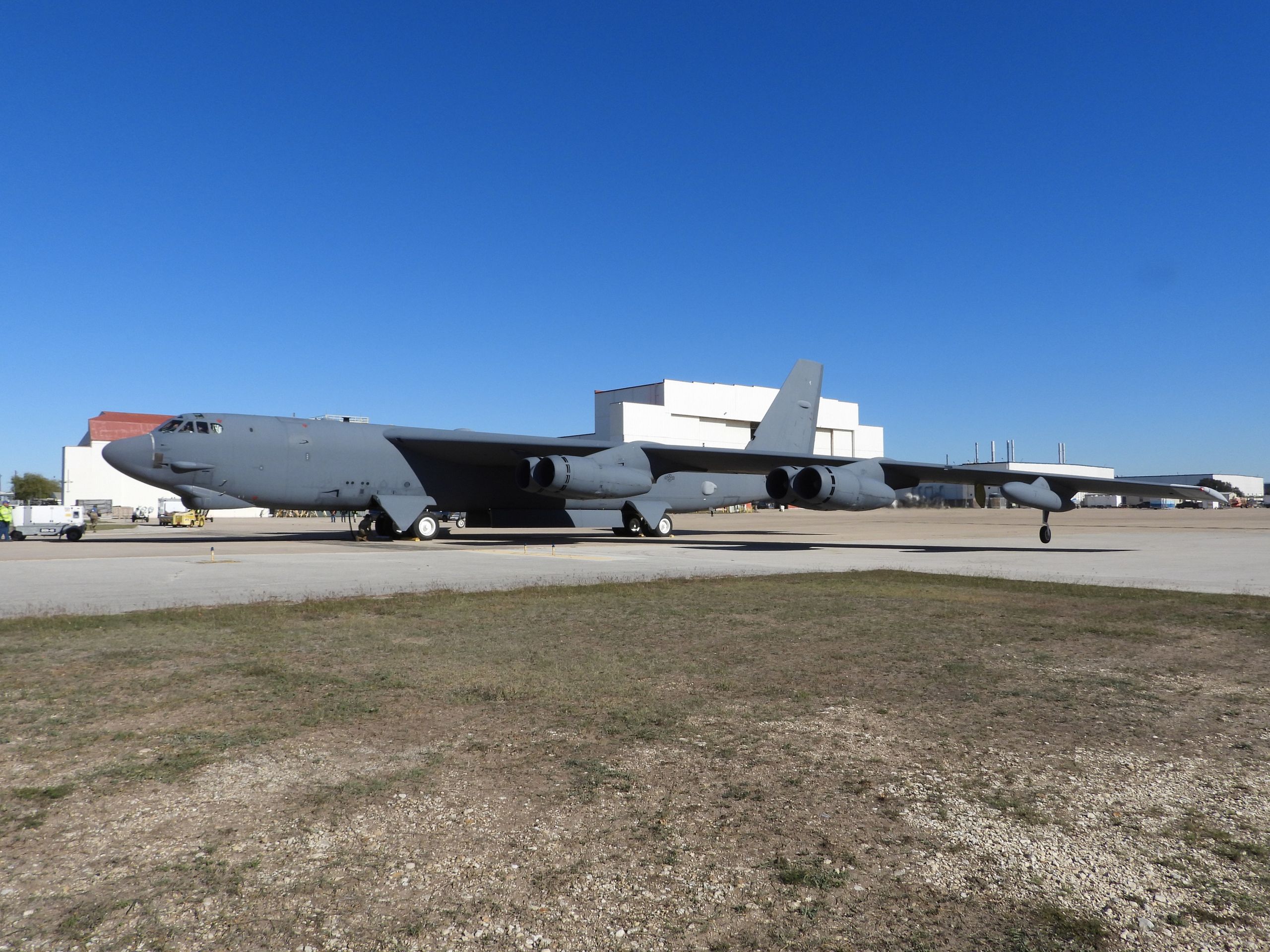
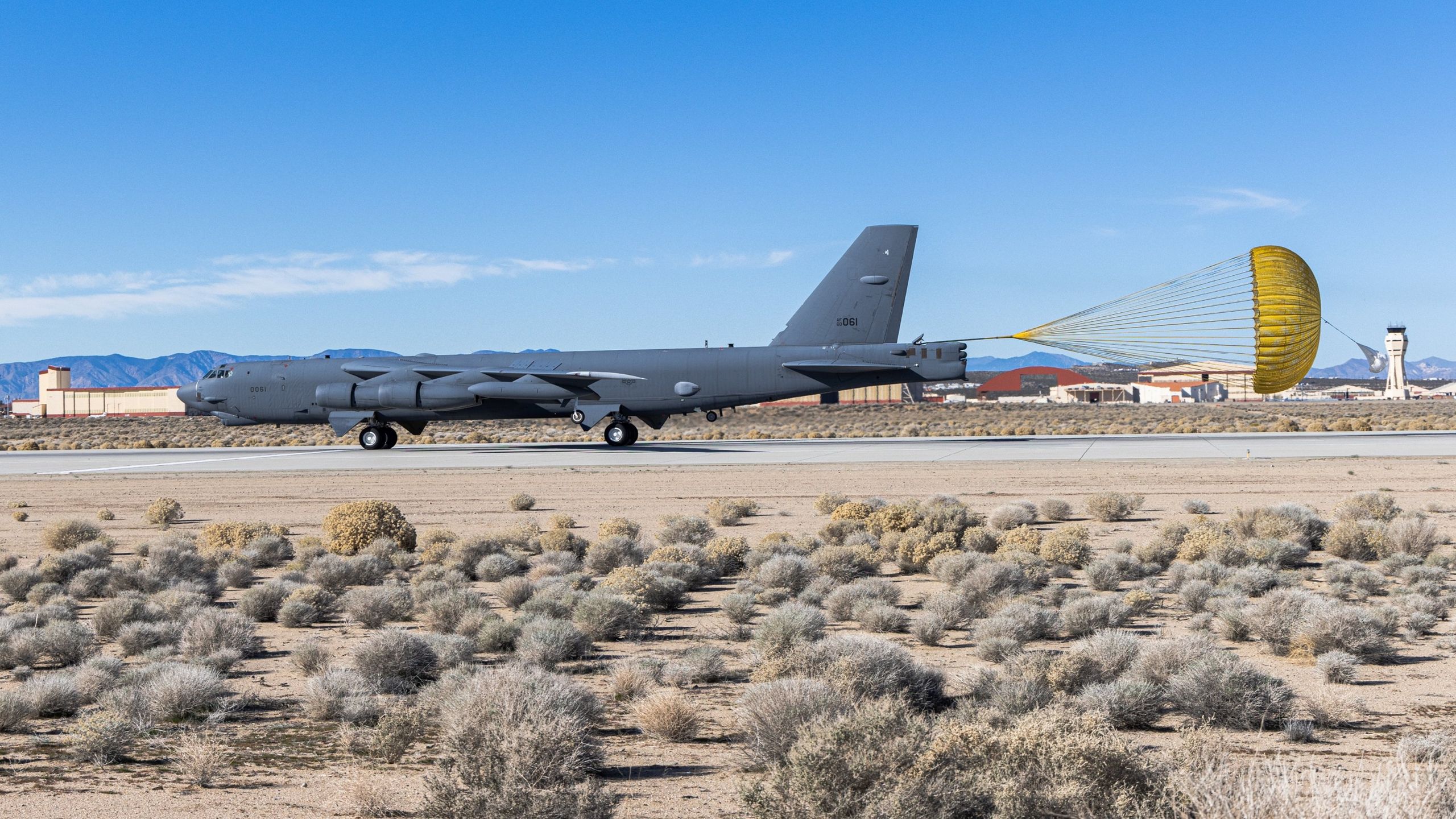
As announced on Thursday, 11 December 2025, the first B-52H Stratofortress strategic bomber integrated with the new Raytheon AN/APQ-188 radar featuring an Active Electronically Scanned Array (AESA) antenna was redeployed from Boeing’s facility in San Antonio, Texas, to Edwards Air Force Base in California, home to the 412th Test Wing, as part of the B-52 Radar Modernization Program (RMP).
 Photos: USAF
The ferry flight took place on 8 December with a mixed crew from the 49th Test and Evaluation Squadron based at Barksdale Air Force Base in Louisiana and the 419th Flight Test Squadron from Edwards Air Force Base. The test team will conduct ground and flight tests of the aircraft throughout 2026 to enable a decision on serial production of the radars later that year. Earlier, initial ground tests following radar integration with the aircraft were conducted in San Antonio.
The new radar will replace the late-1980s Northrop Grumman AN/APQ-166 mechanically scanned radars, which have a range of 277.8 km and operate in conjunction with a FLIR/EO low-altitude navigation and targeting system. Raytheon (now part of the RTX corporation) received the contract to design the new radar on 11 July 2019.
It should be recalled that Raytheon proposed a new radar based on solutions derived from systems such as the AN/APG-63(V)3 (used on the F-15C/D and F-15SG), AN/APG-79 (F/A-18E/F and EA-18G), and AN/APG-82(V)1 (F/A-18E/F and F-15E). Northrop Grumman’s offer featuring the AN/APG-83 SABR (Scalable Agile Beam Radar), which is being fielded on F-16C/D Block 70/72 and F-16V multirole fighters and, in the modified SABR-GS (Global Strike) variant, on B-1B Lancer bombers since 2016, was rejected.
The AN/APQ-188 will provide improved all-weather navigation and targeting capabilities for the 65-year-old strategic bomber, ensuring its continued effectiveness in the future. The AESA radar, developed by Raytheon and integrated on the B-52H by Boeing, will deliver a level of capability and ease of sustainment comparable to that of the AN/APG-82(V)1 installed on the latest F-15EX Eagle II fighters.
“The ferry flight of this upgraded B-52 marks an important moment in our efforts to modernize the bomber force,” said Secretary of the Air Force Troy Meink. “This radar modernization ensures that the B-52 will continue to serve as a cornerstone of American airpower well into the future. We are committed to extending the life of this vital platform, allowing it to operate alongside next-generation fighter and bomber aircraft.” (USA: Second Prototype of B-21A Raider Strategic Bomber Takes Flight)
“The new radar will significantly increase B-52 mission effectiveness by improving situational awareness, speeding target prosecution and enhancing aircrew survivability in contested environments,” said Troy Dawson, vice president of Boeing Bombers. “This phase of the program is dedicated to getting it right at the start so that we can execute the full radar modernization program.”
The B-52 RMP program also includes the integration of two display and system sensor processors serving as mission computers to enable radar integration with the B-52’s systems, as well as two large 8×20-inch high-resolution touchscreen displays for the navigation and radar navigation stations (Nav and Radar Nav) for radar imagery, control, and replacement of legacy displays, along with two hand controllers for radar operation similar to those used in fighter aircraft. The system features improved liquid cooling and engine bleed-air heating for operation in extremely cold conditions.
It is also worth noting that the B-52 RMP program is delayed, and radar production was originally scheduled to begin in 2024. According to a June report by the Government Accountability Office (GAO), schedule slippage occurred due to issues with environmental testing, software development, and parts procurement, as well as problems with physically fitting the new radar into the bomber’s nose section. This resulted in a 15 percent increase in costs.
The B-52 RMP program is part of a broader initiative to modernize the B-52H bomber fleet to the B-52J standard, which under the B-52 CERP (Commercial Engine Replacement Program) includes replacing the TF33-PW-103 (Pratt & Whitney JT3D) turbofan engines with F130 engines (a variant of the Rolls-Royce BR700).
Two fairings will be installed above the wings, likely housing GPS transmitters and other classified communications and navigation equipment. A partial replacement of analog instruments with digital displays (a hybrid cockpit) is planned, which will reduce crew workload and facilitate the integration of additional systems. The modernization also includes the installation of a diagnostic system for all onboard subsystems, upgrades to electronic warfare systems, the introduction of Link 16-class data links, as well as increased avionics resistance to jamming and improved threat source localization. It is also possible that, during the course of the work, the AN/AAQ-33 Sniper ATP targeting pods will be relocated from beneath the right wing to the fuselage, which would increase their field of view. The installation of additional electro-optical sensors to enhance day and night surveillance capabilities is also being considered.
The aircraft will also be integrated with the future Raytheon AGM-181 LRSO (Long-Range Stand-Off) cruise missiles featuring nuclear warheads and reduced radar cross-section (the aircraft are expected to be able to carry up to 20 missiles simultaneously). Recently, spotters have observed B-52H tests with new weaponry, possibly including the LRSO.
It is anticipated that at least part of the planned fleet of 76 B-52H aircraft will be upgraded to the B-52J standard by the end of the current decade, allowing the bombers to remain in service at least into the 2050s, in line with the Bomber Vector plans disclosed in February 2018.
On the (﹙˓ radar ˒﹚).
The first B-52 Radar Modernization Program rapid prototype for the @USAirForce has been delivered to @EdwardsAFB for testing. The radar upgrades improve the aircraft’s navigation accuracy – targeting and tracking while providing new, high-resolution… pic.twitter.com/SHMdkRNmhg
— Boeing Defense (@BoeingDefense) December 11, 2025
A new BUFF has joined the test fleet!
In partnership with @Boeing, crews from the 419th FLTS @EdwardsAFB & 49th TES @TeamBarksdale successfully ferried the 1st B-52 with a modern Active Electronically Scanned Array (AESA) from San Antonio.
Read more: https://t.co/WI16nQvfWK pic.twitter.com/qe9kiWL72e
— Air Force Global Strike Command (@AFGlobalStrike) December 11, 2025
A rare view of B-52's open nose. In 2023, Boeing initiated a major radar upgrade program for the B-52. The Radar Modernization Program (RMP) will equip the venerable B-52H with new, fighter-like radar capabilities. This upgrade will enhance navigation accuracy, targeting,… pic.twitter.com/IIIM1iqWPi
— Air Power (@RealAirPower1) December 13, 2024
