














On Friday, September 5, 2025, U.S. defense outlets Breaking Defense and USNI News were the first to report that the U.S. Navy’s Naval Air Systems Command (NAVAIR) had awarded contracts to five companies under the CCA (Collaborative Combat Aircraft) program, its own counterpart to the U.S. Air Force (USAF) initiative to develop autonomous combat unmanned aerial vehicles, known as Loyal Wingman.
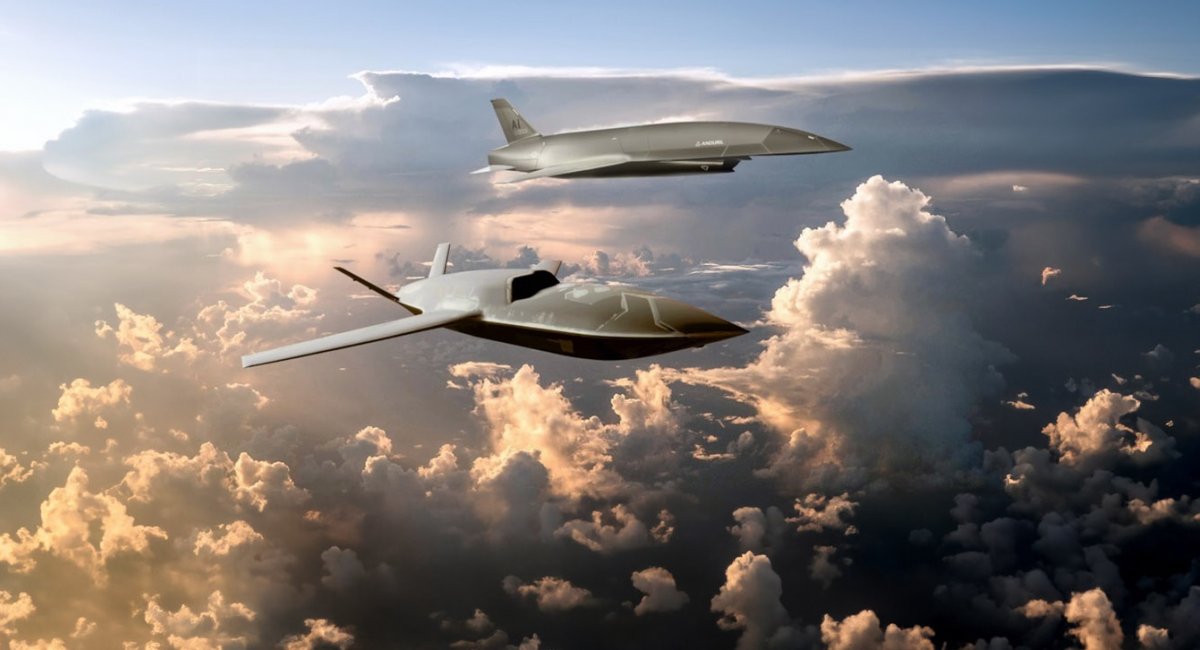 Prototype drones Anduril YFQ-44A (top) and General Atomics YFQ-42A (bottom), selected in the U.S. Air Force CCA program / Graphic: USAF
According to a slide shown during a NAVAIR presentation at the Tailhook Symposium in Reno, Nevada, on August 21, Anduril Industries, Northrop Grumman, Boeing, and General Atomics Aeronautical Systems Inc. (GA-ASI) received undisclosed-value contracts for the development of conceptual aircraft designs, while Lockheed Martin received a contract for a joint control system design. These contracts had not been publicly announced before.
The slide itself is dated August 20, and the initiative is managed by the Program Executive Office for Unmanned Aviation and Strike Weapons.
Although the U.S. Navy has been working on the CCA concept, envisioned as a carrier-based UAV, in parallel but separately from the U.S. Air Force, its program is not as advanced. The Air Force has already selected two bidders in the first phase (Increment 1): Anduril Industries with the YFQ-44A and General Atomics Aeronautical Systems Inc. with the YFQ-42A. The latter has already flown, while the former is expected to take to the air soon.
Anduril Industries and Northrop Grumman confirmed to Breaking Defense their participation in the U.S. Navy program. Lockheed Martin also confirmed, noting that on November 7, 2024, it had tested the MDCX (Multi-Domain Combat System) autonomous control system together with the UMCS (Unmanned Carrier Aviation Mission Control Station) control station, developed by Skunk Works, on the MQ-20 Avenger UAV, in cooperation with the U.S. Navy and GA-ASI.
Rear Adm. Michael Donnelly, from the staff of the U.S. Navy Chief of Naval Operations, responsible for developing CCA requirements, said on April 8 of this year that the Navy is working with the Air Force on common standards for elements such as mission planning, but most of the work is being conducted behind closed doors.
A requirement for the U.S. Navy is, of course, autonomous carrier take-off and landing, an area where Northrop Grumman (with the carrier-based X-47B technology demonstrator) and Boeing (with the MQ-25 Stingray unmanned tanker) have experience, and where GA-ASI also has plans (Gambit 5 and MQ-9B STOL). The Navy is also seeking lower unit costs, estimated at around 15 million USD, while USAF forecasts put their aircraft at 25–30 million USD.
Rear Adm. Donnelly also said that CCA will not be something designed to fly for hundreds of hours. “The last hour [of flight] is either as a target or as a weapon [a kamikaze drone], but we do not intend to keep them for 30 years.” The U.S. Navy would like to see its CCA flying by the end of the decade.
The CCA will therefore operate alongside current carrier-based aircraft such as the F/A-18E/F Super Hornet and EA-18G Growler, as well as the F-35C Lightning II, and with the planned sixth-generation F/A-XX.
See also:
