





















The contract is valued at 240.9 million USD and is to be completed by November 30, 2028. Neither party has publicly disclosed the number of missiles ordered. In addition to the missiles themselves, the deliveries will include transport and storage containers, diagnostic equipment, as well as spare parts and support equipment. Most of the work will be carried out at Kongsberg Defence & Aerospace facilities in Norway. Full funding for the procurement was released at the time the contract was signed.
The JSM was developed between 2008 and 2018 in cooperation with Raytheon (part of RTX Corporation) as an evolution of the Norwegian NSM (Naval Strike Missile), and serial production began in 2021. To date, Norway as the program’s initiator, as well as Japan and Australia, have decided to procure the missile. In the future, Finland and Italy will join them. Poland has also expressed interest in this weapon system as it seeks an anti-ship missile for the F-35A Husarz; the larger AGM-158C LRASM from Lockheed Martin is also being considered. To meet demand for both JSM and NSM missiles, Kongsberg will expand its production capacity in the United States and Australia.

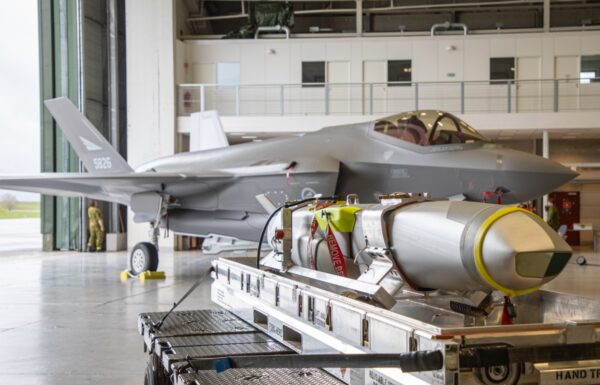
The Americans ordered a second serial production batch of Kongsberg JSM missiles, which are to be delivered by the end of 2028. Photo: Ministry of Defence of Norway
The JSM is a fifth-generation anti-ship missile built using reduced radar cross-section (stealth) technology, developed to fill gaps in the F-35A’s capabilities for the precision engagement of surface targets. It is the only missile of its class that can be carried in the internal weapons bay of the F-35A and F-35C (in the case of the F-35B, it can be carried only on external underwing hardpoints). In the latest Block 4 version with the Technical Refresh 3 (TR3) configuration, the F-35A will also be capable of engaging ground targets.
The JSM’s guidance seeker features an autonomous target recognition system based on images stored in the onboard computer, combined with an infrared sensor, an inertial navigation system (INS), satellite navigation (GPS), and a laser altimeter. This allows the user, depending on the target, to program the type of attack, the point of impact, and the detonation yield of the 125-kilogram high-explosive fragmentation warhead. Thanks to a two-way data link, the operator also has the ability to abort the attack at any point during flight.
