

























Homar-K MRL
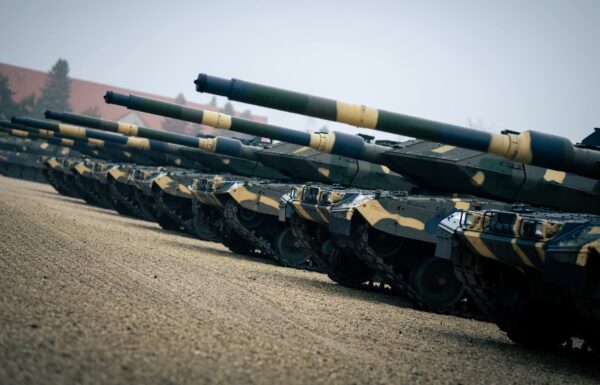
In 2025, four deliveries of Homar-K multiple-launch rocket system (MLRS) modules took place. Homar-K is the Polish variant of the K239 Chunmoo, integrated with Jelcz P882.57 TS T45 K-MLRS 8×8 chassis in cooperation with the Polish Armaments Group (PGZ), as well as with the Topaz battle management system, the Fonet digital vehicle communication platform, and the Radmor radio communication system from WB Group.
This brings the total to 72 Homar-K MLRS modules delivered in 2025, and including deliveries from previous years, the number of delivered modules has increased to 156 units.
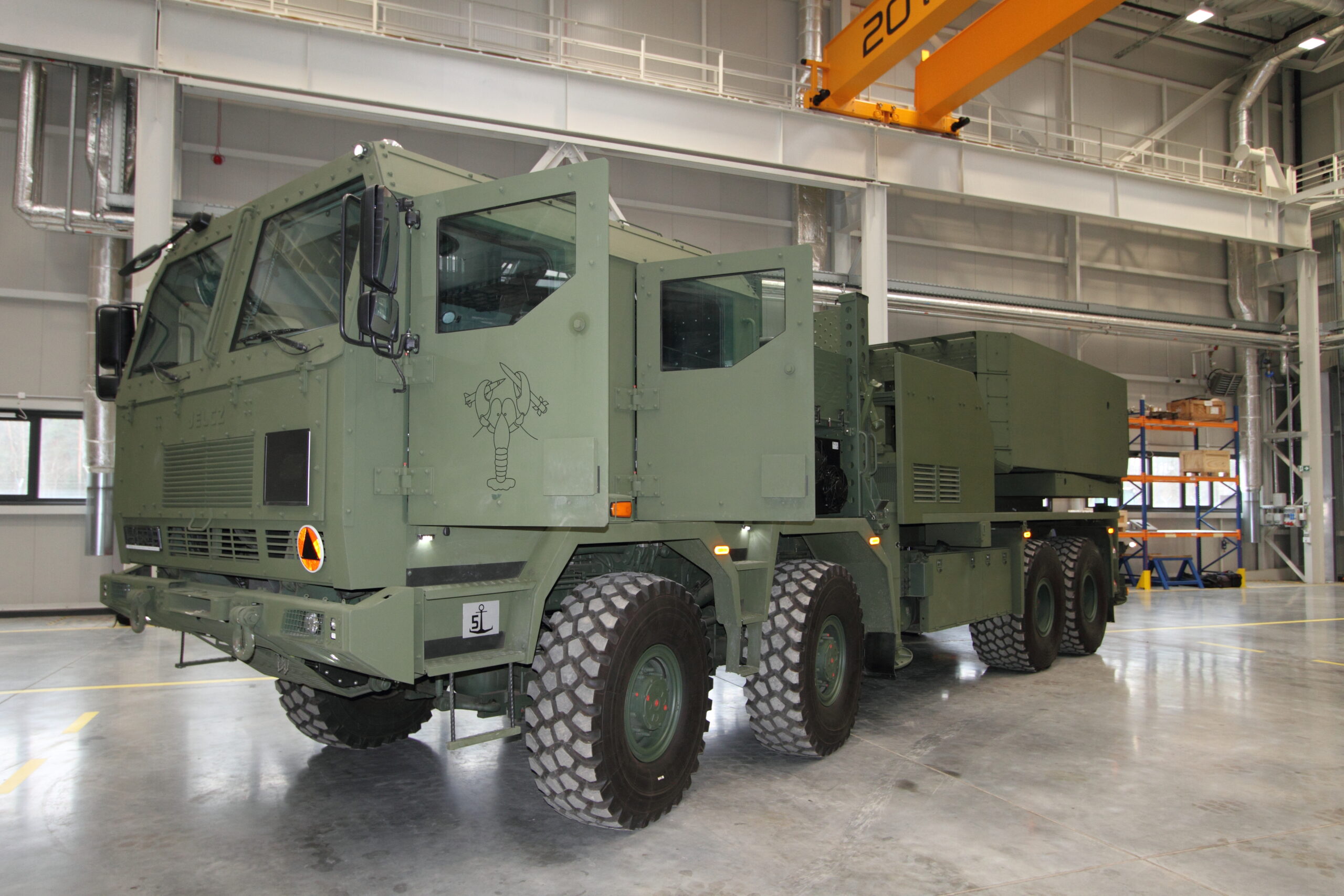 Photo: Grzegorz Sobczak, MILMAG
Deliveries are being carried out under the first executive contract of 4 November 2022 for 218 units. Additionally, on 25 April 2024, a second executive contract was signed for another 72 units, meaning that the Polish Armed Forces will ultimately receive 290 launchers, two of which will go to the newly established Rocket and Artillery Forces Training Centre in Toruń.
The Homar-K launcher is equipped with two rocket pods capable of accommodating two types of munitions. Each pod can hold, depending on the ammunition used: six CGR-080 guided rockets of 239 mm caliber with a range of 80 km, or one CTM-290 tactical guided ballistic missile of 600 mm caliber with a range of 290 km.
Regarding the CGR-080, on 2 September this year, during the XXXIII MSPO, Hanwha Aerospace and WB Group signed a breakthrough agreement to establish the Polish-Korean joint venture Hanwha WB Advanced Systems, whose goal is the local production of CGR-080 missiles.
So far, Homar-K launchers have been delivered to: the 18th Artillery Regiment in Nowa Dęba (by the end of 2023; in May this year its personnel took part in the first international training course for Chunmoo users in the Republic of Korea), the 1st Masurian Artillery Brigade in Węgorzewo (since 12 August 2024), the 23rd Silesian Artillery Regiment in Bolesławiec (since 18 July this year), and the 5th Lubusz Artillery Regiment in Sulechów (since 26 September this year). In November, launchers from Węgorzewo took part in the international exercise Northern Strike 25-2 at the Rovaniemi training area in Finland.
It is also worth noting that during the aforementioned MSPO, Hanwha signed a Memorandum of Understanding (MoU) with the Swedish company Saab Defence and Security to explore the possibility of integrating the Ground-Launched Small Diameter Bomb (GLSDB) with the Chunmoo launcher. Furthermore, on 11 September 2025, Hanwha signed an MoU with BAE Systems to integrate British advanced anti-jamming GPS guidance systems (Advanced Anti-Jamming GPS) with guided ammunition for Chunmoo.
K9A1 Thunder
In the case of the 155 mm K9A1 Thunder self-propelled howitzers, five deliveries took place this year:
- 21 February – 8 units
- 23 May – 18 units
- 14 July – 6 units
- 27 August – 15 units
- 16 November – 21 units
This amounts to a total of 68 howitzers delivered in 2025, and when deliveries from previous years are included, the total number delivered has risen to 204 units.
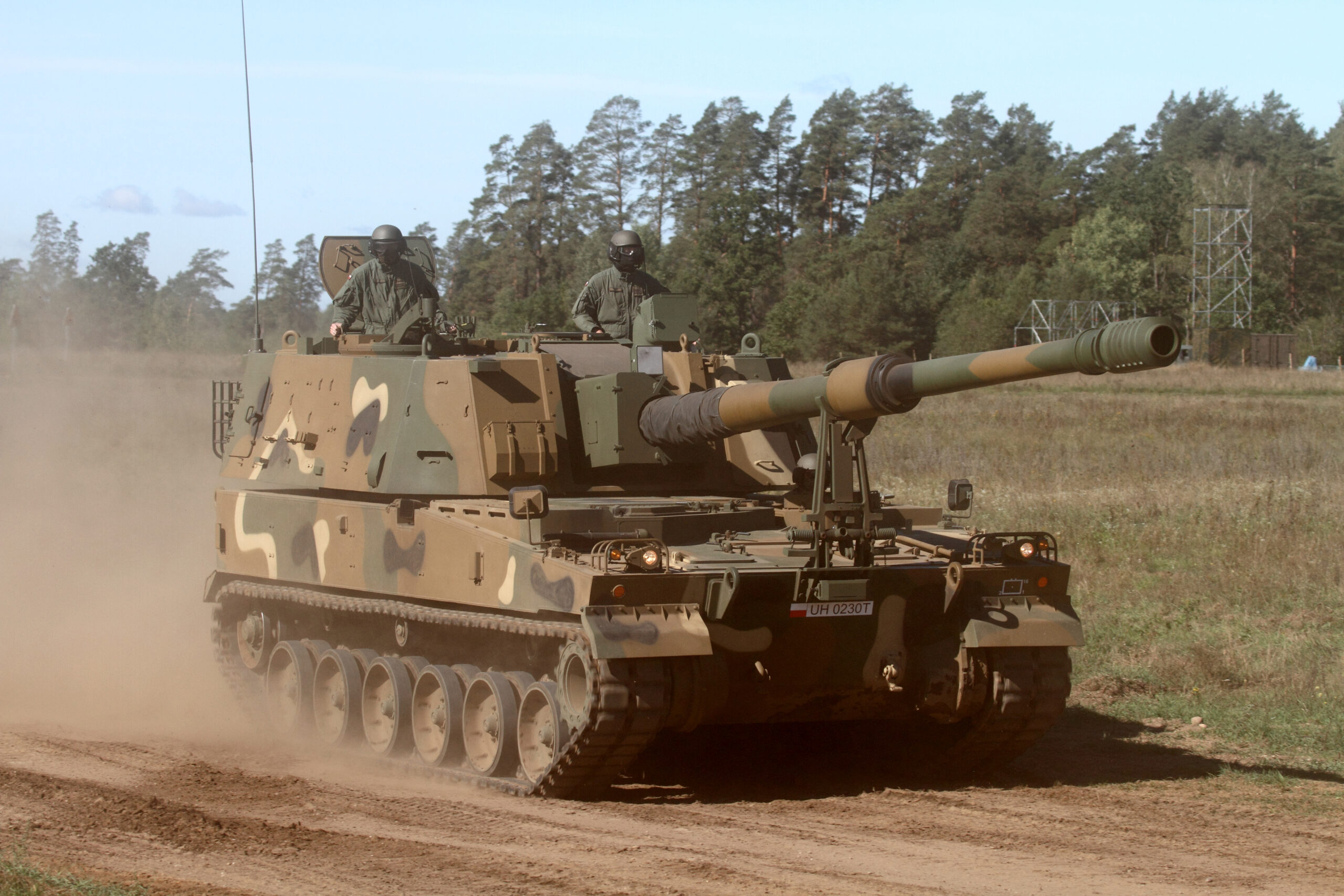 Photo: Grzegorz Sobczak, MILMAG
Deliveries are being carried out under the first implementation contract of 26 August 2022, valued at 2.4 billion USD net (11.38 billion PLN net / 13.99 billion PLN gross). Under this agreement, 212 K9A1 howitzers are to be delivered between 2022 and 2026 (which means that eight howitzers still remain to be delivered).
Subsequently, on 1 December 2023, an additional six K9A1s and 146 Polish-configured K9PLs were ordered, and on 2 December 2024 the Ministry of National Defence announced the start of deliveries under this order. On 23 December 2024, the ministry signed a contract with Huta Stalowa Wola for the supply of over 250 support vehicles for these howitzers.
The K9 Thunder is a South Korean tracked self-propelled howitzer. Its main armament is a 155 mm, 52-calibre gun capable, depending on the type of ammunition, of delivering accurate fire at distances exceeding 40 km. The K9’s armor provides protection against small-arms fire and artillery fragments. It is powered by a 1,000 hp diesel engine paired with an automatic transmission, giving it high speed and mobility in all terrain conditions. The howitzer weighs 47 metric tons. The K9A1 variant introduced a number of improvements, with the main focus on increasing firing effectiveness and range to 54 km, improving situational awareness, and enhancing crew comfort.
The howitzers are equipped with Polish communication and fire-control systems. WB Group supplies the Fonet communication system and the Topaz fire-control system.
It is also worth noting that on 7 May this year, the 1st Masurian Artillery Brigade reported on tests of anti-drone shields intended for the Korean-produced howitzers.
K9A2
Meanwhile, during this year’s MSPO in Kielce, the Koreans presented a proposal for a deep modernization of the howitzer to the K9A2 version, which, according to information obtained by the MILMAG Editorial Team, will feature a fully automated loading system.
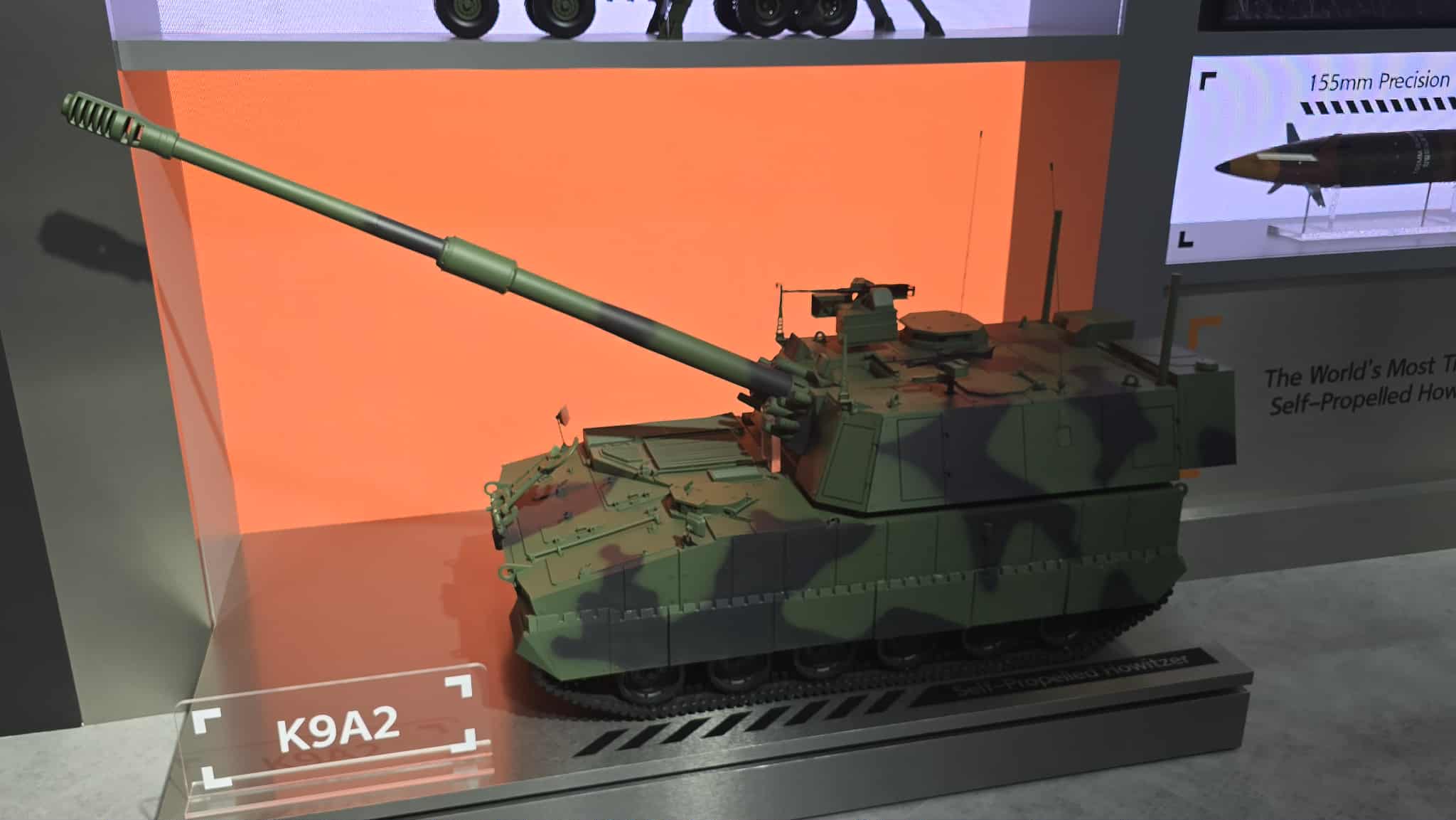 Photo: Jakub Link-Lenczowski, MILMAG
The K9A2 crew is to consist of three soldiers: a driver, a commander, and a gunner (with the obvious absence of a loader). The autoloader is expected to provide a sustained rate of fire of 10 rounds per minute, with the ability to switch between different types of ammunition. The ammunition supply in the turret-mounted autoloader will amount to 40 rounds, with an additional 8 rounds stored in the hull. The firing range is to increase from 40 to 54 km thanks to an extended 58-calibre barrel, compared to the 52-calibre barrel used in the K9A1.
The vehicle is to be equipped with a laser warning receiver, systems for countering unmanned aerial vehicles, and a rear-mounted auxiliary power unit (APU). The turret drives will be electric. The navigation system, as in the K9A1, will consist of GPS GNSS satellite navigation and INS inertial navigation systems.
This is significant because the K9A2 is intended to serve as the baseline for the Polish-configured K9PL ordered by the Ministry of National Defence.
Hanwha Aerospace in the AHS Krab program
Hanwha Aerospace is not only the supplier of the K9A1 Thunder, but also an important subcontractor for its cousin, the Polish 155 mm AHS Krab self-propelled howitzer, produced at Huta Stalowa Wola (HSW) for the Regina division fire modules (DMO).
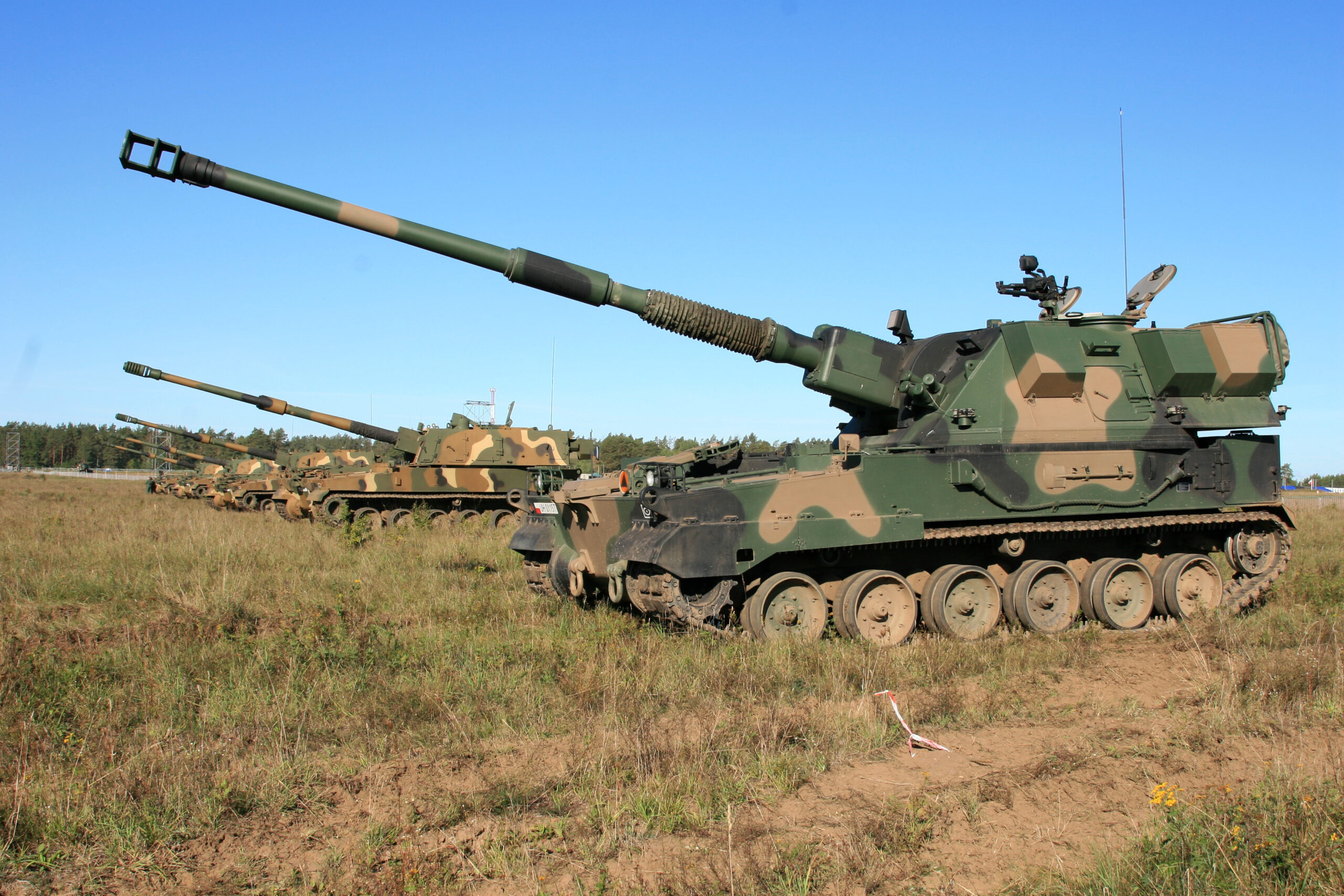 Photo: Grzegorz Sobczak, MILMAG
On 7 April this year, the PGZ-owned company from Stalowa Wola signed a contract worth approximately 280 million USD (1.095 billion PLN) with its South Korean partners for the supply, in 2026–2028, of chassis components, including powerpacks for the Krab howitzers.
The AHS Krab is powered by a powerpack consisting, among other elements, of a four-stroke, liquid-cooled, turbocharged MTU MT 881 Ka-500 diesel engine with a displacement of 18.2 litres, generating 1,000 hp at 2700 rpm and delivering a maximum torque of 2235 Nm at 2000 rpm. The engine is produced by STX Engine under licence from the German company MTU Friedrichshafen (now part of Rolls-Royce Power Systems).
The engine is coupled with an Allison X1100-5A3 hydromechanical transmission with four forward gears and two reverse gears, an integrated hydrostatic steering unit, and a disc braking system. It is manufactured under U.S. licence by SNT Dynamics.
In addition, the AHS Krab uses a Polish-configured PK9 chassis derived from the K9 Thunder howitzer.
This year, HSW resumed deliveries of AHS Krab to the Polish Armed Forces: on 24 September and 25 August, eight howitzers each were delivered to the 23rd Silesian Artillery Regiment in Bolesławiec, while on 25 and 28 November, another eight per batch were delivered to the 5th Lubusz Artillery Regiment in Sulechów.
