




















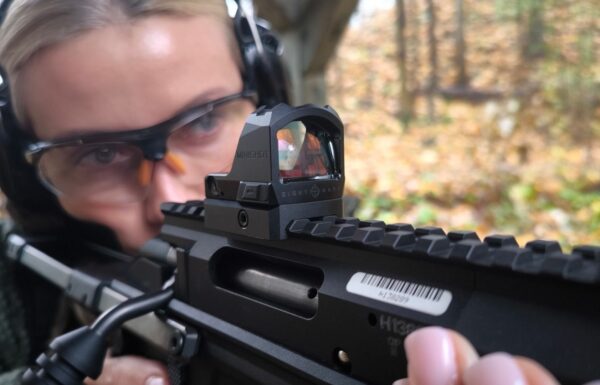
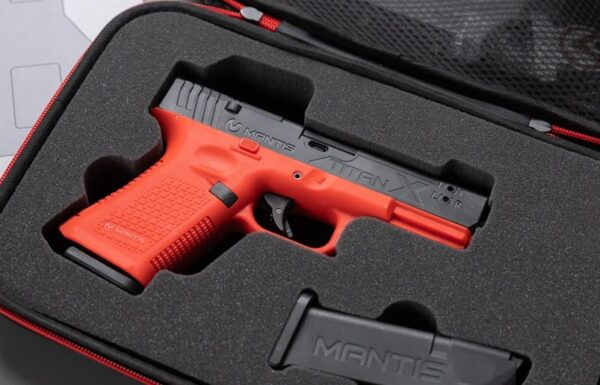




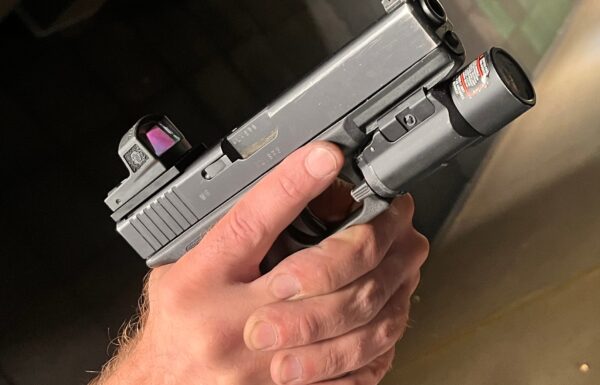







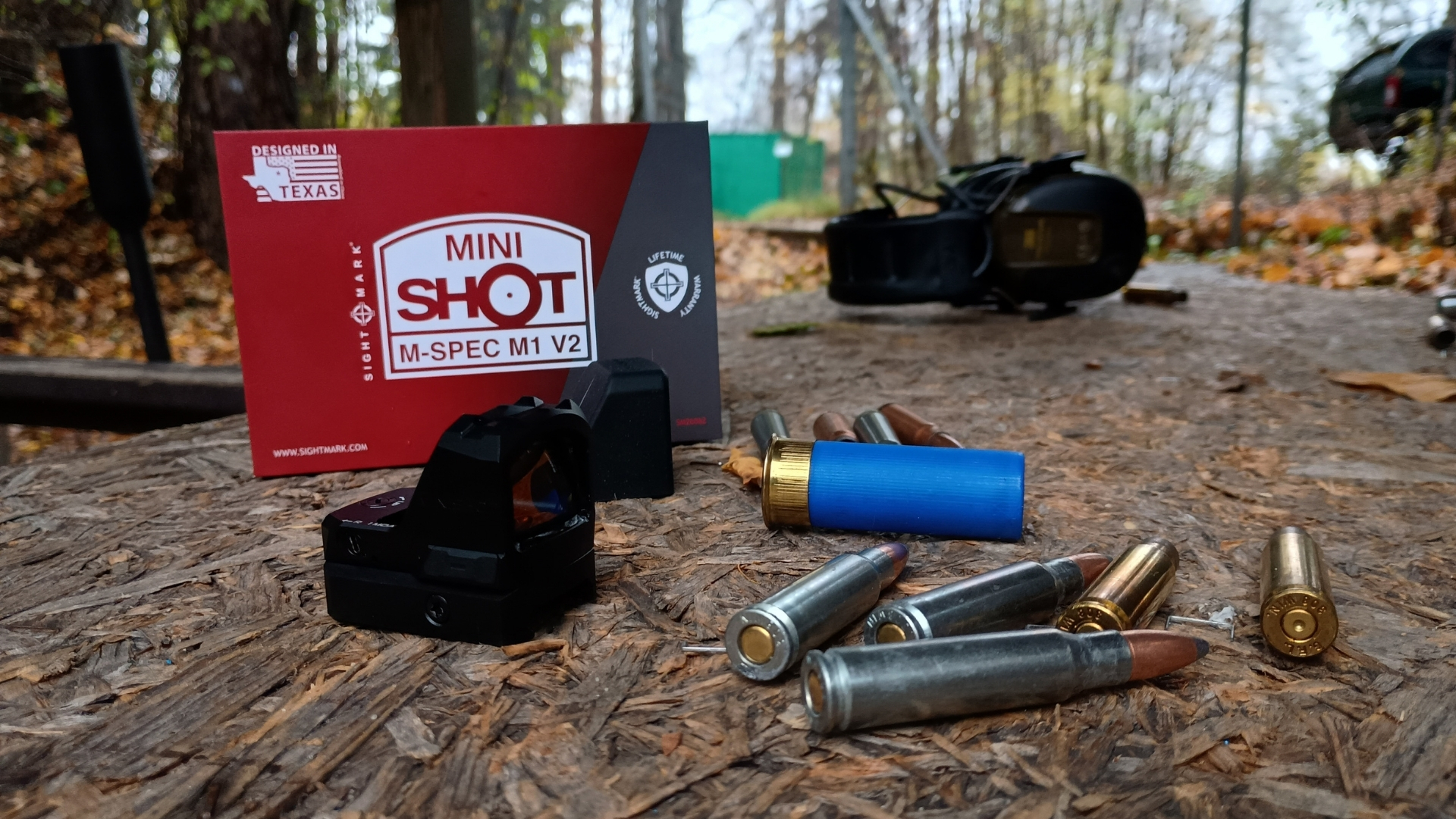
SightMark Mini Shot M-Spec M1 V2 briefly
It can be summed up in one sentence: small, light, and ready to nestle onto practically any firearm you can think of. End of review. But if someone expects a bit more… Mini Shot M-Spec M1 V2 is a classic lightweight in the category of open reflex sights, typically thrown into the “pistol” drawer. Although in its case, that label is a bit unfair, because it performs just as well on various types of long guns. Of course, it’s far from the large electro-optical sights that you can mount essentially only on rifles and shotguns (and on some hunting revolvers, but that’s another story). And in fact, that’s a compliment.

The M1 V2 is light as a feather – 36 g. To be precise: like a condor’s feather, but still very little. The manufacturer doesn’t specify whether this weight includes the battery, but with a CR1632 the difference is negligible anyway. The low weight doesn’t seem to translate into a fragile construction. The collimator’s housing is made of 6061-series aluminum. And the lens? Large for such a compact gadget – 24 × 19 mm. The whole unit measures 47 × 32 × 29 mm. Of course, this won’t be perfectly comfortable in every weapon configuration, but nothing is truly universal.
Specifications – or what kind of performance hides behind the complicated name
A CR1632 coin battery provides, at least theoretically, anywhere from 800 to 50,000 hours of operation. That’s a spread like a shotgun without a choke, but of course it all depends on the brightness setting. And there are 11 of those: nine for use in visible light and two for those who like to look at the world through night vision.


The M1 V2, unsurprisingly, has no magnification, and the aiming point can be adjusted by 160 MOA horizontally and 120 MOA vertically. That’s plenty. The reticle is a 3 MOA dot with (or without) a 32 MOA circle. The manufacturer states that the sight can withstand use even on a .308 Win. The optic’s built-in mounting footprint is compatible with the Docter/Venom pattern. If that doesn’t suit someone, adapter plates will be necessary. The box also includes two Picatinny mounts – a low one (0.8”) and a high one (1.5”), measured, which is worth noting, to the center of the lens. Thanks to this, the M1 V2 can be fitted to practically any platform without forcing you to bend your neck.
On a shotgun – Bartek's opinion
I’m not a fan of semi-auto shotguns, so I run all my tests on a pump – a Mossberg M590A1. The variant I use is equipped with iron sights, but the little SightMark works just fine – meaning the irons don’t get in the way, but because of the sight’s relatively high mount they stop being functional. There’s no so-called co-witness.
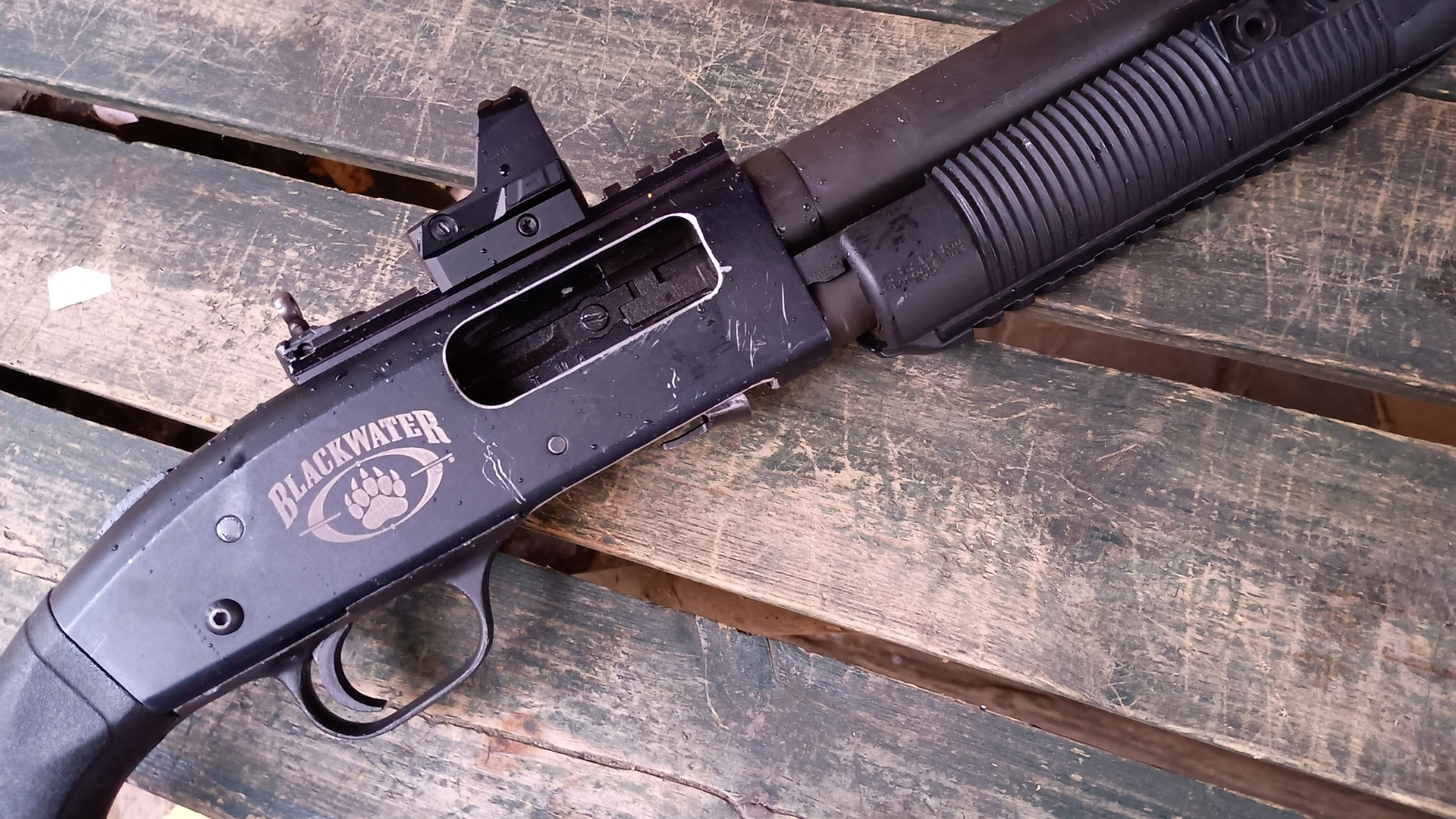
If the sight really withstands normal use on a shotgun, as the manufacturer claims, then this limitation isn’t a problem. Under our conditions it’s hard to perform a true durability test within the time available – you’d need to fire a thousand rounds or more. Back to practical use: one wrench is used both to attach the base to the sight and to secure the base to the shotgun’s Picatinny rail. Excellent. The other end of that wrench – a screwdriver – allows you to adjust/zero the optic.
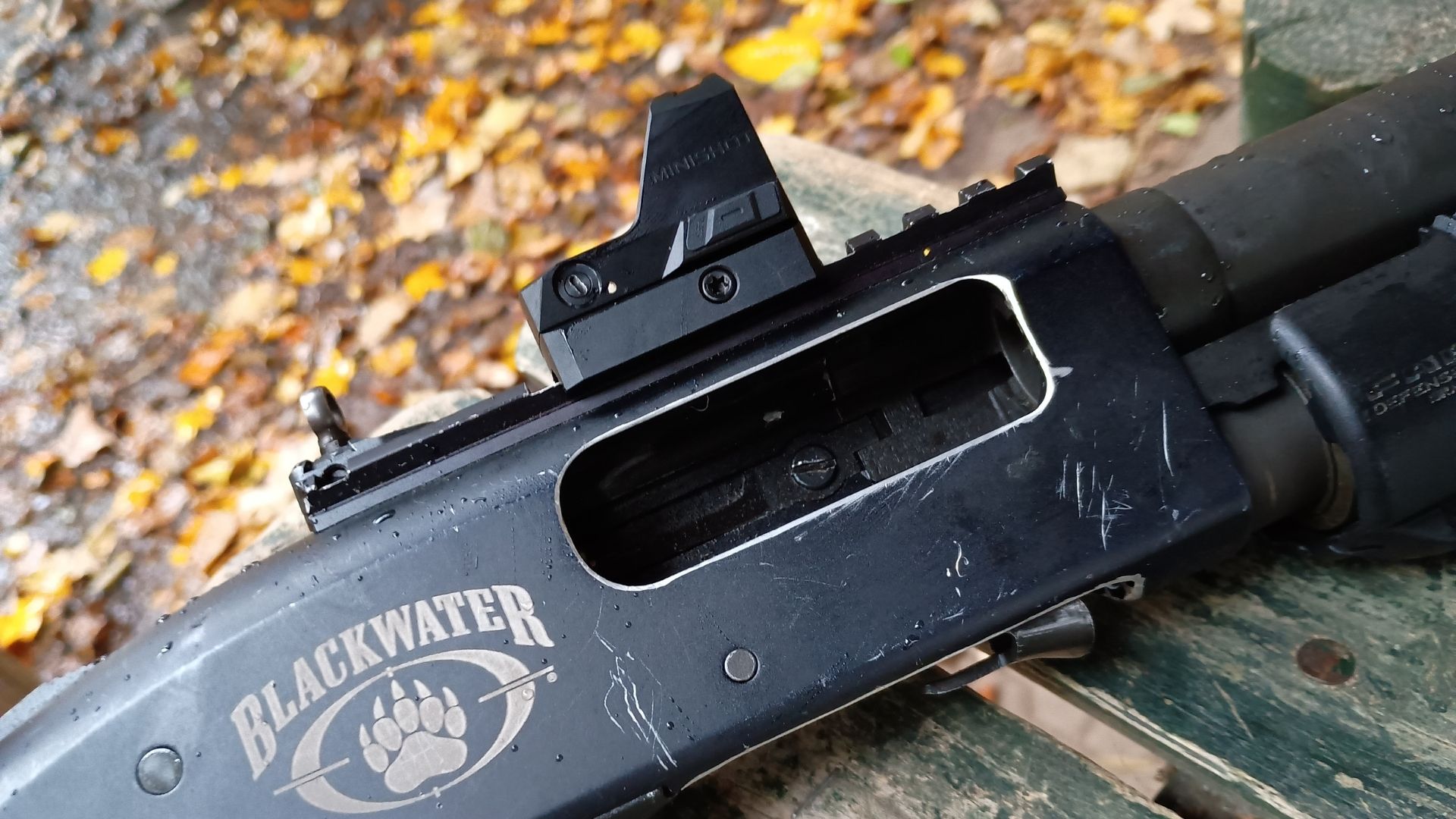
After years spent with a shotgun and its very low-mounted ghost ring, getting used to a new cheek weld took me a bit of time. It does shoot well and accurately, but on a shotgun I still prefer classic iron sights – even if that means a tiny brass bead reduced to the absolute minimum.
On CZ600 Trail 7,62 x 39 rifle – Bartek's opinion
I shoot bolt-actions more often at shorter rather than longer distances, because I’m not very patient and my eyesight isn’t great. That’s why a reflex sight, an AK-caliber rifle, steel targets set at roughly 50 to 100 meters, and shooting on a timer are a lot more fun for me than spending half a day lying in the dirt and shooting at targets set somewhere beyond the horizon.

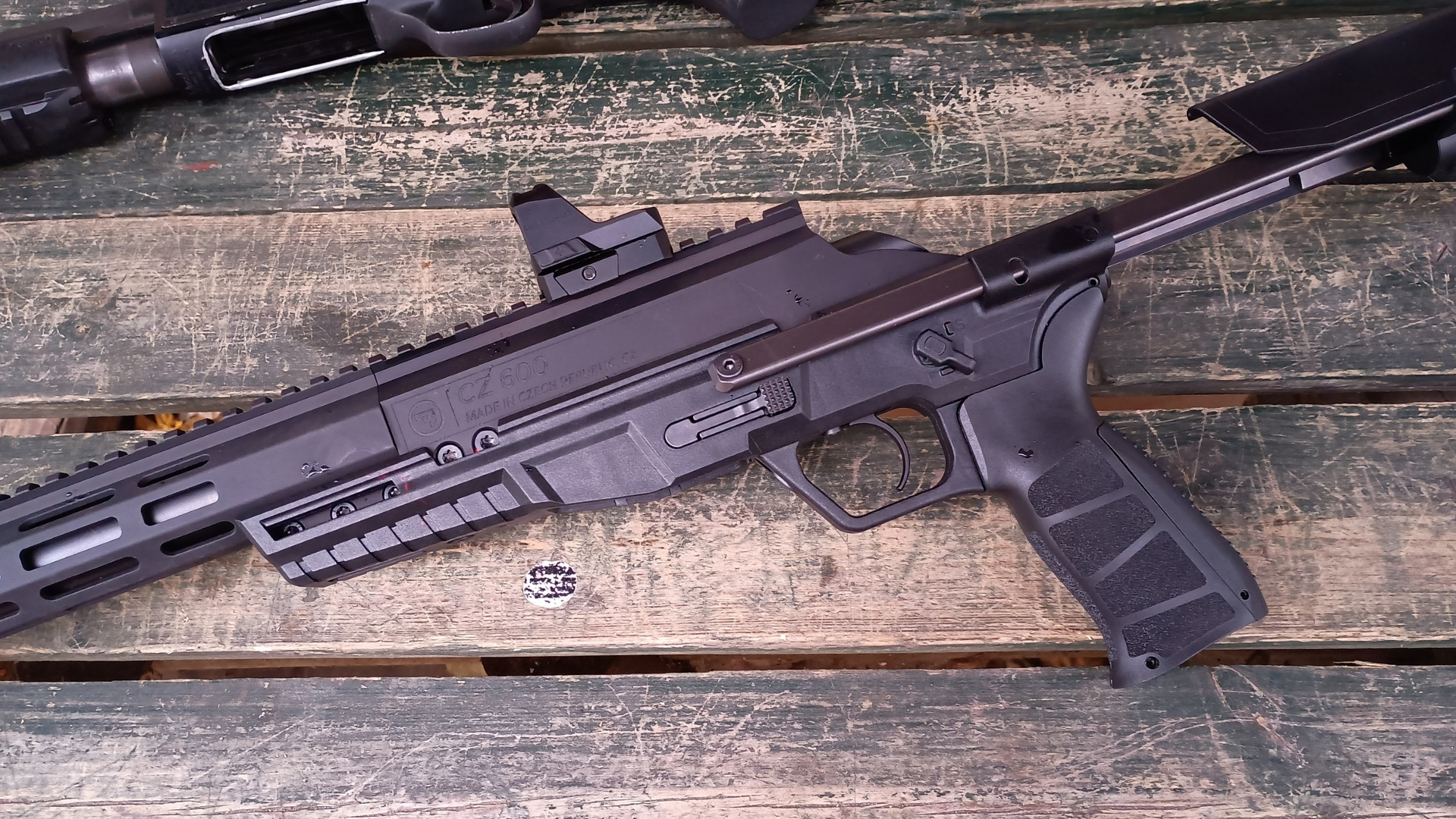
The CZ600 Trail in its most compact version paired with a SightMark reflex sight really gets the job done in this kind of shooting. Despite having astigmatism, I’m able to get used to the image in the optic and use it consistently in so-called practical shooting. That was exactly the case with the M1 V2. I certainly see the reticle differently than you do, but with quality equipment the image is repeatable and always the same, which means the shooting is repeatable as well. Additionally, the optic’s small profile makes it easier to swing this contraption around – the one experts refer to with some fancy name that I definitely don’t.

Running, shooting, unconventional firing positions – that’s exactly what reflex sights are made for. The M1 V2 doesn’t force a specific eye relief or require you to take the same position every time. Unlike scopes or, to a lesser extent, prismatic sights. Thanks to that, you can focus on movement, on the shot, on finding a good spot and a position that allows you to efficiently neutralize the steel plate. Overall, good fun.
On Shotgun – Ania's opinion
I’m not a fan of pump-actions, so, as always, my tests were done on a semi-automatic Saiga-12. It’s not a gentle platform: the bolt cycles very energetically, the recoil with the right ammunition is substantial, and yet the sight doesn’t give the impression that it’s about to fly off with a bang after the first decent string. Once the mount is properly tightened on the rail, everything stays exactly where it should.
I fired both birdshot and slugs. After a few magazines I checked the point of impact – the zero stayed exactly where I’d left it. There was no “wandering” of the group across the target that would make me look suspiciously at the screws or the construction itself. The optic handles the Saiga’s cyclic action more bravely than my collarbone does. Because of the sight height, the iron sights effectively stop being useful – all the more so since I don’t have any on this gun anyway. The Saiga is the kind of firearm that you naturally shoulder “for the red dot,” not “for the front sight.” The window is large enough that during dynamic shooting the dot quickly appears where you want to see it, even if your position is slightly imperfect.
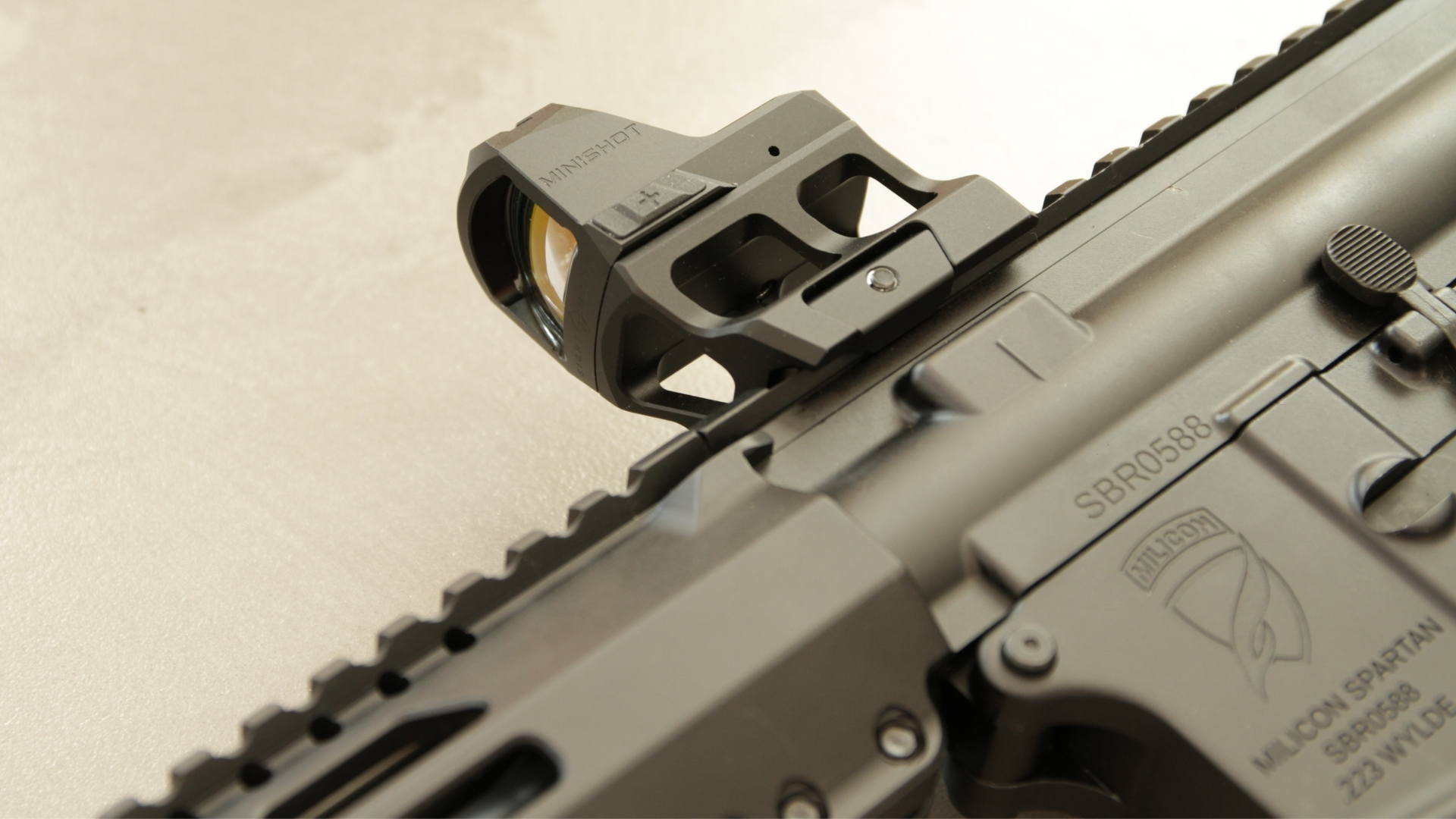
When shooting quickly at moving targets, it doesn’t distract, it doesn’t dominate the firearm, and it doesn’t force you to fight for a proper cheek weld. For an open reflex sight of this size, on such a brutal platform, the M1 V2 performs very respectably.
On .308 Win rifle – Ania's opinion
The manufacturer claims that this Mini Shot can handle shots fired from a firearm chambered in .308 Win – which bodes well in this comparison. I won’t keep you in suspense. The sight held up. It wasn’t exactly a rigorous exam for this piece of equipment, because, as we know, ammunition doesn’t grow on trees, and the Sabatti wasn’t the main focus at the time, but… better something than nothing. The sight itself weighs very little, so on a heavier rifle like the Rover Scout it’s practically unnoticeable. I don’t feel like I’m adding anything cumbersome. The Picatinny mount provides a solid attachment point. And with no magnification, getting a sight picture through the optic is intuitive. Equipped with the Mini Shot, the Sabatti is a great fit for fast, “field-style” shooting, where the rifle is used more or less on the move.
Summary
The M1 V2 doesn’t pretend to be something it isn’t. It doesn’t try to compete with armored, toaster-sized red dots, nor does it put on any sort of overly “military” seriousness. It’s light, simple, durable, and it just works.

What’s more, it works in places where, by common sense, such a tiny optic shouldn’t necessarily work – on hard-kicking shotguns and on .308 Win rifles. Does the M1 V2 have drawbacks? Of course! Unfortunately, under certain lighting conditions the dot and circle can create reflections, making small targets harder to read. The glass, although wonderfully clear in bright daylight, loses contrast in low-light conditions. Still, if someone is looking for a red dot that’s still budget-friendly but already from a reputable brand, this one fits the bill. It doesn’t fall apart after the third shot, and it doesn’t require a PhD to operate two buttons.
We thank Sellmark for providing the equipment for testing.
Advertising cooperation. Product testing is conducted independently; all opinions are solely those of the author. The advertiser has no ability to influence the content of the review.
