




















On Thursday, 4 December 2025, the Romanian Ministry of Defence reported that the day before, Navy EOD divers (Forțele Navale Române), specializing in explosive ordnance disposal, carried out a mission at the request of the Border Police (Poliția de Frontieră) to neutralize an object posing a threat to navigation in the Black Sea.
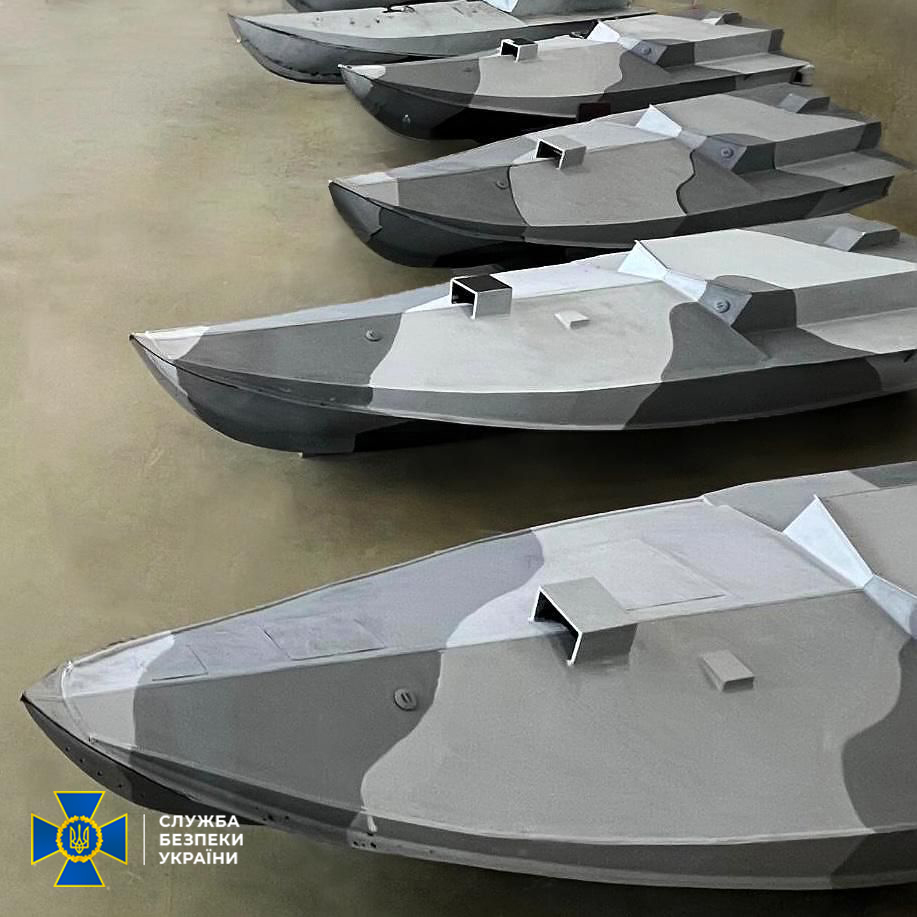 Sea Baby unmanned combat boats / Photo: Security Service of Ukraine
Soldiers from the Navy’s 39th Diving Centre were transported to a maritime area approximately 36 nautical miles east of Constanța, supported by the Border Police’s maritime patrol and observation vessel MAI 1107.
After examining the drifting object, the soldiers discovered that it was a Ukrainian Sea Baby unmanned combat boat. The intervention team received authorization to neutralize the identified object in accordance with standard operating procedures, and at around 13:00 local time the naval drone was destroyed through a controlled detonation.
Since the beginning of the full-scale Russian–Ukrainian war, which also affects the Black Sea region, Romanian naval forces have continuously monitored and overseen their designated maritime and riverine areas, using both their own ships and aircraft and cooperating with other branches of the Romanian Armed Forces as well as NATO member states. From February 2022 to the present, freedom of navigation has been ensured for more than 12,000 commercial vessels passing through the Black Sea basin.
Another serious threat to maritime security is drifting naval mines. In the past four years, around 150 sea mines have been neutralized in the Black Sea, seven of which were destroyed by Romanian naval forces.
Romania is also part of the Mine Countermeasures Black Sea Task Group, alongside the Bulgarian and Turkish navies. Romanian naval personnel assumed command of this maritime task force six months ago.
Recently, Ukrainian Sea Baby naval drones have been used to strike tankers belonging to Russia’s so-called “Shadow Fleet,” which is used to circumvent Western sanctions: the Kairos and Virat on 28 November, and the Midvolga 2 on 2 December, all of which were sailing on ballast (without cargo) toward Novorossiysk.
According to available information, Sea Baby drones are 6 m long, 2 m wide, and 0.6 m high. They carry either an 850-kg explosive charge or six RPW-16 thermobaric grenade launchers. They are capable of high surface speeds of up to 49 knots and have a range of at least 1,000 km. Later variants received a single Molniya/Vympel R-60 (DIA/NATO: AA-8 Aphid) air-to-air missile for self-defense against Russian helicopters (in addition, other Ukrainian combat boats such as Magura V5 and V7 use R-73 and AIM-9 missiles).
Sea Baby drones are operated by the 385th Independent Special-Purpose Brigade of Unmanned Maritime Systems, subordinate to the Security Service of Ukraine (SBU). They made their debut during the second attack on the Crimean (Kerch) Bridge on 17 July 2023. They were later used, among other operations, in attacks on Russian ships: on 14 September against the RFS Samum Bora-class patrol corvette, and in October against the RFS Pavel Derzhavin, a Project 22160 patrol ship.
On Wednesday, December 3rd, the Romanian🇷🇴 Naval Forces military IED divers, specialized in countering explosive devices, conducted a mission to neutralize an object that was endangering navigation in the Black Sea, at the Coast Guard request.https://t.co/gpinXg3QBu pic.twitter.com/dfyNGUehek
— MApN (@MApNRomania) December 4, 2025
