
























The HK433 rifle is often described as a hybrid of the HK G36 and the HK416, the flagship designs of the German manufacturer, both of which are in service with numerous uniformed forces worldwide. The weapon had its official debut in 2017 at the Enforce Tac trade fair in Nuremberg. The designers from Oberndorf set out to create a modular platform that combines the best features of the rifles mentioned above while incorporating the latest materials as well as technical and ergonomic solutions.
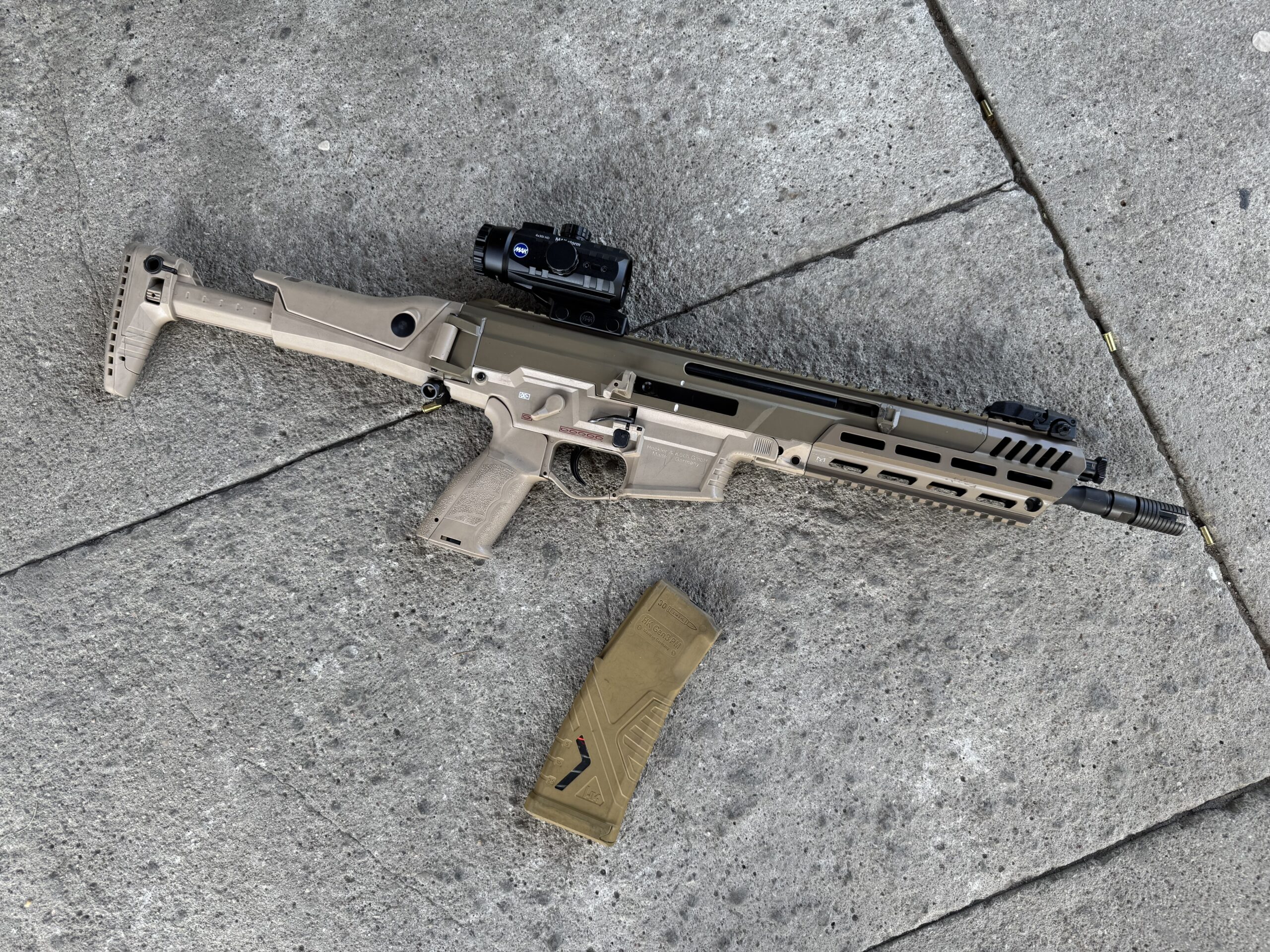
HK433 rifle
HK433
The weapon tested by our editorial team is the HK433 with an 11-inch barrel (the manufacturer also offers versions with 14.5- and 16.5-inch barrels) and a muzzle device allowing for quick installation of selected sound suppressor models. One of the first noticeable features of the rifle is the prominent gas regulator marked S and N, enabling adjustment of gas flow depending on whether the weapon is operated with a suppressor [S] or without one [N]. The adjustment is facilitated by a distinct, textured regulator knob, which operates with significant resistance, ensuring that, despite not being shielded by the handguard, it is unlikely to fall out or be lost by the shooter.
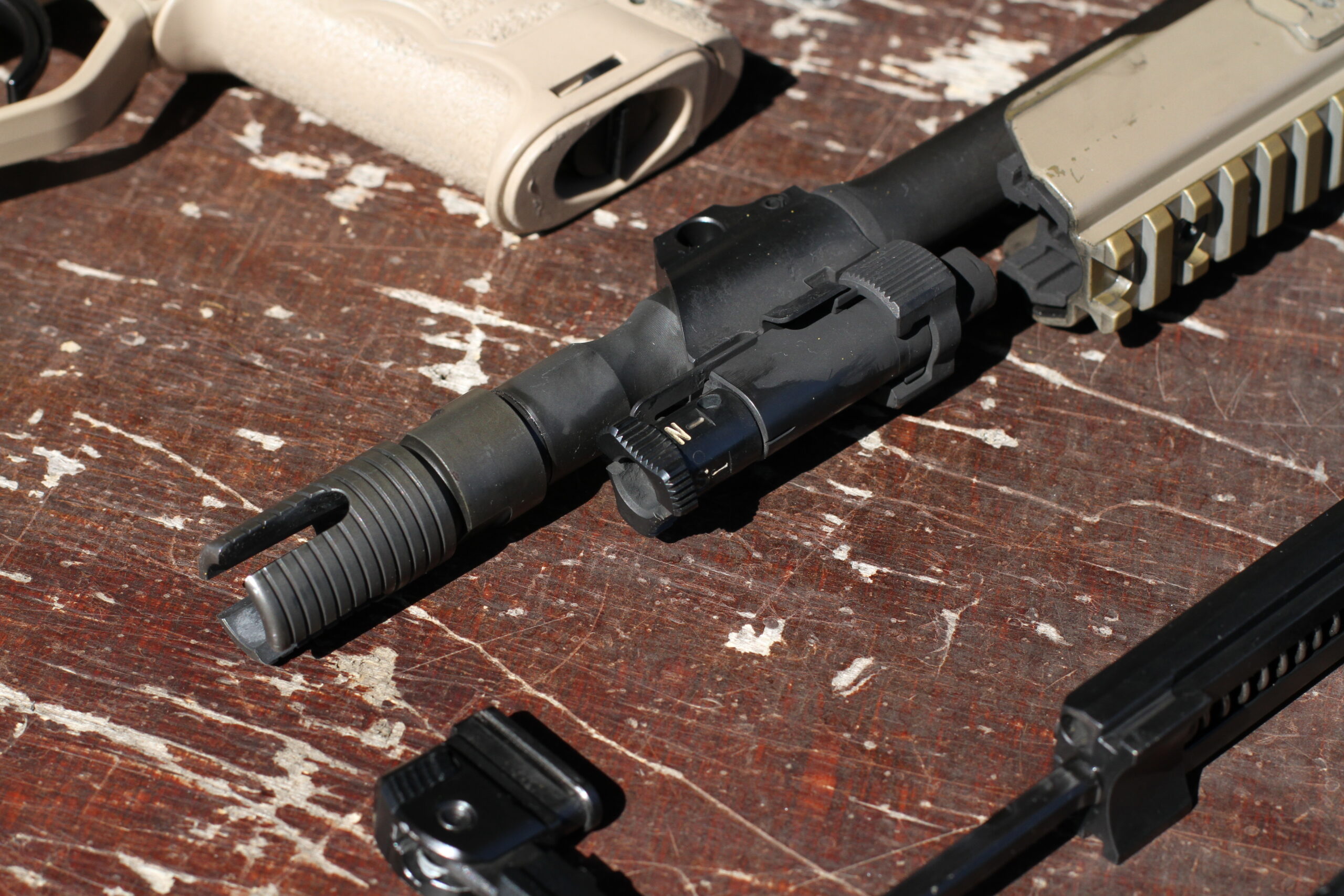
Gas block adjustment on the HK433
The rifle’s handguard is designed as a cover that slides onto the receiver and is secured with a single pin, which can be easily removed without tools or with the tip of a cartridge. The sides of the handguard are fitted with the M-LOK accessory mounting system (three slots on each side). However, the manufacturer also offers versions equipped with handguards using its proprietary HKey system – known from the HK416 and G36 models. The bottom of the handguard features a standard Picatinny rail. It is worth noting that the handguard actually covers only the sides and bottom of the barrel, as the top is shielded by the monolithic receiver with an integrated Picatinny rail. The handguard can be removed extremely smoothly and quickly.
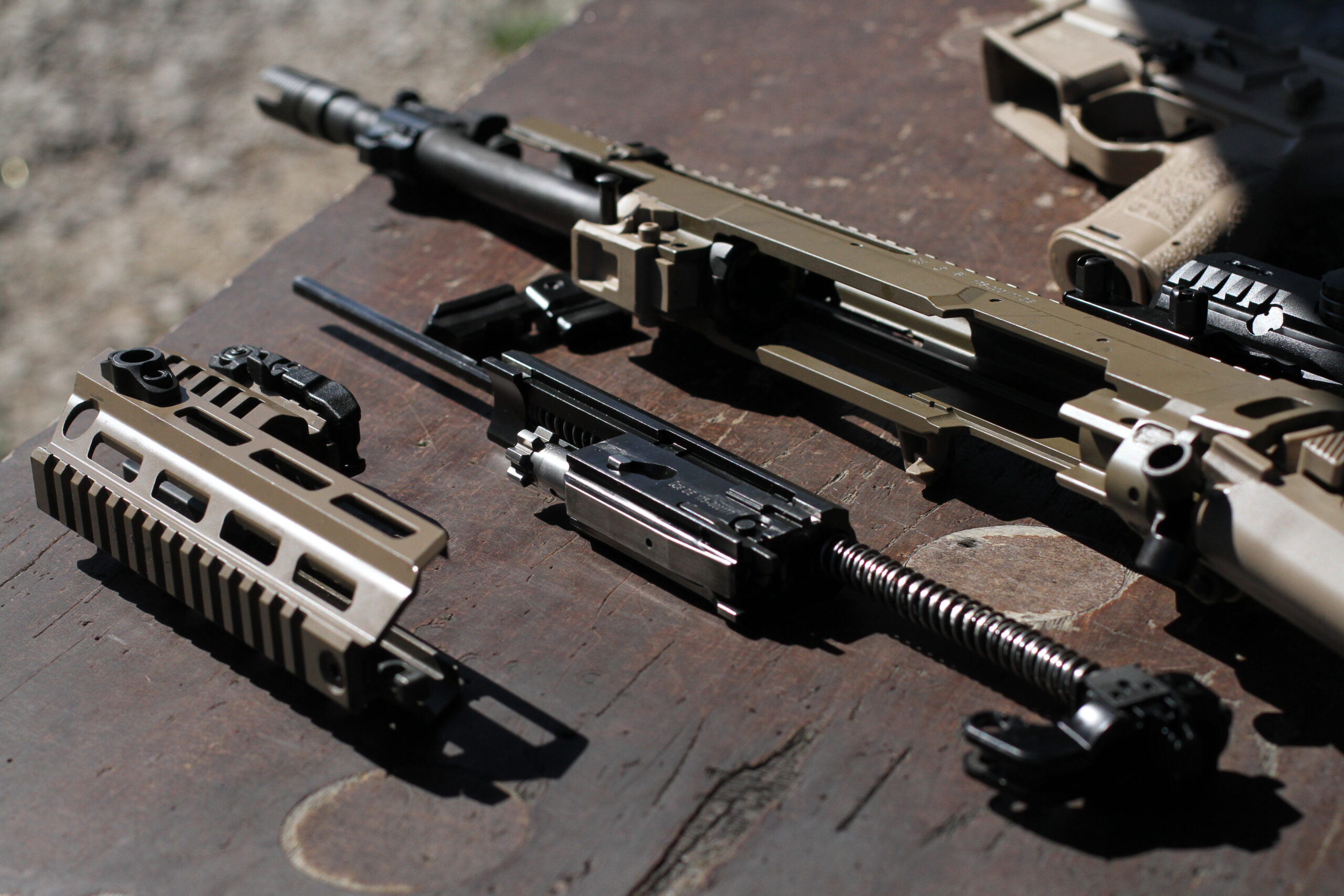
Disassembled handguard and bolt of the HK433
The HK433 receiver has been designed as a single unit together with the top accessory rail. This solution provides the user with a more stable space for mounting optics and accessories, eliminating the risk of so-called zero shift, which can sometimes occur in firearm designs where the handguard and receiver are separate components.
The charging handle is typically placed in the upper part of the receiver, closer to the front, by default on the left side. However, the weapon’s design allows it to be quickly switched to the opposite side – a feature that has effectively become standard in modern rifles, accommodating left-handed shooters. The charging handle folds when in its resting position, protecting both the shooter and the weapon from unintended cycling. The case ejection port is located on the right side, and its cover features a white indicator that shows the exact point at which the bolt can be pulled back to check the chamber without unloading the weapon – a process known as a press check. For me, as someone used to performing press checks, this is a helpful feature. Just behind the ejection port, the manufacturer placed a shell deflector, which also serves as the latch for the rifle’s right-folding stock.
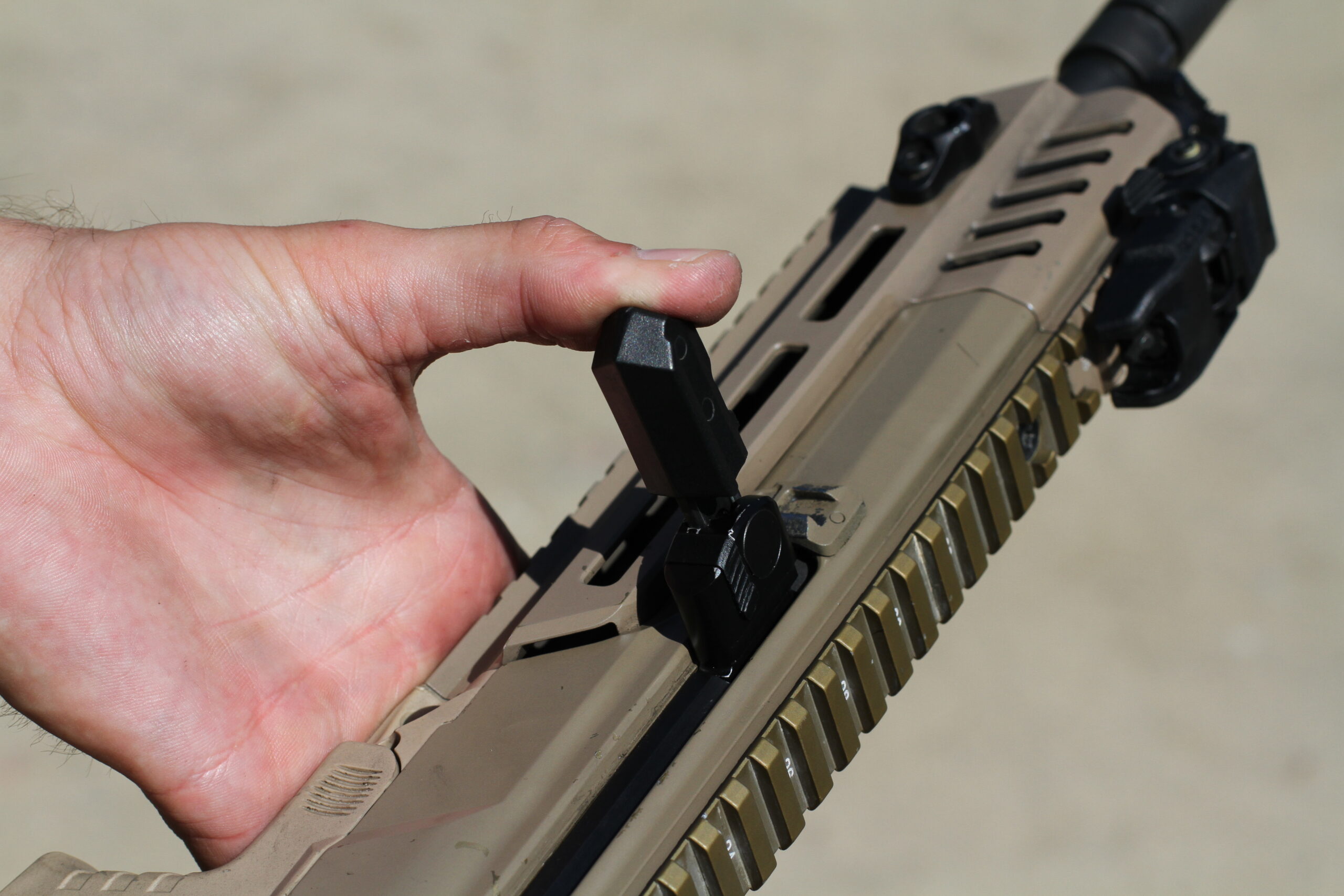
Charging handle on the HK433
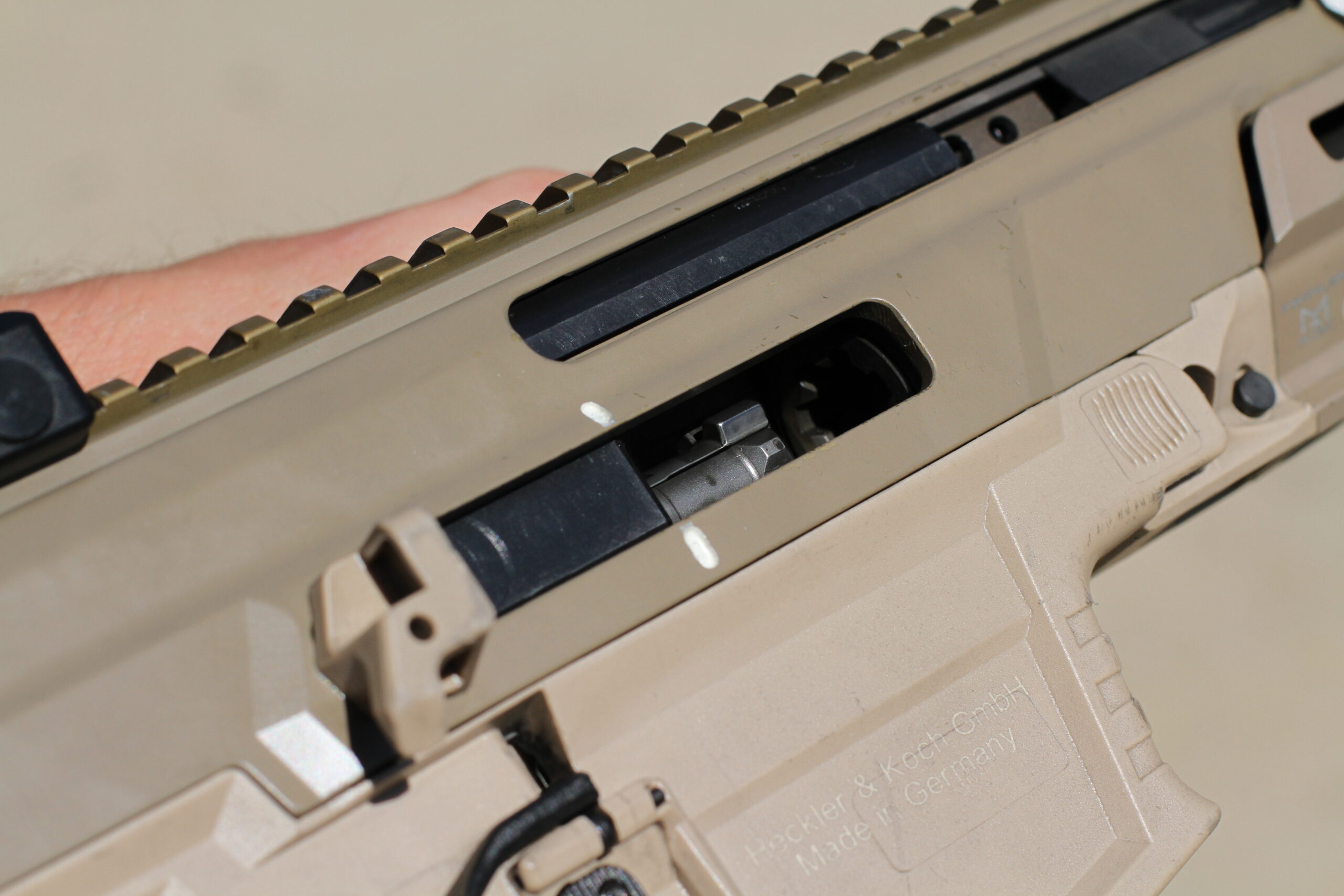
A white indicator has been placed on the ejection port, marking the point to which the bolt can be pulled back to check the chamber status without unintentionally unloading the weapon
The HK433 trigger housing is made of polymer and can be detached from the receiver using a single pin located at the rear section. The weapon is fitted with the Adaptive Battle Grip pistol grip, featuring a storage compartment for tools and interchangeable side panels and backstrap, allowing the grip’s thickness to be adjusted to the shooter’s hand. The grip closely resembles that of the HK SFP9 pistol, with interchangeable side panels compatible with those of the HK433. The magazine well is textured with grooves for a more secure hold. The rifle is, of course, compatible with STANAG standard magazines.
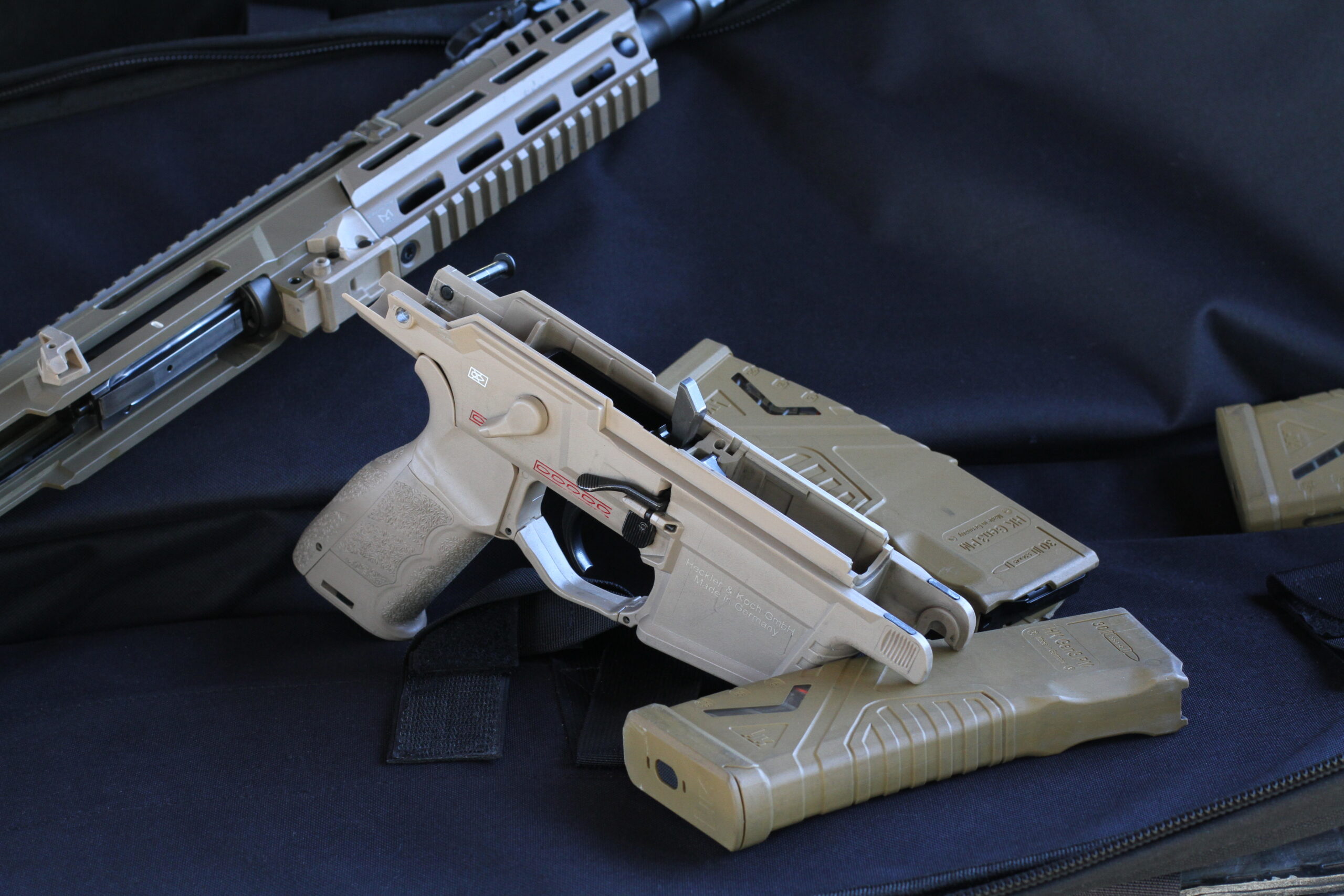
The HK433 trigger housing is made of polymer. The rifle is equipped with the Adaptive Battle Grip pistol grip
The controls in the tested version adhered to the standard layout familiar from the HK416 platform, featuring ambidextrous bolt and magazine release levers in the AR-15 style. From the G36, the HK433’s designers borrowed the fire selector/safety layout, positioned at 45-degree intervals. Interestingly, the manufacturer offers two trigger housing models: the one described above and another with the bolt and magazine release configuration typical of the G36. This is a nod to users of different platforms, as selecting the appropriate trigger housing enables faster training of the end user. The trigger pull weight is approximately 30–40 N, equivalent to 3–4 kg.
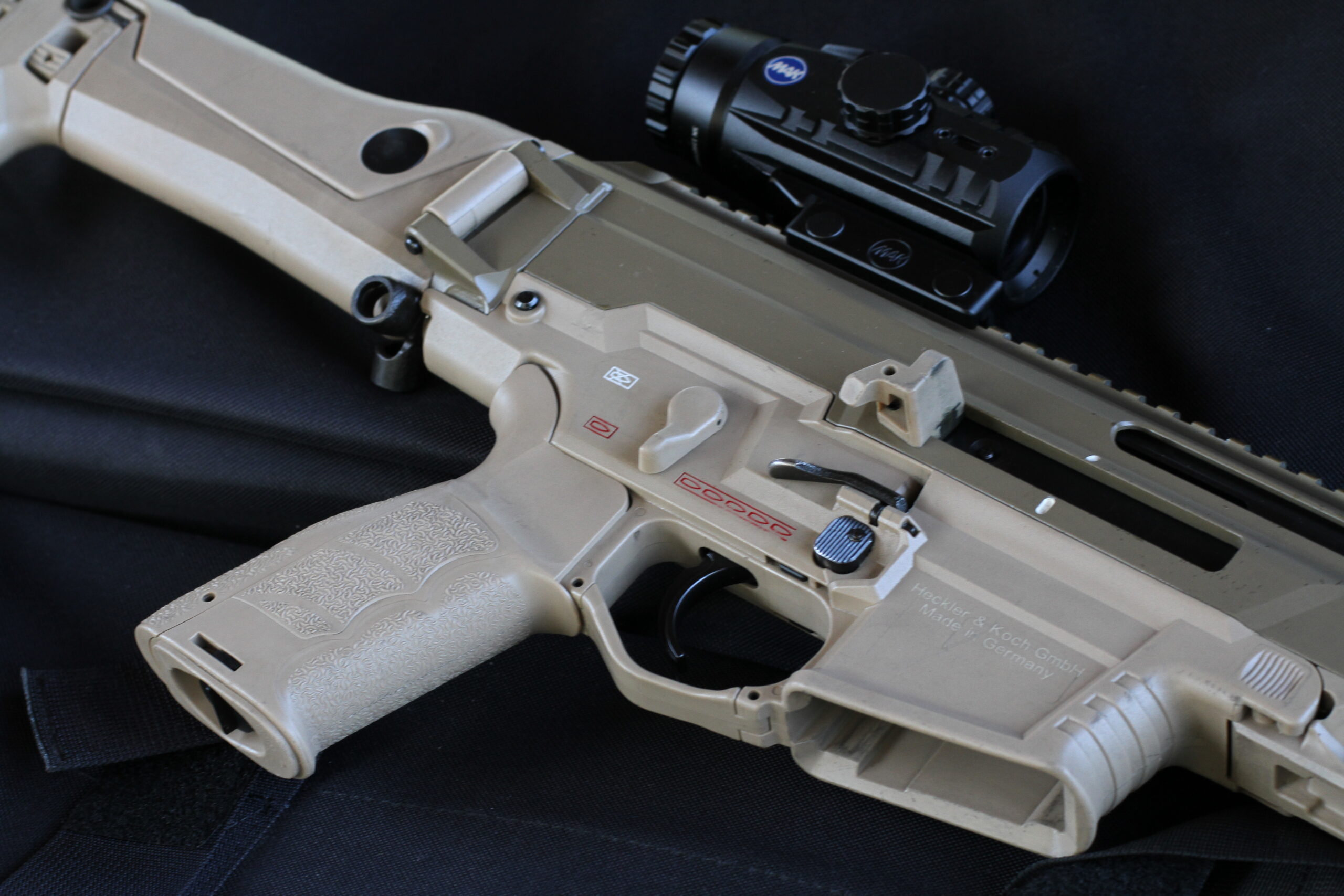
The controls in the tested version followed the standard layout. From the G36, the HK433’s designers borrowed the fire selector/safety configuration, arranged at 45-degree intervals
The HK433 stock is attached to the receiver via a hinge and folds to the right side of the weapon. It also features adjustable length and cheek height. The accessory can be easily replaced by removing the hinge pin, for example, with a model adapted for shooters using helmets with ballistic visors or versions compatible with HK416 stocks. The procedure requires no tools and can be carried out in field conditions by any shooter. Folding the stock to the side still allows the weapon to be fired, with its stable position ensured by the previously mentioned latch, which also serves as the shell deflector. The stock is finished with a rubber buttpad that reduces recoil. It also features four QD sockets for sling attachment – two just below the hinge and two above the stock length adjustment lever.
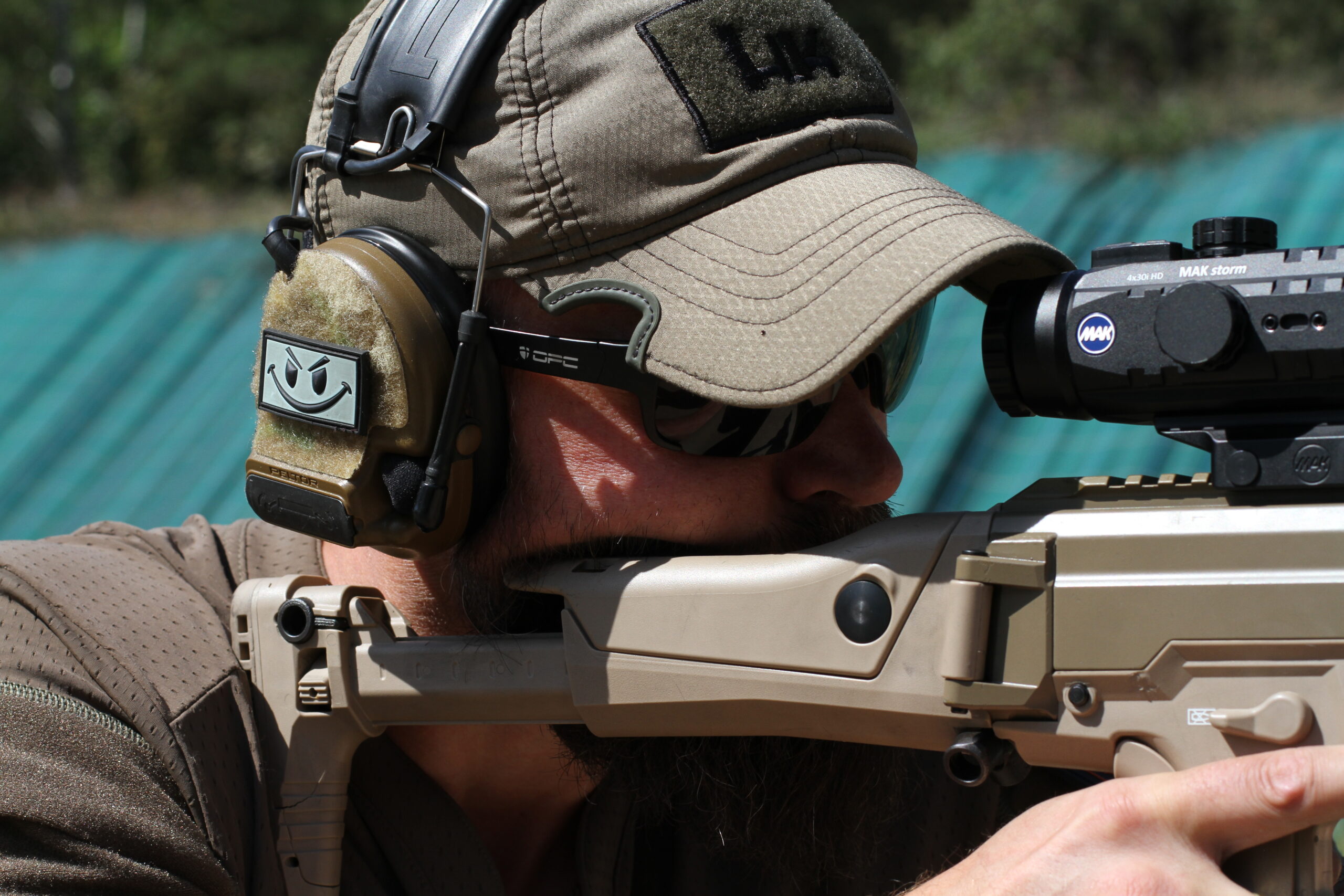
The HK433 stock folds to the right side of the weapon and also features adjustable length and cheek height
Configured in this way, the rifle came into my hands and left a good impression for several reasons. Above all, thanks to the selector settings being different from what I am used to as an HK MR223 user. The 45-degree throw feels more comfortable, especially if the rifle is equipped with a fully automatic mode. I also appreciated the ability to detach the handguard quickly, a helpful feature for cleaning the weapon, as well as the charging handle in the G36 style. Despite the wide adjustment range and the option to fold the stock to the side, it didn’t win me over – I still prefer the classic design known from the HK416.
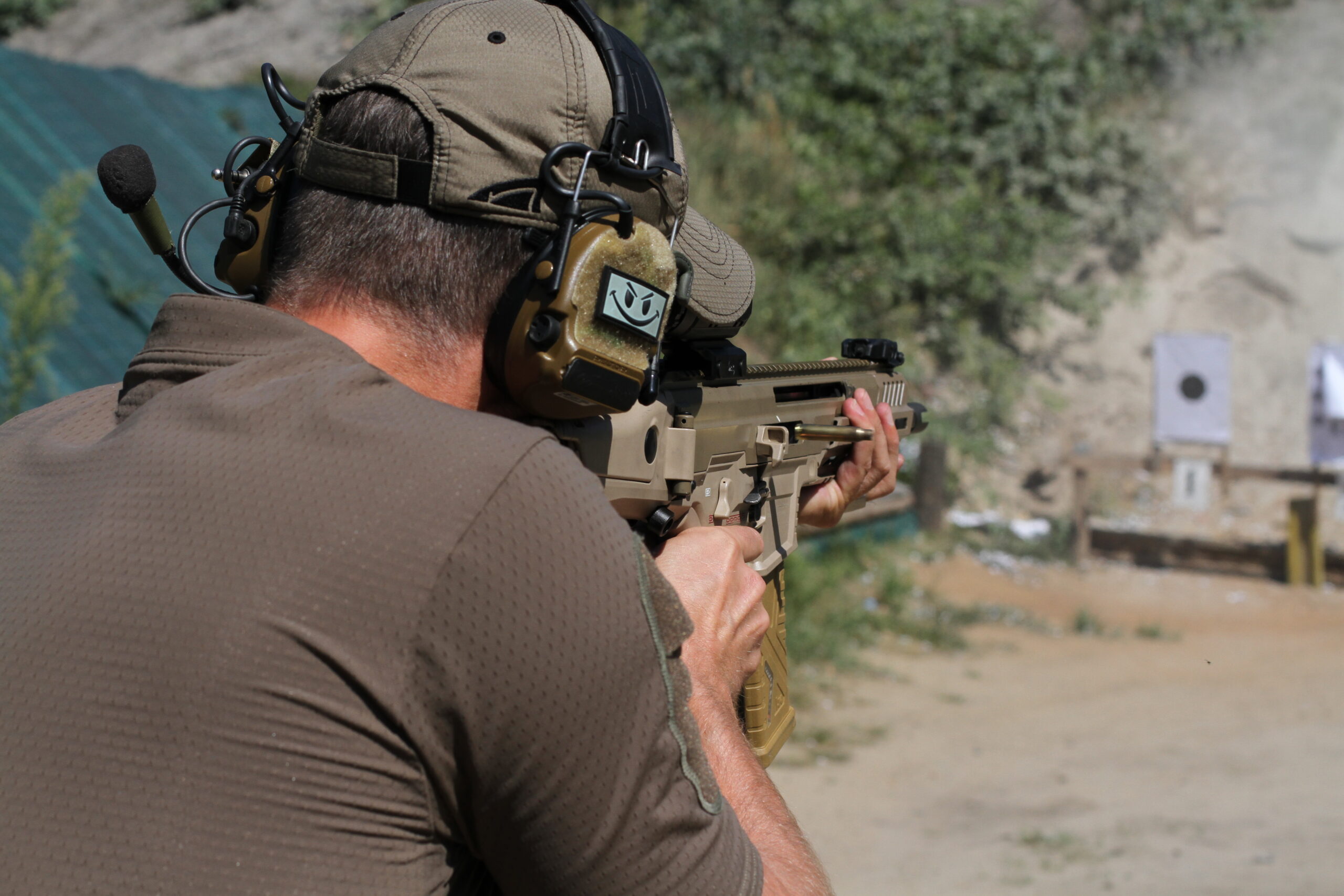
Strzelanie próbne z HK433
HK416A5
During our photo and shooting session, we also had the opportunity to test the HK416 rifles, well-known and widely used in both Polish and international armed forces, in two variants.
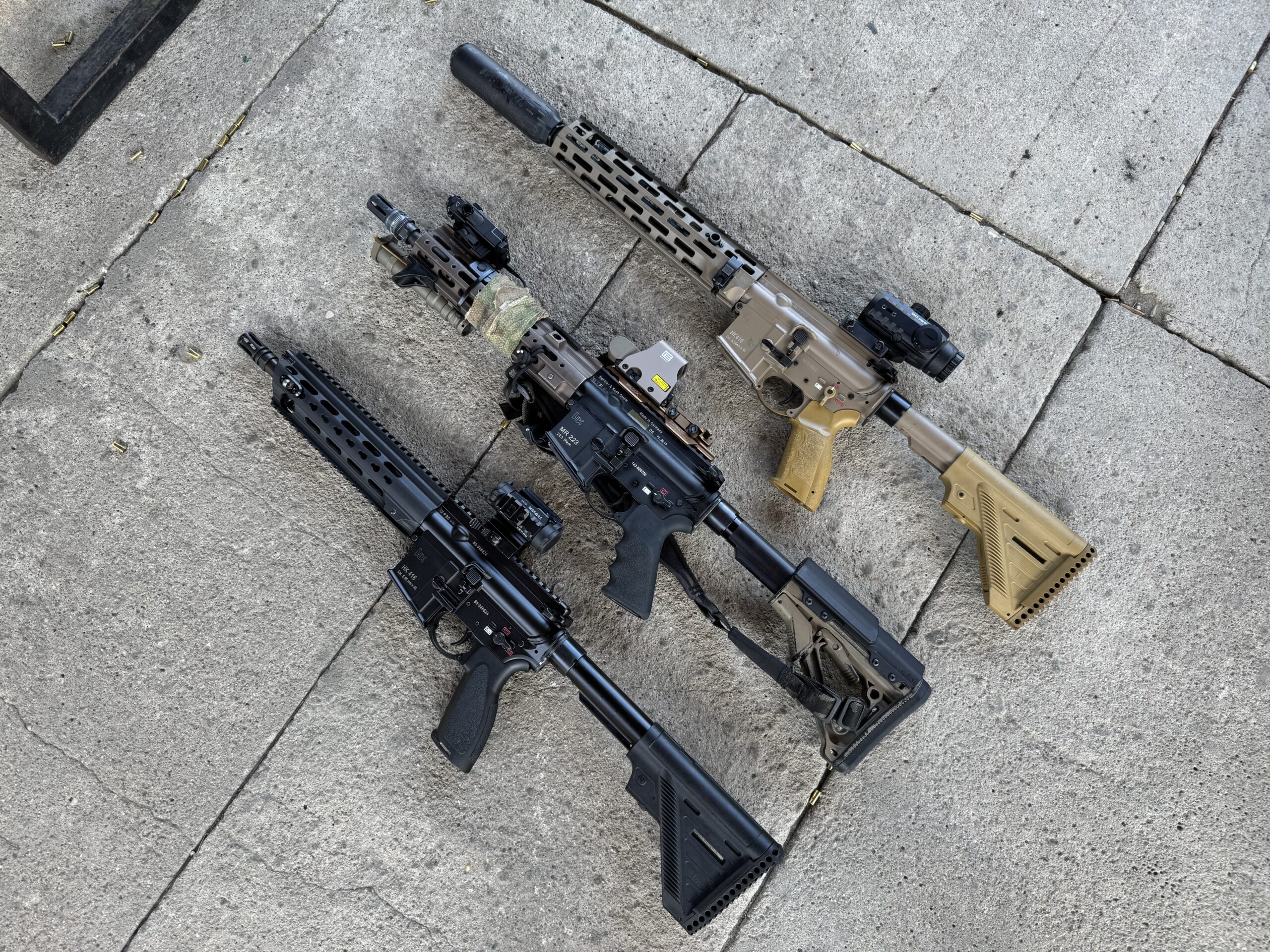
HK416 models available for testing, with the HK MR223 sport version in the middle
The HK416A5 model with an 11-inch barrel is the classic weapon of Polish special forces, one could say. The version we tested was equipped with a handguard featuring the HKey system, a standard pistol grip, and a Slim Line stock. The rifle provided by Cenzin was used, among other things, to compare it with its sporting counterpart, the HK MR223.
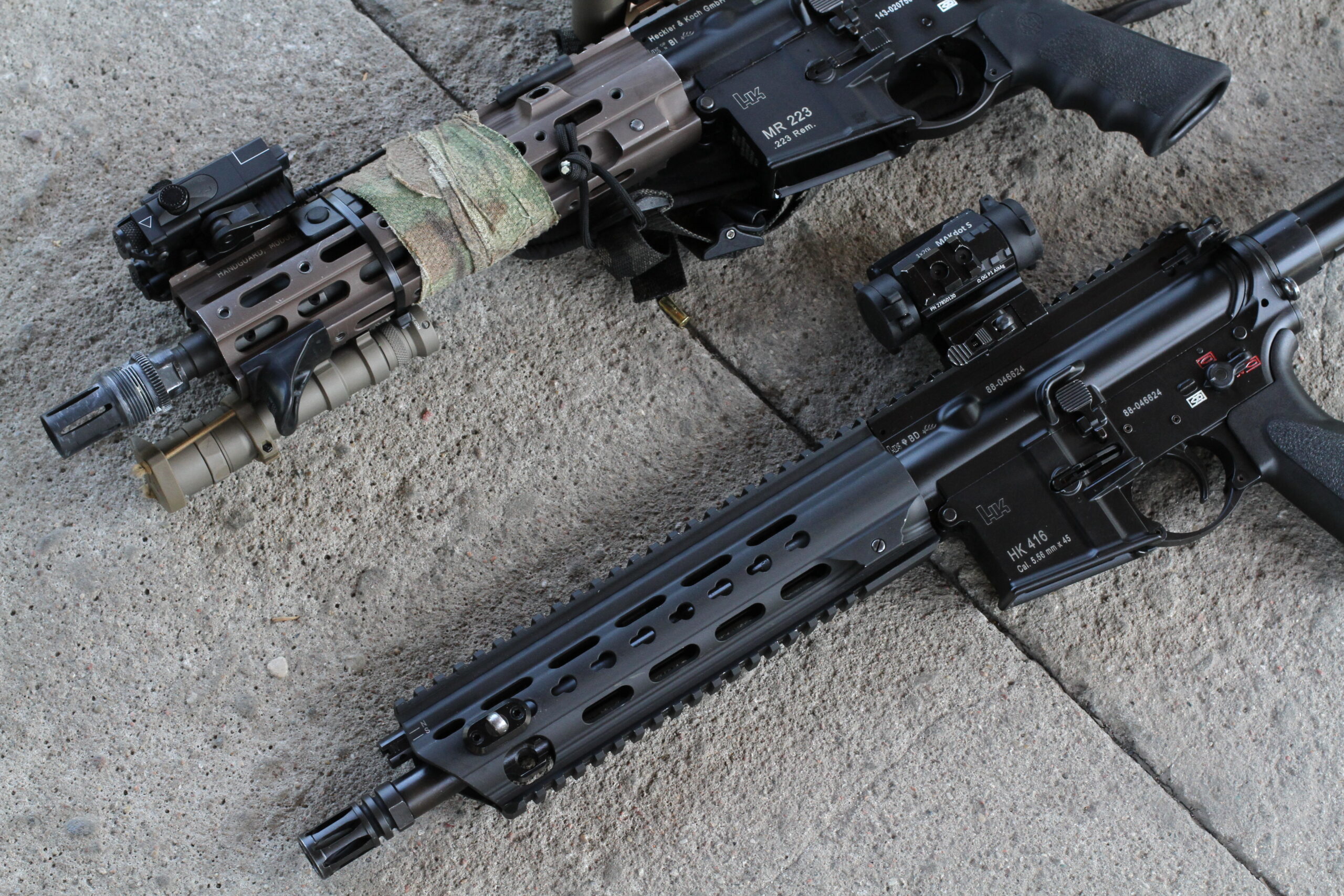
Comparison between HK416 and HK MR223
We took a close look at the design of the bolt carrier group and the details that distinguish the civilian and military versions of the rifle from each other. The first cosmetic difference is the visible ‘MR’ (Match Rifle) marking on the bolt carrier of the civilian/sporting version, which is absent on the military version. This is one of the ways HK marks products intended for different markets. Additionally, the MR223 trigger housing (lower receiver) lacks holes for the automatic sear pin, and the upper receiver does not have the rear cuts required for the automatic fire control mechanism. The MR223 bolt carrier has a cutout that prevents it from engaging an automatic sear, even if installed in a select-fire HK416.
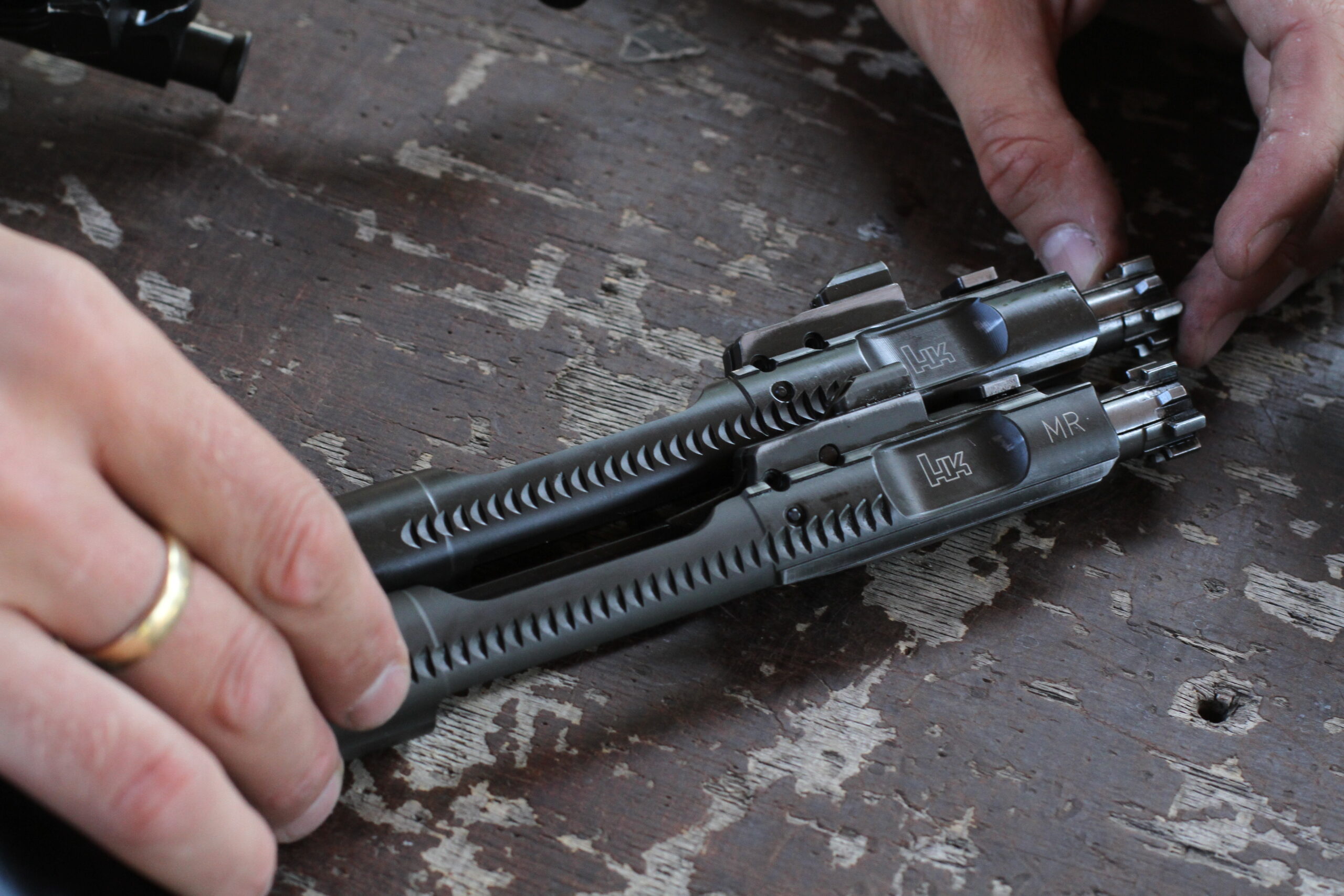
HK416 and HK MR223 bolt carriers
The sporting MR223 also lacks an adjustable gas block, unlike the HK416. This component allows manual regulation of gas flow to adjust the amount when operating the weapon with a suppressor. The HK416 barrel also has a thinner profile and is finished with an imperial 1/2″x28 TPI UNEF thread, known from the M4 and M16 rifles, in contrast to the MR223 barrel, which has a thicker profile and is finished with a metric M15x1 thread.
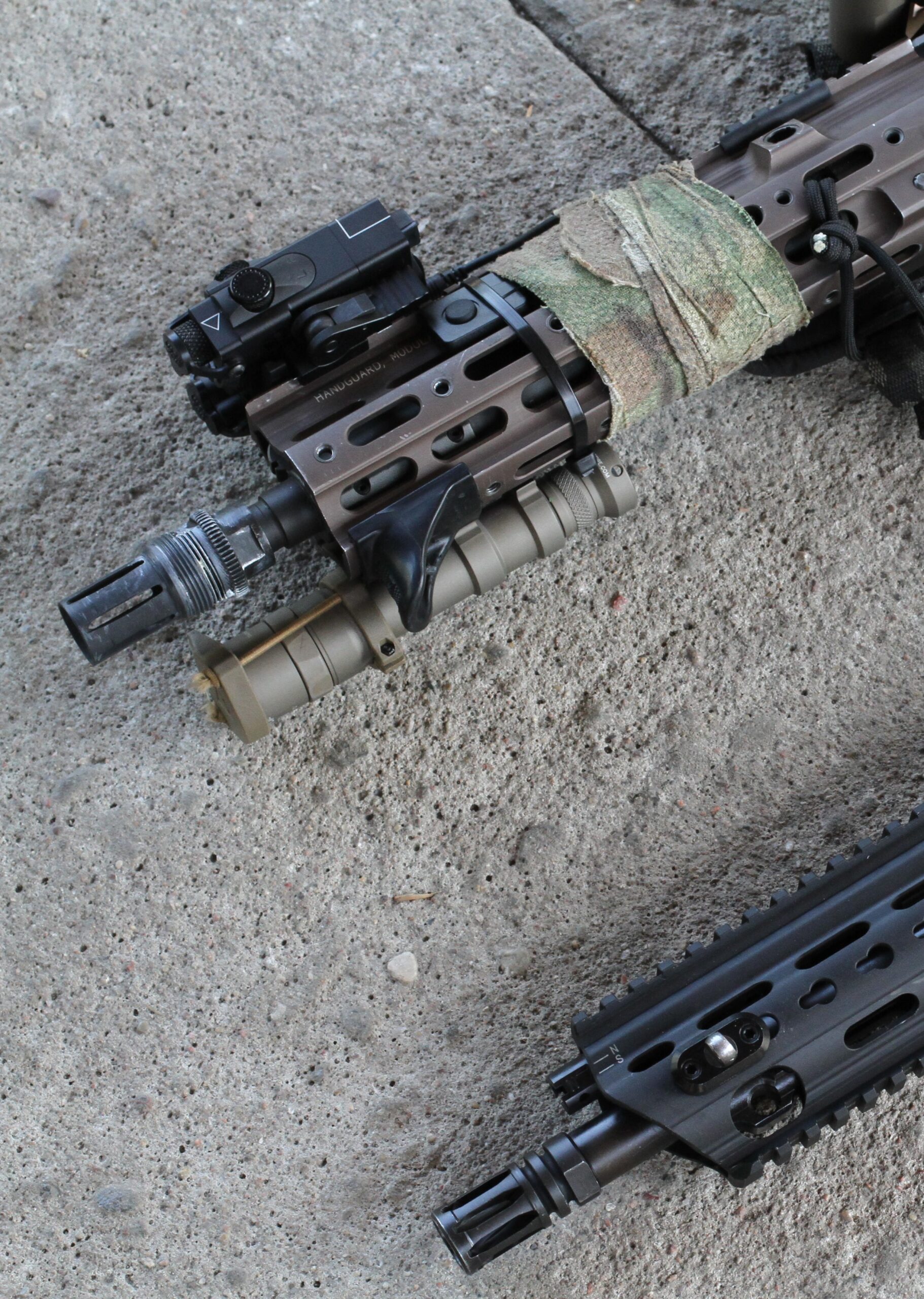
In the sporting MR223 (top), there is no adjustable gas block, unlike in the HK416
HK416A5 FDE
The second model we tested was the HK416A5 FDE with this season’s trendiest 12.5-inch barrel. Apart from its modern color and barrel length, the weapon stood out with a new handguard featuring the M-LOK system. This is clearly Heckler & Koch’s nod to consumers across the Atlantic, as it was in the U.S. that the new handguard attracted the most significant interest. After all, M-LOK is an invention of the American company Magpul.
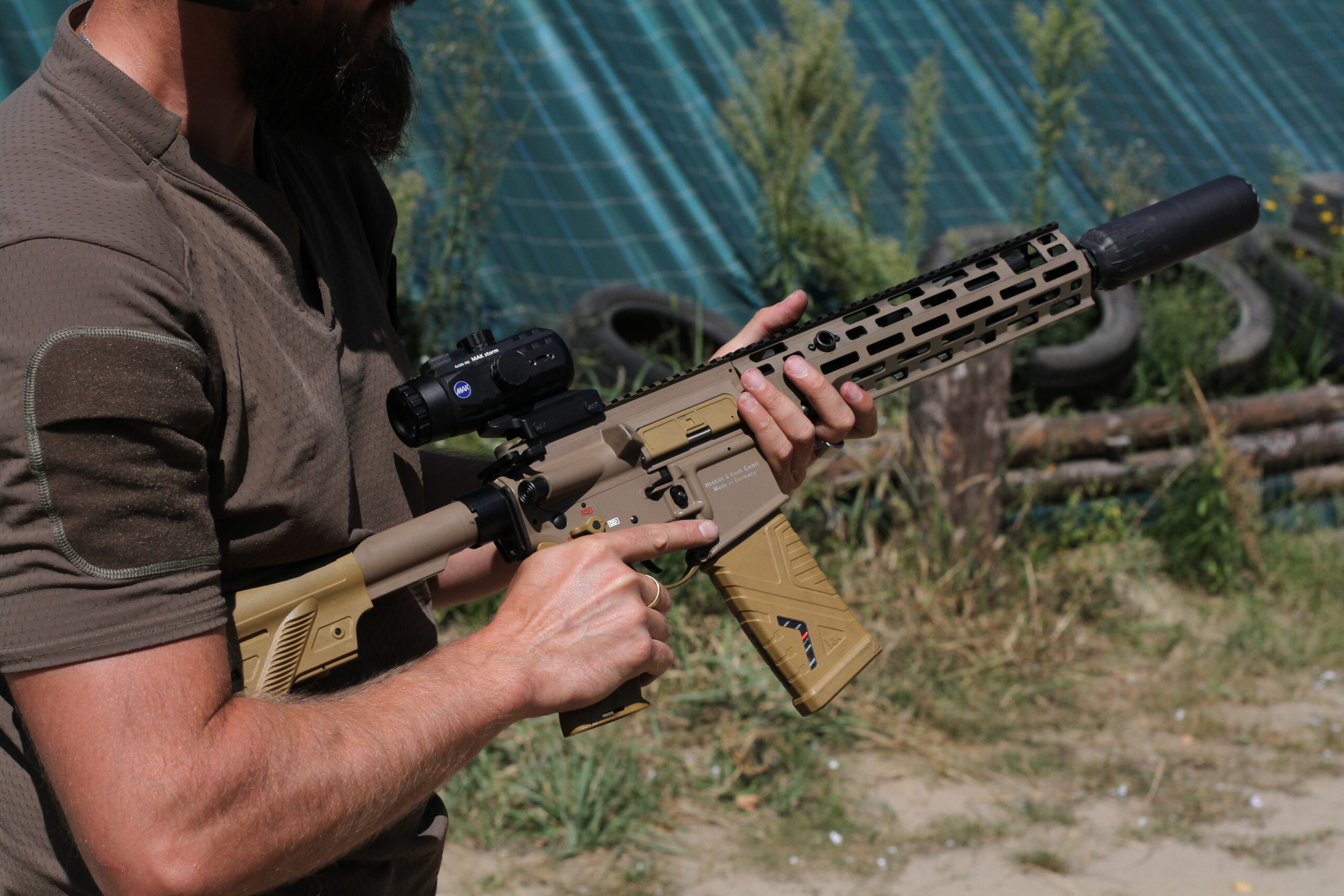
HK416A5 FDE, which we had the opportunity to test
The very idea of changing the accessory mounting system in its flagship product seems justified due to the informal standardization of mounting methods. Today, worldwide, M-LOK and the older Picatinny rail system (sometimes referred to as RIS/RAS) constitute the two informal standards for mounting weapon accessories. Heckler & Koch offers handguards in two types – with Picatinny rails at the 12 and 6 o’clock positions and M-LOK slots at 3 and 9, or with a single Picatinny rail on top at the 12 o’clock position and M-LOK interfaces at 3, 6, and 9.
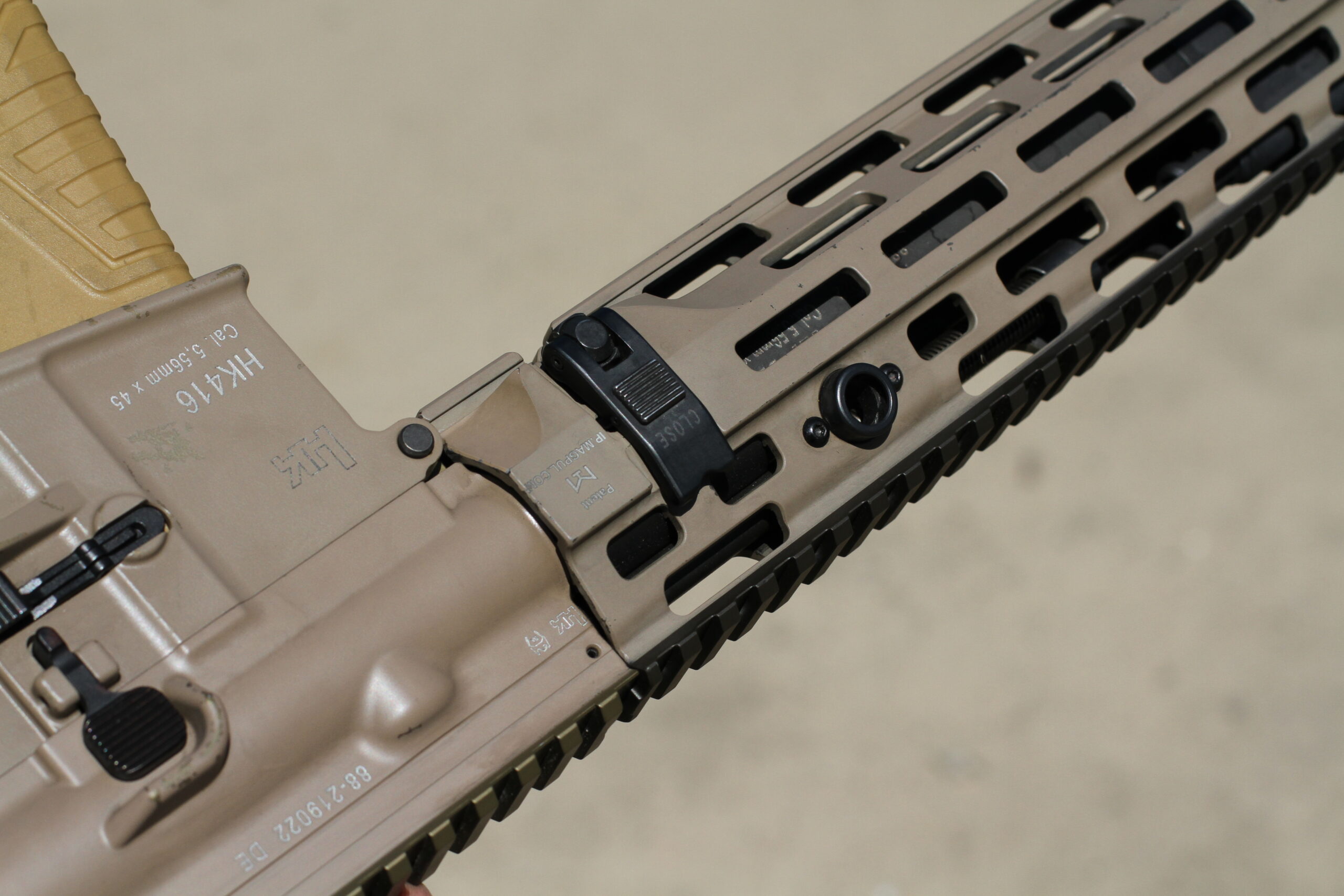
Handguard of the HK416A5 FDE rifle with QD lever mounting
Another good idea from the Oberndorf designers is the way the handguard is mounted – using a QD lever. This eliminates the need for a screwdriver or even the weapon’s bolt carrier (yes, that component could be used for this purpose on older HK416D variants) to unscrew the handguard locking screw on the barrel nut. The new HK416 handguard extends over the gas regulator, protecting it from accidental adjustment. Enlarged openings on both sides of the handguard provide access to the regulator. To conclude the topic of the new handguard, it is worth mentioning the two QD sling attachment points added by the manufacturer. Previously available only as separate parts, these are now an integral element of the rifle.
The “sand-colored” HK416 is also equipped with the new Adaptive Battle Grip pistol grip, previously mentioned in relation to the HK433. The rifle additionally features an ambidextrous charging handle, unlike the single-sided charging handles used in the 416 series until now.
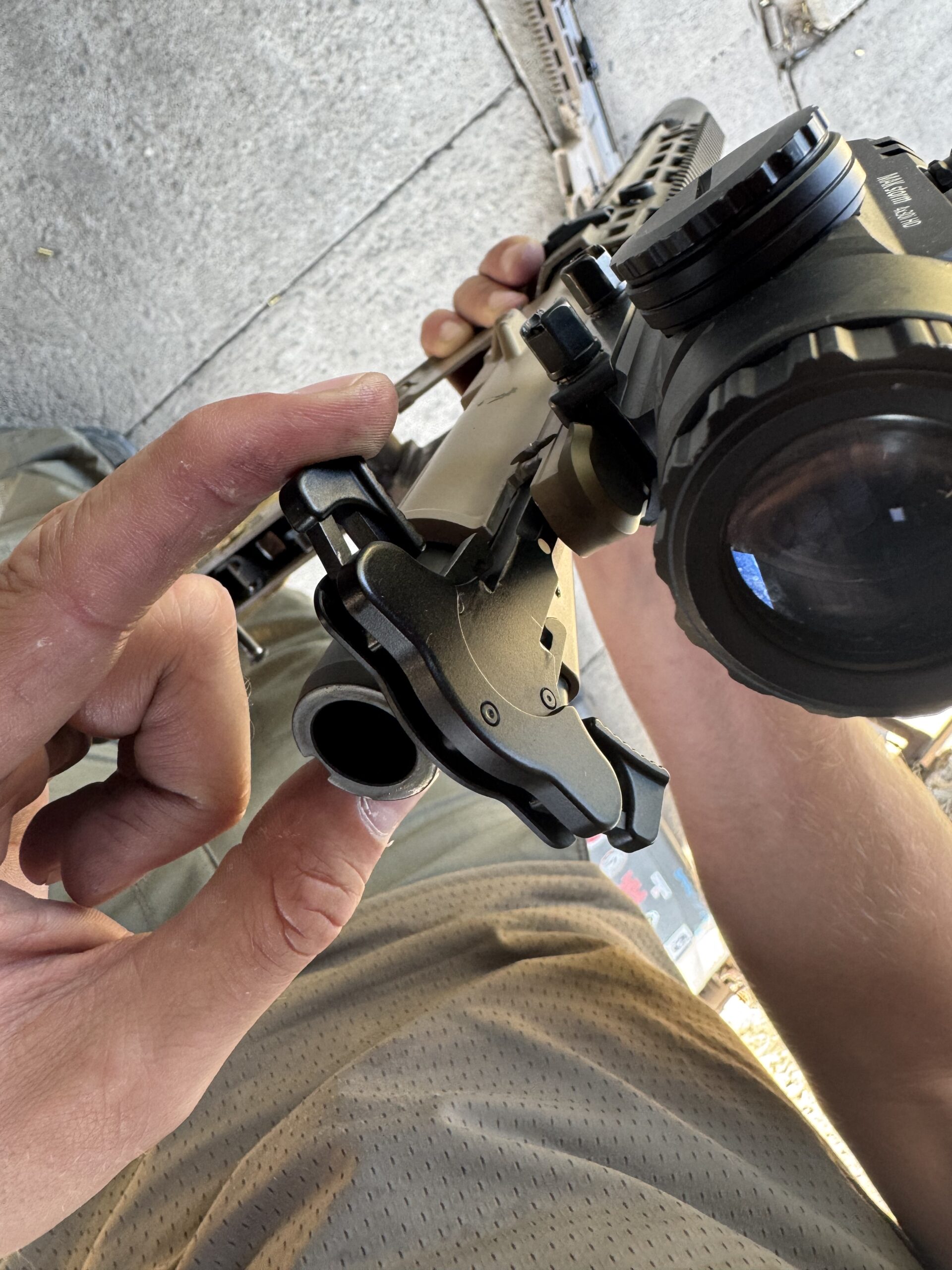
Ambidextrous charging handle on the HK416A5 FDE
The weapon in the tested configuration was equipped with a Huxwrx Flow suppressor and, combined with the longer barrel, gave the impression of smoother operation compared to the HK416 with an 11-inch barrel without a suppressor. According to some experts, the 12.5-inch barrel is the golden mean when it comes to the AR-15 system. This length provides better ballistic performance than the 11-inch version while still maintaining the compact dimensions that are harder to achieve with a 14.5- or 16.5-inch barrel.
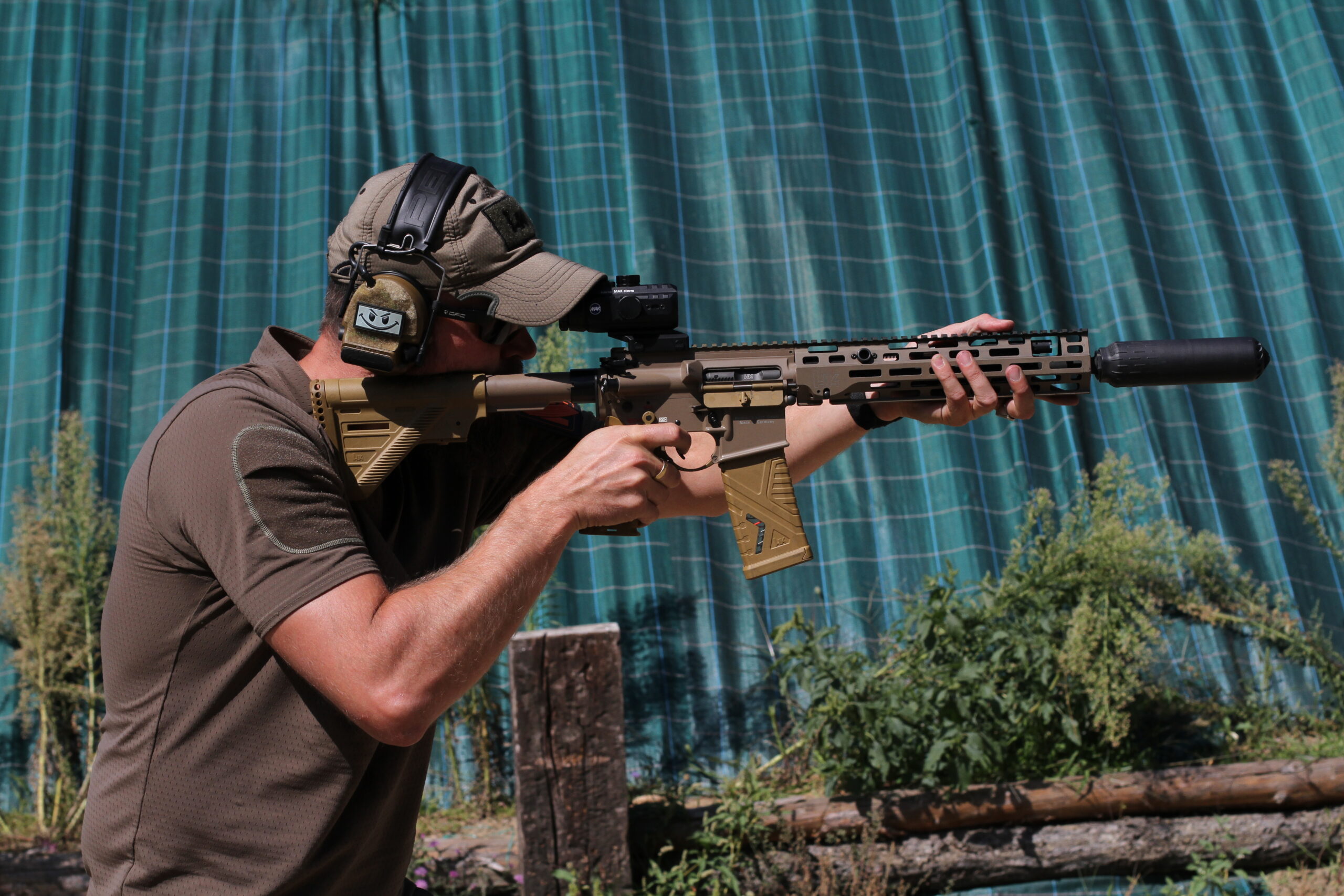
HK416A5 FDE in the tested configuration was equipped with a Huxwrx Flow suppressor / Photos: Tomasz Karasiński, MILMAG
Whether a weapon configured in this way will be adopted by the services remains to be seen. It is worth noting that ‘our guys’ most often use HK rifles in the 11- and 14.5-inch variants.
