























The meeting in Bremen brought together representatives of ESA member states, who jointly discussed the key directions for the development of European space policy for the coming years. The Polish delegation actively participated in the proceedings, presenting Poland’s priorities and expectations in the key areas of space policy.
 Image: POLSA via ESA
“Poland has doubled its contribution to optional technological programmes and signed a letter of intent regarding the establishment of an ESA Technology Centre in Poland. In this way, we are becoming a strategic partner within ESA and strengthening our position as a technological leader in Central and Eastern Europe. We consistently invest in high value-added programs that support the development of an innovation-driven economy and future technologies,” said Minister of Finance and Economy Andrzej Domański.
Poland’s contribution of nearly EUR 550 million for 2026–2028 concerns ESA’s optional programs in the fields of Earth observation, secure communications, space transportation, in-orbit servicing, space safety, robotic exploration, and the development of technologies and equipment for future missions. The ESA programs subscribed by Poland create new opportunities for companies and research institutes that deliver increasingly complex technologies and services. These are investments in competencies, national security, and the development of a modern economy.
During the deliberations, priorities were presented in the context of dynamic technological progress, growing international competition, and new geopolitical challenges. Poland highlighted the key importance of Europe’s resilience, security, and strategic autonomy in space. The significance of developing Earth-observation systems, ensuring secure satellite communications, and protecting orbital infrastructure was emphasized. In this context, Poland reaffirmed its strong commitment to the European Resilience from Space program, aimed at strengthening Europe’s security and resilience through advanced space capabilities and forming an important part of the broader ESA program package supported by Poland.
A significant part of Poland’s contribution to the discussion focused on the role of the IGNIS mission by Dr Sławosz Uznański-Wiśniewski on the International Space Station, which represents an important contribution to the development of scientific and technological competencies and enhances the visibility of the Polish space sector on the international stage
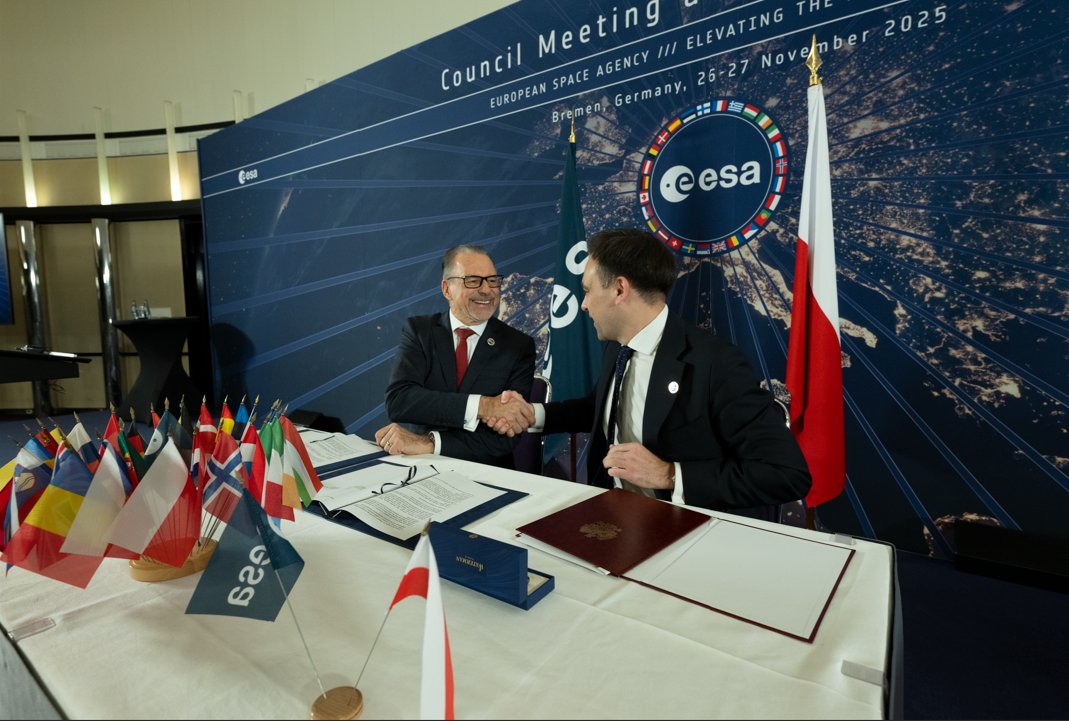 Image: Josef Aschbacher via X
Poland confirmed that the development of a modern and competitive space sector remains one of the government’s priorities. In the last three years, our country has increased its contribution to ESA tenfold, reflecting both trust in the Agency and the recognition of the importance of the projects it carries out.
Since joining ESA in 2012, the Polish space sector has been developing dynamically – both in terms of the number of projects implemented and the competencies of companies and research centers working in the fields of Earth observation, robotics, navigation, planetary exploration, and space safety.
In parallel, Poland is developing national space programs and international cooperation with partners in the European Union and worldwide. These efforts strengthen the resilience of the national sector and support the long-term vision of building a strong Polish presence in space.
“Poland’s presence in ESA is realized through participation in funding specific programs of the European Space Agency. We consider programs related to enhancing security – carried out through satellite monitoring, secure satellite communications, and the development of space situational awareness systems, including space debris monitoring – to be priorities. Key investment areas for the Polish space sector also include programs developing technologies, participation in scientific missions, and Earth observation research,” emphasized Marta Wachowicz, President of the Polish Space Agency (POLSA).
Poland remains ready to further increase its contribution to ESA initiatives and actively co-shape European space policy. Cooperation among member states is crucial to maintaining a strong, secure, and competitive position for Europe in the global space sector.
Na Radzie Ministerialnej @esa podpisaliśmy list intencyjny o utworzeniu Centrum Europejskiej Agencji Kosmicznej w Polsce🇵🇱. Nasze inwestycje w sektorze rosną ponad dwukrotnie. Każde zainwestowane euro w sektor kosmiczny to nawet sześciokrotny zwrot do gospodarki🇵🇱. To inwestycja… pic.twitter.com/rtTniVIV9o
— Andrzej Domański (@Domanski_Andrz) November 27, 2025
#ICYMI watch the replay of today's press conference here: https://t.co/nmx544ieng
— European Space Agency (@esa) November 27, 2025
22.1 billion euros subscribed.
A record.
A first.
And a clear message that Europe is serious about space and that @ESA is the agency it trusts to deliver.A historic Ministerial. A united Europe. A stronger ESA.https://t.co/znjgxtyCab
— Josef Aschbacher (@AschbacherJosef) November 27, 2025
Today marks a milestone for European space exploration. The largest contributions in the history of the European Space Agency, €22.1 billion, were just approved at our Ministerial Council meeting in Bremen, Germany. #CM25
More details 👇 https://t.co/WXJicR77Jy
— European Space Agency (@esa) November 27, 2025
🇵🇱Today, Minister @Domanski_Andrz and I formalised our political commitment to consider an @ESA security centre in Poland, based on the outcomes of this Ministerial Council.
This is a positive step in Poland's involvement in ESA and will support their growth as an emerging… pic.twitter.com/RVXNb2iCPC
— Josef Aschbacher (@AschbacherJosef) November 27, 2025
