




















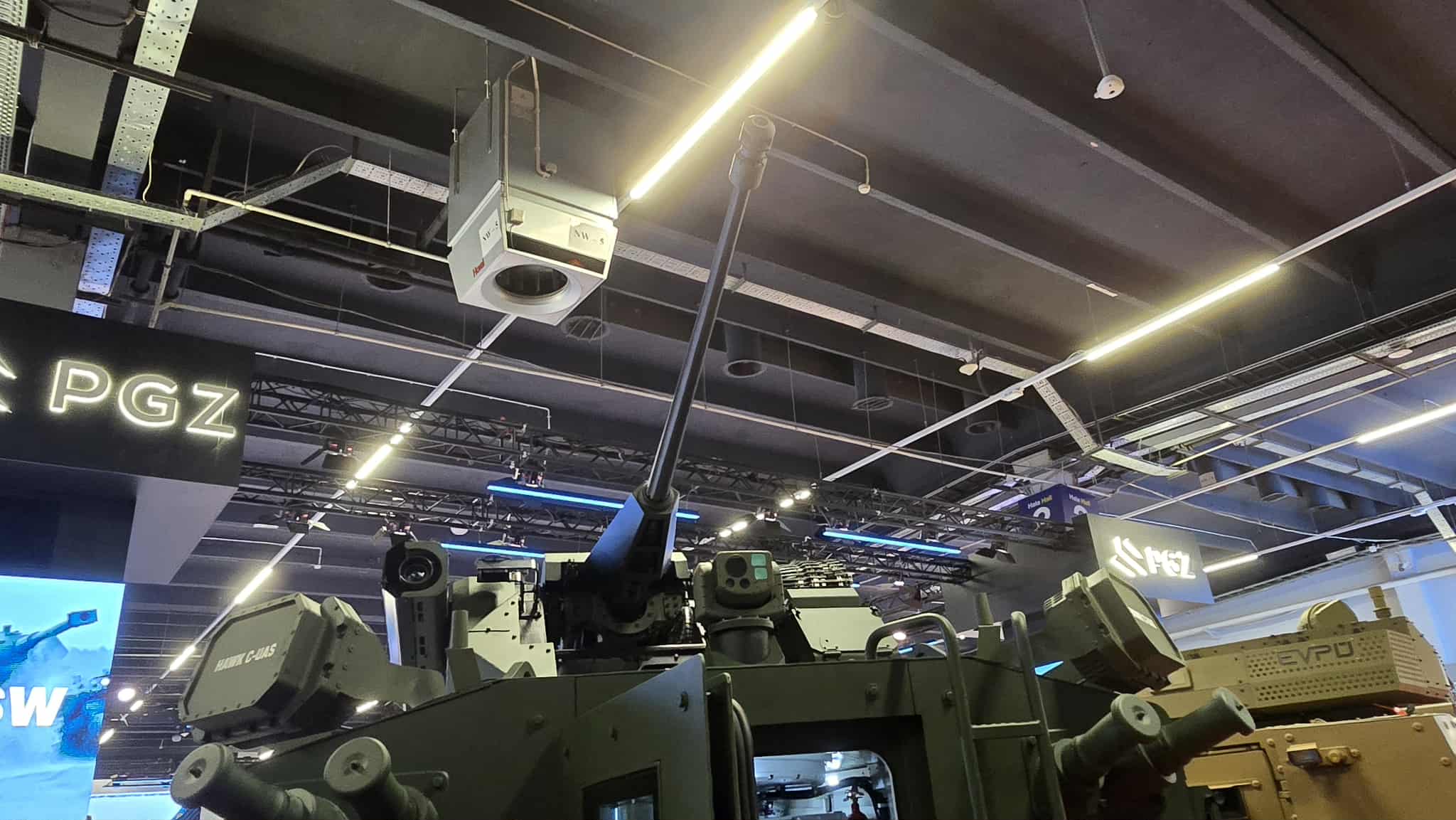
During the 33rd International Defence Industry Exhibition (MSPO) at Targi Kielce, one of the two premieres from Huta Stalowa Wola (HSW), a company within the Polish Armaments Group (PGZ), was the 30/40 mm Remote Weapon Station, which has been integrated with the Waran 4×4 Tactical Multirole Vehicle.
 Photos: Jakub Link-Lenczowski, MILMAG
As announced by HSW, the Remote Weapon Station (a so-called light turret) with interchangeable 30 mm or 40 mm armament is a modular turret system with a low weight of under 1,500 kg and an elevation range from –12° to +65°.
It features two-axis weapon stabilization, an independent stabilized HD-quality sight for the operator, as well as Hunter-Killer and Killer-Killer operating modes. It is equipped with an automatic target tracker (AUTOTRACKER) and other systems known from the ZSSW-30 Remote Turret System, developed by HSW and the WB Group, and integrated to date with the upgraded Rosomak 8×8 wheeled infantry fighting vehicles and the new Borsuk infantry fighting vehicles.
These include: a laser-warning receiver integrated with the vehicle chassis, an open-architecture fire-control system (FCS), a navigation system with an integrated satellite-navigation transmitter and cryptographic module offering high accuracy and reliability, active and passive counter-UAS sensors integrated with existing reconnaissance systems and the turret’s weapon system, enabling non-kinetic drone neutralization.
The turret also includes a dedicated 7.62 mm machine gun and a launcher for Spike anti-tank guided missiles. As noted, HSW showcased the module integrated with the Waran 4×4 Tactical Multirole Vehicle, which provides a high protection level for a crew of six (two crew members and four passengers).
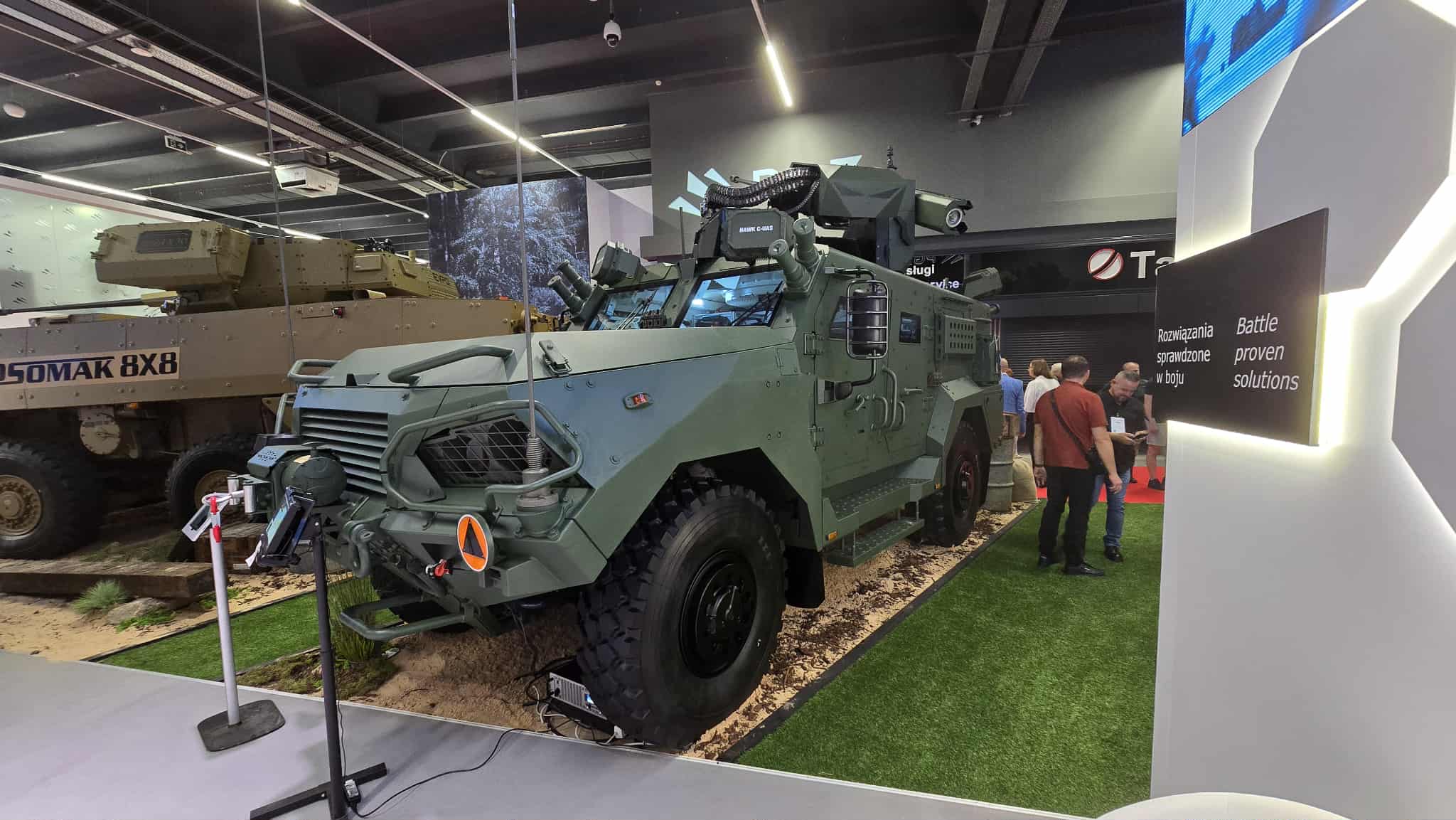
The Waran 4×4 was developed in cooperation with the Czech company Tatra Export (part of Tatra Trucks, owned by the Czechoslovak Group and Promet Group) and is already being fielded by the Polish Armed Forces under the Ottokar-Brzoza tank-destroyer program and the Gladius loitering-munition carrier program. In 2023–2024, the Polish industry also offered a command variant of the Waran, as well as a counter-UAS system based on the platform.
The starting point for the future Waran was the Czech Patriot II, based on the T815-7M3B21.372 Force series chassis, which was shown at the 2019 MSPO. However, the Polish design has since been extensively reworked and modified.
The Waran is powered by an air-cooled Tatra T3C-928-90 six-cylinder diesel engine producing 300 kW, or alternatively by an air-cooled Cummins ISL rated at 270 kW, paired with an Allison 4500SP six-speed automatic transmission. This provides a top road speed of up to 100 km/h and a driving range of up to 650 km. The vehicle features ballistic protection from Level 2 to Level 4 and mine protection from Level 2a/2b to 3a/2b, in accordance with STANAG 4569.
The Waran’s curb weight is 13,000 kg, with a gross vehicle weight of 18,000 kg (18 metric tons). It can climb vertical obstacles up to 0.4 m, cross ditches 0.55 m wide, handle a longitudinal slope of 60°, and ford to 0.8 m without preparation. Operational temperature range is –32°C to +49°C. Ground clearance is adjustable between 260 mm and 430 mm. The vehicle measures 6.19 m in length, 2.55 m in width, and 2.73 m in height.
The core of the design is a central load-bearing tube approximately 400 mm in diameter. It consists of modules with gearboxes mounted between them, transferring torque from the internal drive shafts to the swinging half-axles. This eliminates the need for Cardan joints. As a result, the drive shafts and gearboxes are protected from damage caused by terrain obstacles. According to HSW, the chassis offers excellent mobility characteristics.
A major advantage of this solution is its modular construction, which allows the vehicle to be easily expanded or adapted. For example, it can be reconfigured from a 4×4 drivetrain to 6×6 or 8×8, and can integrate additional mission systems. The modular chassis, used across a wide range of military vehicles, simplifies maintenance and reduces operating costs.
